About 170 beer bottles in the cab: Texas driver arrested in New Hampshire faces arraignment today
Bow police say Edgar Ramirez, 33, of Odessa, Texas, was arrested Oct. 23 after officers found approximately 170 beer bottles in his semi's cab at a school bus lot — hours after the department had already been searching for the same truck over a report of an intoxicated driver leaving a truck stop. He faces a subsequent-offense DWI charge and arraignment today in Concord.
Summarized from CDLLife.
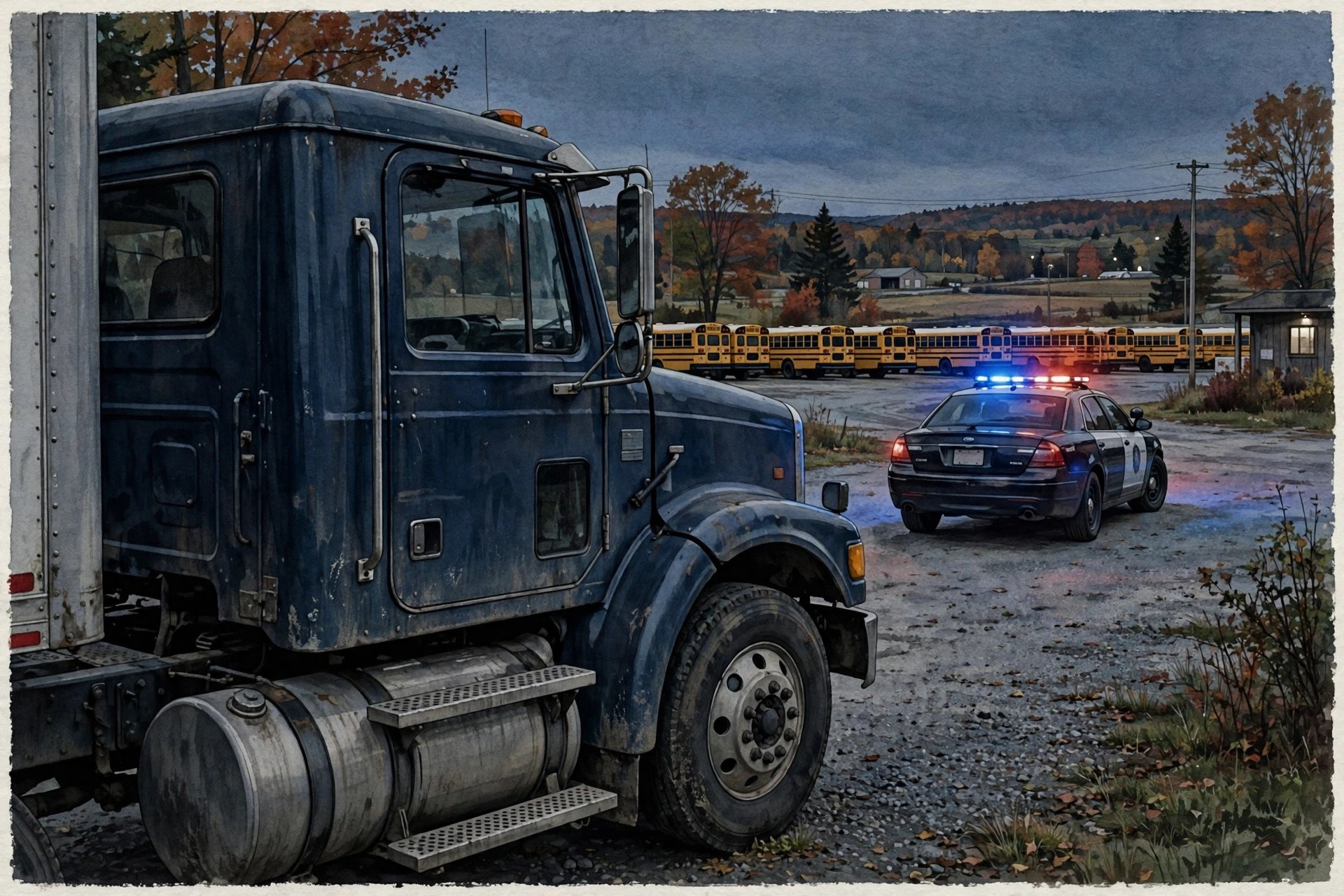
Image: Illustration: AI-generated by CDLWire
A Texas truck driver arrested in New Hampshire after police say they found approximately 170 beer bottles in the cab of his semi truck is due to be arraigned today, according to CDLLife on Oct. 25, reporting the Bow Police Department. Edgar Ramirez, 33, of Odessa, Texas, faces arraignment on Oct. 26, 2026, in the 6th Circuit, District Division, Concord Court, on charges that include Driving While Intoxicated – Subsequent Offense, Open Container of Alcohol and Resisting Arrest. The charges are allegations; the arraignment is the first court step, and no finding has been made.
The arrest itself happened on Oct. 23, 2026, when the Bow Police Department responded to a report that a commercial vehicle was blocking in school buses at a bus lot located on 12 Robinson Road in Bow, New Hampshire. Officers made contact with the truck driver, who refused to exit the vehicle. The driver was removed from the cab after a brief struggle with police and was arrested after he was, in the department's words, 'ultimately determined to be driving while intoxicated.' As part of the investigation, officers reportedly discovered approximately 170 beer bottles in the cab of the semi truck — a count police describe as approximate, covering bottles found inside the cab.
The detail that turns this from a roadside arrest into a system question is the timeline police themselves gave. 'Several hours earlier, the Bow Police Department was searching for this same tractor trailer after it was reportedly leaving a truck stop with an intoxicated driver. At that time, officers were not able to locate the truck,' the department said. In other words, on the police account, a report came in hours before the arrest that this truck was leaving a truck stop with an intoxicated driver; officers looked for it and did not find it; and the truck surfaced again only when it ended up blocking school buses at a bus lot, where the driver was taken into custody. No crash and no injuries are reported in the account — the school buses were blocked in, not struck — but the gap between the first report and the arrest is the part of the story that will draw scrutiny, because it is measured in hours of a commercial vehicle moving, on police's account, with an intoxicated driver, before it was stopped.
The charge sheet carries its own information. The lead charge is styled Driving While Intoxicated – Subsequent Offense, which is the department's characterization and indicates police are treating this as a repeat allegation rather than a first offense; the open container charge tracks the bottles officers say they found; and resisting arrest reflects the brief struggle officers describe when Ramirez refused to exit the cab. What the reporting does not include is a blood-alcohol figure — no breath or blood test result has been published in the account — nor the name of a carrier or employer, so neither should be assumed. The facts beyond the police statement will be tested starting with today's arraignment and the court process that follows it.
Bow police closed their statement with the reminder they attach to impaired-driving arrests, sharpened for commercial vehicles: 'The Bow Police Department reminds motorists that operating a vehicle while impaired by alcohol poses a serious risk to public safety. Impaired driving involving commercial vehicles is particularly concerning due to their size and potential to cause significant harm in a collision,' police said. That is the department's framing, and it is also the arithmetic every CDL holder already knows: an impaired-driving arrest in a commercial vehicle is not a traffic ticket problem, it is a livelihood problem, because the license the job runs on is the first thing the process puts at risk.
The practical takeaway is about the hours before the arrest, not the arrest itself. On the police account, someone saw a driver they believed was intoxicated leaving a truck stop and reported it — and that report is the reason officers were looking for the truck at all. For drivers, the lesson runs in both directions: alcohol in the cab, open or not, is the kind of evidence that converts a bad stop into a career-ending file, and if you see a fellow driver you believe is impaired getting behind the wheel of a rig, the call is worth making, because in this case the system worked on the second sighting, hours later, at a school bus lot — a place where the margin for a different ending was much thinner.
Sources
Related coverage
 October 22, 2026 · EnforcementFeds charge driver in alleged $12 million cargo theft scheme built on hijacked carrier identities
 October 22, 2026 · EnforcementEl Paso starts truck inspections on both sides of Transmountain after deadly brake-failure pileup; city weighs limiting heavy trucks
 October 22, 2026 · EnforcementChemical release at MC Tank terminal in Toledo forces a 1-mile evacuation; zone cut to half a mile as 35 people seek hospital care
Comments
Loading comments…