Long Beach set its own container record in September — and rail, not the gate, is where San Pedro Bay backed up
The Port of Long Beach set an all-time record in September at 997,177 TEUs, up 25%, and Los Angeles posted 1,042,652 TEUs as national imports hit a September record of 2,546,261 TEUs. Truck dwell stayed fluid at 3.18 days while rail dwell hit 7.19 days, pushing boxes onto trucks and tightening Southern California's long-haul lanes.
Summarized from Transport Topics.
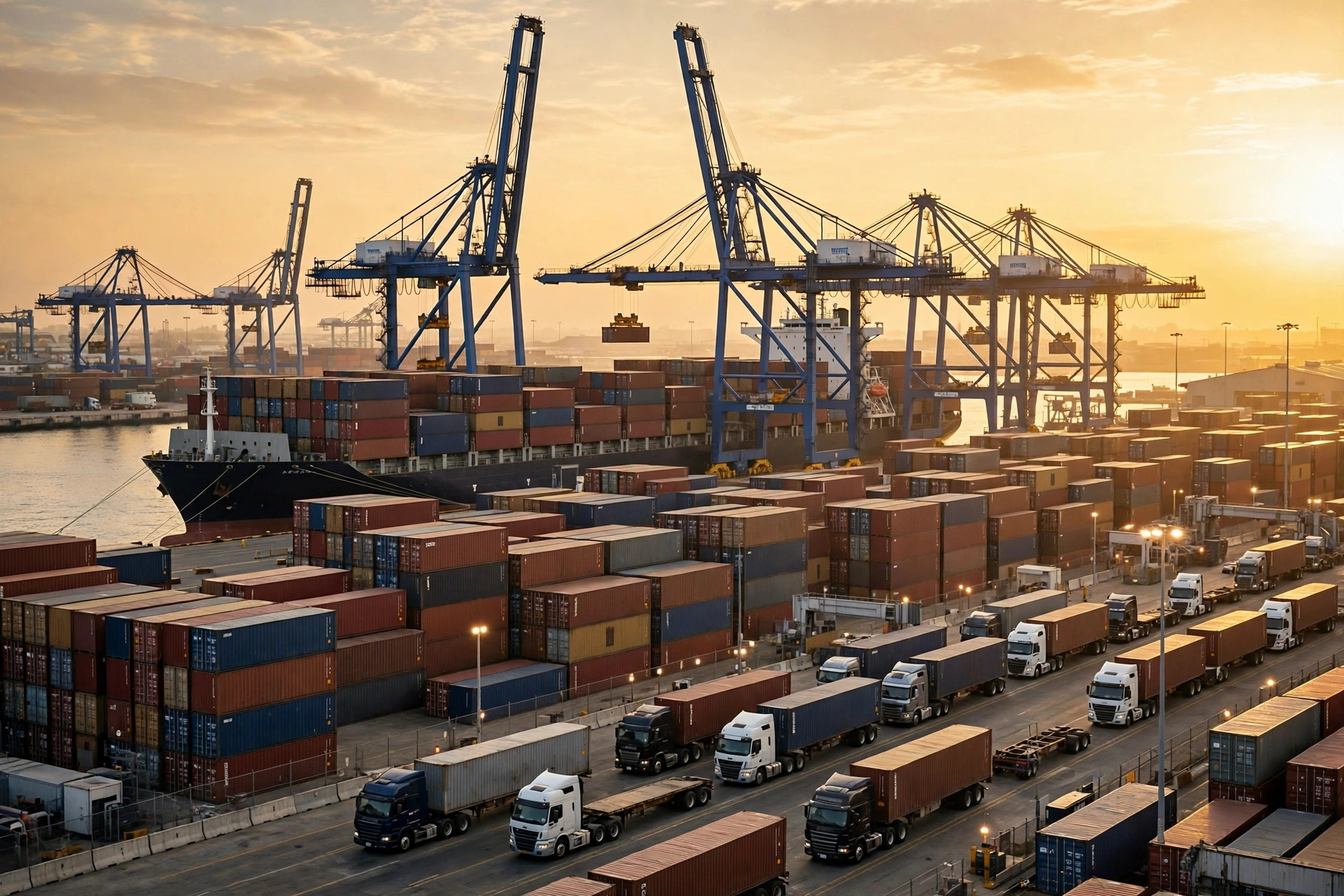
Image: Illustration: AI-generated by CDLWire
September was not supposed to be the peak — but at the two biggest container ports in the country, it was the biggest month ever recorded, according to Transport Topics on Oct. 29. The Port of Los Angeles reported its busiest month on record in September, with container volume increasing 18.1% to 1,042,652 TEUs from 883,053 a year earlier. The Port of Long Beach likewise reported an all-time record, with volume increasing 25% to 997,177 TEUs from 797,537. Together, San Pedro Bay handled just over 2 million TEUs in a month — and every box becomes a drayage move, a transload, or a long-haul load out of Southern California.
The national figures show a West Coast shift, not a uniform boom. Descartes Systems Group reported in its monthly global shipping report that overall container import volumes increased 10.3% from the prior year to 2,546,261 TEUs — the highest volume on record for the month, though down 2.2% compared with August — and noted that maritime imports remain resilient. "September was the month the import surge stopped being lane-specific and became a West Coast story," said Cory Petersen, vice president of sales and operations at Circle Logistics. "The national picture was the strongest September on record. But the detail that matters for trucking is that Oakland and Savannah grew modestly while the Gulf Coast was down almost 15% month over month." Petersen added that the results have been driven by ocean routing rather than consumer demand favoring Southern California, noting that canal restrictions, Suez Canal uncertainty and diesel prices have pushed cargo to the fastest transpacific lanes in a way that favored the San Pedro Bay.
The other major ports fill out the map. Port Houston container volume increased 11% year over year in September to 376,419 TEUs, from 337,659. Port of Oakland container volume increased 5.4% to 188,517 TEUs, from 178,942. The Northwest Seaport Alliance moved the other way, with volume down 8.1% to 265,692 TEUs, from 289,120. The Intermodal Association of North America reported its Intermodal Volume Index rose 5.2% from the prior year to 106.4, with underlying strength all year.
Where the system strained was not the gate but the rail ramp. The Pacific Merchant Shipping Association reported that truck dwell increased 7.8% from the previous month to 3.18 days in September, while rail dwell increased 6.5% to 7.19 days, across both the Los Angeles and Long Beach ports. "Higher dwell times reflect the sheer volume of cargo moving through the complex, with rail dwell continuing to be the area of greatest pressure," said Natasha Villa, senior manager of public affairs at PMSA. "Marine terminals, drayage providers and rail partners continue to work closely together to keep cargo moving throughout our extended peak season." Petersen put the trucking consequence directly: "The pressure point right now is rail, not the gate. Truck dwell at L.A./Long Beach has held just under three days, which is fluid. Rail-destined containers were sitting close to seven days, the longest of the year, and September volume did not help." And when rail backs up, boxes get converted to transload and over-the-road — which is where outbound capacity tightens first out of Southern California.
The money figures confirm that this is a capacity market, not a demand explosion. The Cass Freight Index showed shipments increased 1.9% year over year across North America, while expenditures rose 20.4% and the truckload linehaul index increased 10.1% — an acceleration in expenditures over the past two months driven by higher shipments, rates and fuel surcharges. "That spread between volume growth and rate growth is the whole story of this market," Petersen said. "San Pedro Bay absorbed it whether or not the inland network grew with it. Pricing is firming because trucking capacity has contracted, not because freight demand is exploding everywhere." His team's tightness showed up on the longer-haul lanes out of the region instead of local drayage, and the main constraint for the month was finding qualified capacity, not just any capacity.
"The bigger takeaway is that the traditional freight calendar is gone," Petersen said. "September used to be the tail end of peak. This year it was the peak, and it was driven by canal access, fuel prices and trade policy rather than a retail calendar. Shippers who plan drayage, chassis and outbound truck capacity off the old calendar will keep getting caught by months like this one."
The practical takeaway depends on your lane. If you run drayage or Southern California outbound, the working facts are a record 2 million-plus TEUs through San Pedro Bay, truck dwell fluid at 3.18 days, rail dwell at a year-long worst of 7.19 days, and conversion of rail boxes to over-the-road freight tightening the long-haul lanes first — that is where the loads and the pricing power are. If you run the Gulf, the same report says volumes there fell almost 15% month over month, and the Northwest Seaport Alliance was down 8.1% on the year: the surge is real, but it is regional, and capacity positioned on the wrong coast is not sharing in it. Plan November around routing and rail conditions, not the retail calendar — the ports just proved the calendar is the one thing that no longer predicts the freight.
Sources
Related coverage
 October 14, 2026 · InfrastructureUSDOT awards $200 million for 14 truck parking projects in 12 states
 October 14, 2026 · InfrastructureNew York City puts $5 million behind off-hour truck deliveries
 October 13, 2026 · InfrastructureLove's opens Casper stop with 52 truck parking spaces on I-25
Comments
Loading comments…