NHTSA starts the first major tire-standard overhaul in more than 20 years — and the bias-era tests may not survive it
A negotiated rulemaking announced Oct. 26 puts the plunger-energy strength test, the bead unseating test and the endurance test on the table, along with non-pneumatic tires and sidewall markings. Secretary Sean Duffy will appoint an 18-member committee for a single two-year term; ATA's maintenance council calls the legacy tests 'vestigial' for modern steel-belted radials.
Summarized from Transport Topics.
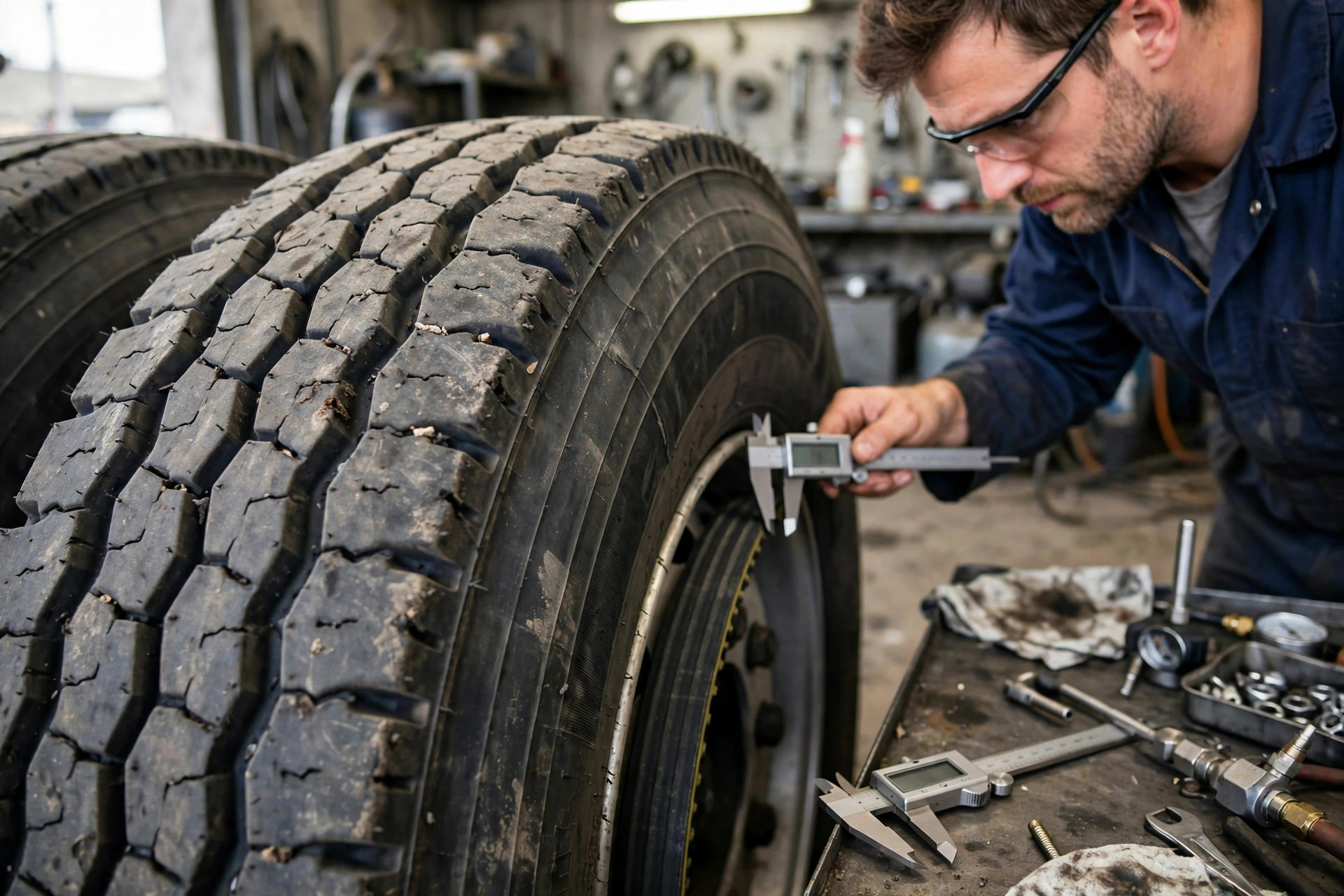
Image: Illustration: AI-generated by CDLWire
The federal tests that decide whether a truck tire is legal to sell have not had a major overhaul in more than 20 years — and the National Highway Traffic Safety Administration has now started the process that could rewrite them, according to Transport Topics on Oct. 29. NHTSA announced on Oct. 26 that it is seeking to modernize tire safety standards through a negotiated rulemaking process. The agency said it would update outdated testing methods on tire strength, rim resistance and endurance, and examine how to set safety rules for new technologies such as puncture-proof tires. Nothing on your truck changes today; what has opened is the process that decides what the next generation of tires must prove.
The mechanism matters, because negotiated rulemaking is not a normal proposal. Instead of the agency drafting a rule and taking comments afterward, NHTSA brings the affected groups together first: Department of Transportation Secretary Sean Duffy will appoint 18 experts and stakeholders to an advisory committee to help craft the standards. A tentative list of the committee includes people representing tire manufacturers or retailers; vehicle or vehicle equipment manufacturing associations; national vehicle manufacturers; national motor vehicle or motor vehicle equipment safety organizations; educational groups; research groups or testing organizations; and professional engineering or standard-setting associations. Under the notice published Oct. 27, committee members will serve a single term of two years or until the completion of committee activities, whichever is sooner.
The substance on the table is three legacy tests. The Oct. 27 notice explained that committee discussions on tire testing would focus on "the continued necessity and effectiveness of the tire strength test (plunger energy), the bead unseating resistance test and the tire endurance test (chunking)." The committee would also evaluate the use of non-pneumatic tires and the modernization of tire markings — the sidewall information every driver and inspector reads.
The trucking case for change was put plainly by the industry's own maintenance experts. Robert Braswell, executive director of the American Trucking Associations' Technology & Maintenance Council, said that possibly removing the bead unseat and plunger energy tests for tires may be the most relevant to commercial trucking of all the issues the committee will examine. He said these tests were developed many decades ago when bias tires were popularly used. "Bias tires are a different kind of tire construction. They're a fabric construction as opposed to a steel fabric construction, which is what radials are," Braswell said. "Some of these tests are really kind of a legacy. They're vestigial, and they're not really necessary with respect to how a radial tire is constructed." Many of the current standards, in his word, are vestigial — organs of a bias-ply era carried into a radial one.
The newer technologies are further from the truck market than the headlines suggest. The evaluation of non-pneumatic tires and extra-load passenger tires would not play as much of a role in commercial trucking, experts on truck technology told Transport Topics. Kevin Grove, ATA's director of safety and technology policy, said he has not seen non-pneumatic tires used on commercial trucks but has seen examples of forklifts using them. "I think there would need to be a lot more data on non-pneumatic performance and reliability before [commercial motor vehicles] would consider adopting them," Grove said. "There would probably also need to be some work with law enforcement on inspection of those types of tires." That inspection point is the practical one: a tire an inspector cannot evaluate the usual way — tread, sidewall, pressure — does not fit the roadside system trucks actually live under.
Both experts were careful about the timeline and the unknowns. It is still too early in the rulemaking process to know many details about how tire safety standards will impact commercial trucking specifically, Braswell and Grove noted, but they said the updates will likely simplify the standards and make them more relevant to modern vehicles. "My sense is that there's an opportunity to streamline the regulations, align them with modern technology, and raise the bars for safety and innovation by bringing a broad range of stakeholders together for a negotiated rulemaking advisory committee," Grove stated. And the process likely will not be swift — it can take years.
The practical takeaway is that this is a slow door, but it is the only door. No test changes this year, no tire on a shelf becomes non-compliant, and your pre-trip obligations — tread, sidewall damage, leaks, inflation — are untouched, because the roadside rules are a separate standard from the manufacturing tests under review. What drivers and small fleets should take from this week is the direction: the tests most likely to disappear are the bias-era strength and bead tests, the markings on the sidewall are in scope for modernization, and the committee that will shape the proposal is being seated now, for a two-year term. Fleets with strong views on what a modern radial truck tire should have to prove — on endurance testing above all — should route them through their associations while the committee is forming, not after a proposed rule appears.
Sources
Related coverage
 October 27, 2026 · EquipmentPilot and Tesla open their first two heavy-duty truck charging sites — Ellabell, Georgia and Tulare, California
 October 24, 2026 · EquipmentA zero-emission dealer says stop aiming at Class 8 first: 'Class 4, 5 and 6 are ready now'
 October 23, 2026 · EquipmentMunich court orders Daimler Truck and MAN to repay cartel-era truck buyers
Comments
Loading comments…