A written 'playbook' told drivers to divert customs-exam containers to warehouses first — three arrested in a Southern California port smuggling case
Federal prosecutors say a written standard operating procedure told commercial truck drivers hauling customs-exam containers from Southern California ports to check for GPS trackers, extra seals and tails — and, if the coast was clear, to divert to warehouses in Irwindale and El Monte, where contraband was removed and counterfeit customs seals attached before the boxes went to their scheduled inspections. Three people were arrested on Nov. 20 on a nine-count indictment charging conspiracy, smuggling and breaking customs seals; all three are presumed innocent until proven guilty.
Summarized from FreightWaves.
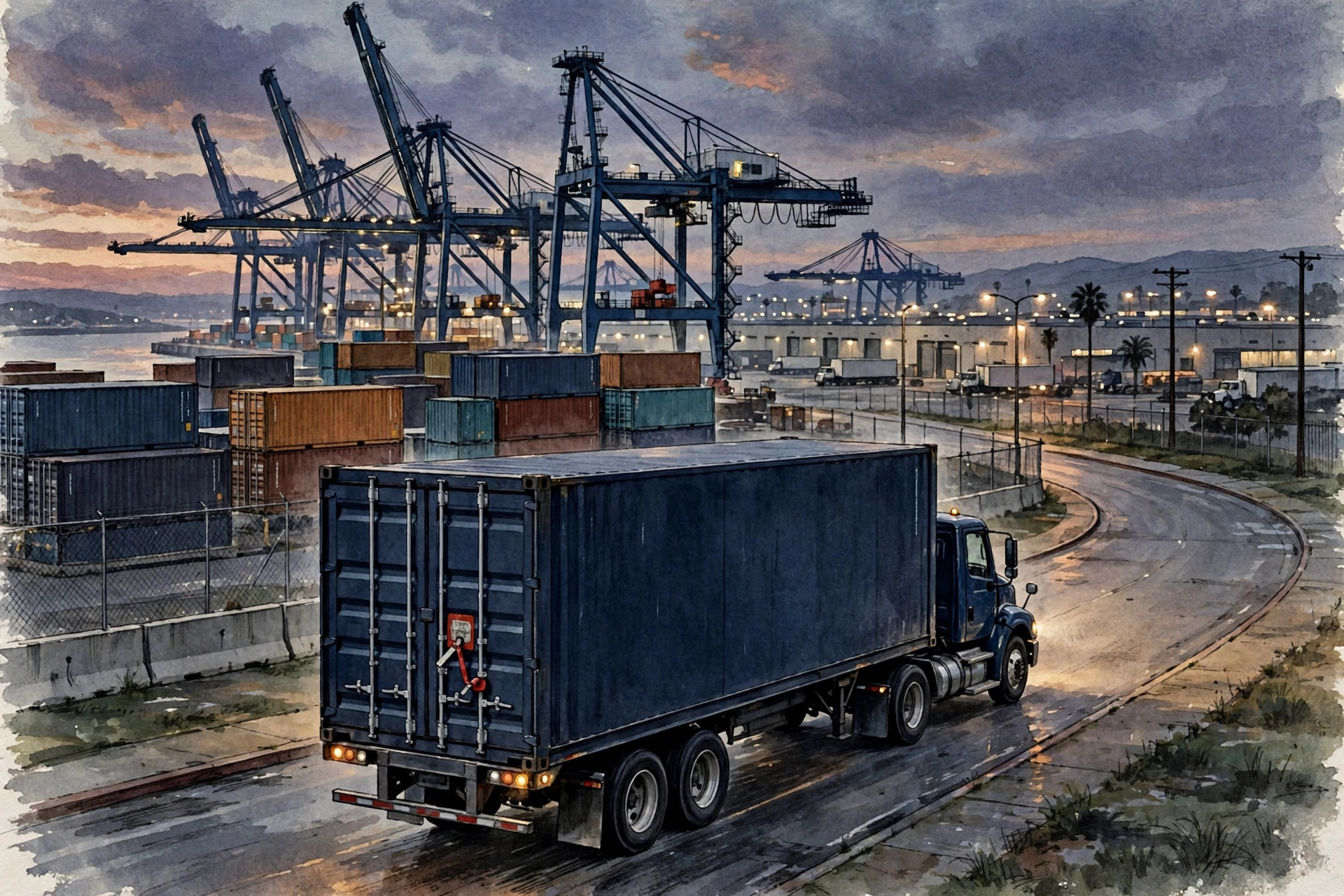
Image: Illustration: AI-generated by CDLWire
Federal prosecutors say they have uncovered a written playbook that instructed commercial truck drivers to divert shipping containers away from customs inspections at Southern California ports — a standard operating procedure that warned drivers about GPS trackers, extra security seals and surveillance, and told them where to go instead — according to FreightWaves on Nov. 23, reporting a federal indictment. Federal authorities arrested Zhe Wang, 40, of La Puente, Eric Ly, 38, of Temple City, and Mildred Estrada, 41, of Lake Elsinore on Nov. 20. A nine-count indictment charges each with conspiracy, smuggling and breaking customs seals. All three defendants are presumed innocent until proven guilty.
The document at the center of the case is, in the prosecutors' telling, a dispatcher's instruction sheet for a crime. Investigators traced the procedures to an April 24, 2024 exchange in which Wang allegedly transmitted a PDF titled “SOP” to Ly through an encrypted messaging application. The instructions told drivers to check containers for signs of monitoring — additional seals, GPS equipment, vehicles potentially following the shipment — before proceeding toward unauthorized destinations. If drivers detected surveillance indicators, they were told to “go to the inspection station directly.” Otherwise, the message directed them to “go to warehouse.” Prosecutors identified another version of the same procedures in communications dated June 24, 2024, reinforcing the same contingency. Federal authorities require selected containers to travel directly to designated examination stations for customs inspection; prosecutors contend the defendants instead diverted those shipments to unauthorized warehouses first, where conspirators removed contraband and attached counterfeit security seals before the trucks continued to their scheduled examination facilities.
The roles the indictment assigns are the roles of an ordinary port drayage operation, which is the point. Wang operated a logistics company and, according to court records, received instructions from overseas customers in China. Ly worked for an international shipping business and allegedly recruited drivers through industry connections. Estrada coordinated transportation between port terminals, private warehouses and designated examination facilities, managing arrangements through delivery orders and dispatch communications. The alleged operation continued from at least July 2024 through July 2025, and prosecutors describe the merchandise involved as tens of millions of dollars in counterfeit and illegal goods. Messages documented the counterfeit-seal preparations alongside the driving instructions: on Aug. 30, 2024, Wang allegedly sent Ly a photograph showing a high-security bolt seal and wrote, “every time I make seal that means job is coming,” and a Sept. 26 exchange referenced two additional counterfeit seals. The indictment identifies the warehouse destinations as Irwindale and El Monte, both in Los Angeles County.
Prosecutors traced four shipments in the filing. The first involved container CBHU9047612 at the Port of Long Beach on Sept. 12, 2024: Ly allegedly sent Estrada a delivery-order photograph before arranging transportation, a WhatsApp message identified Irwindale as the destination, and investigators traced two Cash App transfers totaling $1,212 for related fees and delivery services. In January 2025, Estrada reported that another company had already claimed the PierPASS transaction for container XYLU8188185 but the defendants discussed an unauthorized warehouse in El Monte anyway, and prosecutors contend that shipment stopped there before its scheduled customs inspection in Carson. On June 13, 2025, Ly referenced another delivery order in an encrypted conversation and Estrada responded, “dispatching driver right now to pull out”; the indictment describes that diversion, involving container FFAU6047760, alongside a $1,800 Zelle transfer. The final identified shipment, container UETU5496981 at the Port of Long Beach in July 2025, was allegedly collected before customs officers could examine the merchandise, the contraband removed and a fraudulent seal installed, with another $1,800 Zelle transfer from Ly connected to the movement. The indictment describes the payments as substantially above normal trucking fees, without specifying what the drivers received.
What the filing does not establish matters as much as what it alleges. Court records do not identify the trucking companies or the individual drivers involved, do not name the international shipping company or the specific warehouse addresses, and do not establish whether every participating driver knowingly assisted the operation — other freight fraud investigations have involved legitimate drivers who unknowingly followed instructions from criminals controlling the shipment arrangements. The indictment contains one conspiracy count, four smuggling charges and four offenses involving customs seals. Each defendant faces a statutory maximum of 20 years for every smuggling conviction, up to 10 years per count for breaking the security devices, and five years for conspiracy. Homeland Security Investigations and the Environmental Protection Agency Criminal Investigation Division are investigating the case. The filing also describes additional participants it does not identify, and omits individual shipment valuations.
For port drivers, the practical lesson is in the SOP itself. A customs-exam container has exactly one lawful itinerary: terminal to examination station. Any instruction set that adds a stop — a warehouse in Irwindale or El Monte, a yard, a side street — and asks a driver to inspect his own load for GPS trackers, extra seals or a tail before deciding where to take it is not a dispatch quirk; on the government's evidence, it is the crime, written down. The time to refuse a load like that is when the playbook arrives, not when the seal comes off.
Sources
Related coverage
 November 22, 2026 · EnforcementCalifornia trucker sentenced to 151 months for hauling cocaine and fentanyl in his sleeper — he admitted he was paid $30,000 for the run
 November 22, 2026 · EnforcementMore than a dozen charged in an alleged $22 million train heist ring — crews busted the brakes, stopped the trains and offloaded cargo onto trucks
 November 22, 2026 · EnforcementA fake E-ZPass email is threatening drivers with a $100 penalty and a registration hold — the sender's address and a miscited regulation give it away
Comments
Loading comments…