Tentative deal averts a strike at Los Angeles and Long Beach — 250 watchmen, a 12:01 a.m. deadline, and the holiday gateway stays open
The Pacific Maritime Association and ILWU Local 26 reached a tentative contract agreement on Saturday covering about 250 watchmen who control terminal-gate access and run security patrols at the ports of Los Angeles and Long Beach, averting a strike set for 12:01 a.m. that morning. Local 26 is only about 2% of the ILWU workforce at the ports, but longshoremen were expected to honor its picket lines, which would have shut down cargo operations at terminals handling the majority of Long Beach cargo and about a third of Los Angeles cargo. The deal, reached under federal mediation, is subject to ratification; the existing contract will be extended while members vote, and no terms were disclosed.
Summarized from The Maritime Executive.
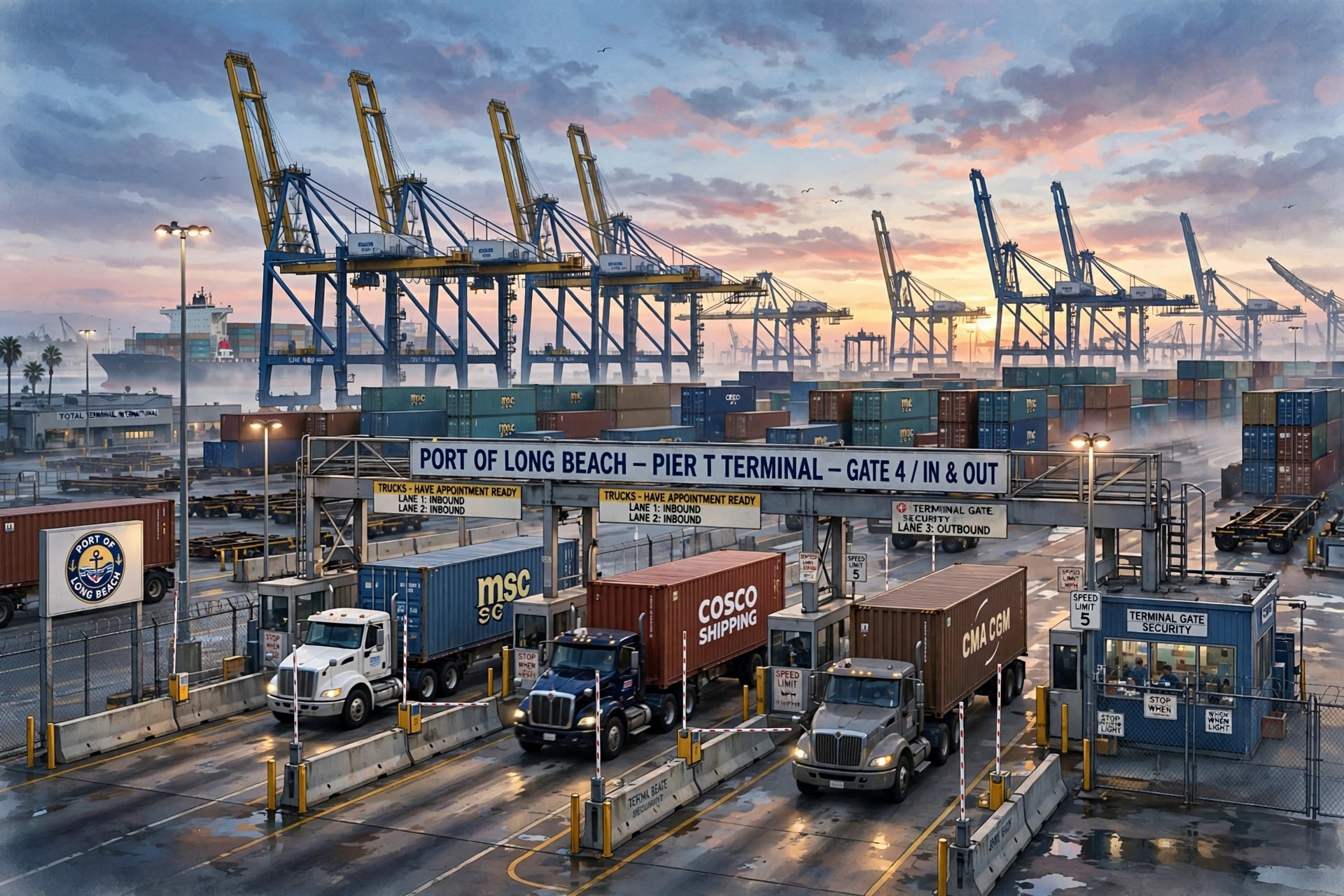
Image: Illustration: AI-generated by CDLWire
The strike that could have idled much of the nation's busiest container gateway heading into the holiday freight peak is off the table: terminal employers and the union representing about 250 security watchmen at the ports of Los Angeles and Long Beach reached a tentative contract agreement on Saturday, averting an immediate walkout, according to The Maritime Executive on Nov. 22.
The Pacific Maritime Association, which represents the terminal employers, and International Longshore and Warehouse Union Local 26, the union representing the ports' security guards, reached the tentative agreement on Saturday, Nov. 21. The agreement remains subject to ratification by Local 26 members, and FreightWaves — which reported the same agreement on Nov. 21 — adds that the existing contract will be extended while that ratification process proceeds, under federal mediation. No terms or timeline for ratification were disclosed. Local 26's watchmen control access at terminal gates and run security patrols; FreightWaves puts the coverage at six container terminals across the two ports, with duties that also include reporting safety issues. They are, in other words, the people at the gate every drayage driver checks in with — a small workforce positioned at the exact chokepoint where trucks meet terminals.
That position is why a dispute covering roughly 2 percent of the ILWU workforce at the two ports carried gateway-wide stakes. Local 26 accounts for only about 2 percent of the ILWU workers at the ports, but all of the union's longshoremen were expected to honor picket lines, which would have shut down cargo operations at the affected terminals in the event of a strike. The container terminals covered by the dispute handle the majority of the cargo at the Port of Long Beach and about a third at the Port of Los Angeles. A walkout by 250 watchmen, honored across the waterfront, would therefore not have been a security-guard strike in its effects; it would have been a shutdown of most of Long Beach and a third of Los Angeles, at the busiest U.S. trade gateway, in the week before Thanksgiving. The deadline was real and it was hours away when the deal came: the watchmen's last contract expired in July 2025, they have worked under a series of extensions since then, union members had authorized a strike in late October, and the union had indicated it would not extend the agreement past 12:01 a.m. Pacific time on Saturday morning. Federally mediated negotiations resumed Friday after an earlier bargaining session ended without a breakthrough.
The pressure around the table in the final days was public and organized. The watchmen first threatened to walk out in late October, and the strike deadline was pushed back several times under pressure from stakeholders throughout the economy. On Friday, more than 110 U.S. trade groups urged both sides to keep talking and keep cargo moving; the signers included the National Retail Federation, the U.S. Chamber of Commerce, the National Association of Manufacturers and the American Trucking Associations. They warned that a stoppage would jeopardize holiday shipments, and noted that the ports already face potential congestion issues. For trucking, the ATA's signature on that letter is the industry's own assessment of what a gate shutdown at Los Angeles and Long Beach does to the drayage and intermodal networks that feed on the complex: appointments missed, containers stranded inside terminals, chassis and yard space locked up in the wrong places, and holiday freight that cannot be recovered by working harder the following week.
One set of numbers in the coverage needs careful handling, because it describes an offer, not the deal. Before the settlement, the PMA said its proposal included a $3,200 one-time bonus and wage increases that would lift average annual earnings for full-time watchmen from more than $170,000 to $198,000, along with continued fully employer-paid healthcare for active workers and retirees and higher pension benefits. Those were the employers' stated terms on the table before Saturday, as the PMA described them; the terms of the tentative agreement itself were not disclosed, and the two should not be read as the same document. What the PMA did say about the agreement itself, in its announcement, is that it would provide greater certainty for the ports, for cargo owners and workers throughout the supply chain, and for the Southern California regional and national economies — and it thanked the Federal Mediation and Conciliation Service, the U.S. Department of Labor and Local 26's bargaining committee for their work. FreightWaves reported it had reached out to Local 26 for comment.
The longer history explains why both sides had reason to settle. The tentative settlement follows more than a year of bargaining, on a contract that expired in July 2025. And the industry's memory of the alternative is recent: during the last round of full-scale ILWU and PMA negotiations in 2022 and 2023, industrial action closed terminals at Los Angeles and Long Beach, and the Port of Seattle had to suspend container operations briefly, before longshore workers ratified a six-year coastwide contract later that year. The Local 26 watchmen's agreement runs on a different cycle from that coastwide contract — which is how a 250-person unit came to hold its own deadline, its own strike authorization, and, for one weekend, the holiday supply chain's attention.
The practical takeaway for drivers and carriers is continuity, with one open item. Terminal gates at Los Angeles and Long Beach stay on their normal footing: no picket lines to honor, no shutdown to route around, and the holiday container flow proceeds under an extended contract while Local 26 members vote. That vote is the remaining uncertainty — a tentative agreement is a recommendation by negotiators, not a ratified contract, and a rejection would return the dispute to the table with the strike authorization already in hand. Nothing in the reporting sets a date for the vote. For a drayage sector that spent October and November pricing the risk of a gate shutdown into the holiday peak, Saturday's agreement removes the largest single disruption risk on the board — five days before Thanksgiving.
Sources
Related coverage
 November 21, 2026 · InfrastructureThe rebuilt I-26/I-95 interchange in South Carolina is fully open — six months early, with the cloverleaf replaced by flyovers
 November 19, 2026 · InfrastructureCongestion cost trucking $128.2 billion in 2024 — 1.24 billion hours of delay and 6.66 billion gallons of diesel burned standing still
 November 18, 2026 · InfrastructureMichigan will close five rest areas Dec. 1 through April 12 — St. Ignace, Topinabee and Hebron on I-75, Ludington and Hart on US-31
Comments
Loading comments…