A zero-emission dealer says stop aiming at Class 8 first: 'Class 4, 5 and 6 are ready now'
Range Zero Emissions CEO Johannes Ariens argues incentives are fixated on Class 7 and 8 while medium-duty trucks can charge overnight on power a small business already has — and that hydrogen and battery will split Class 8 between them.
Summarized from FreightWaves.
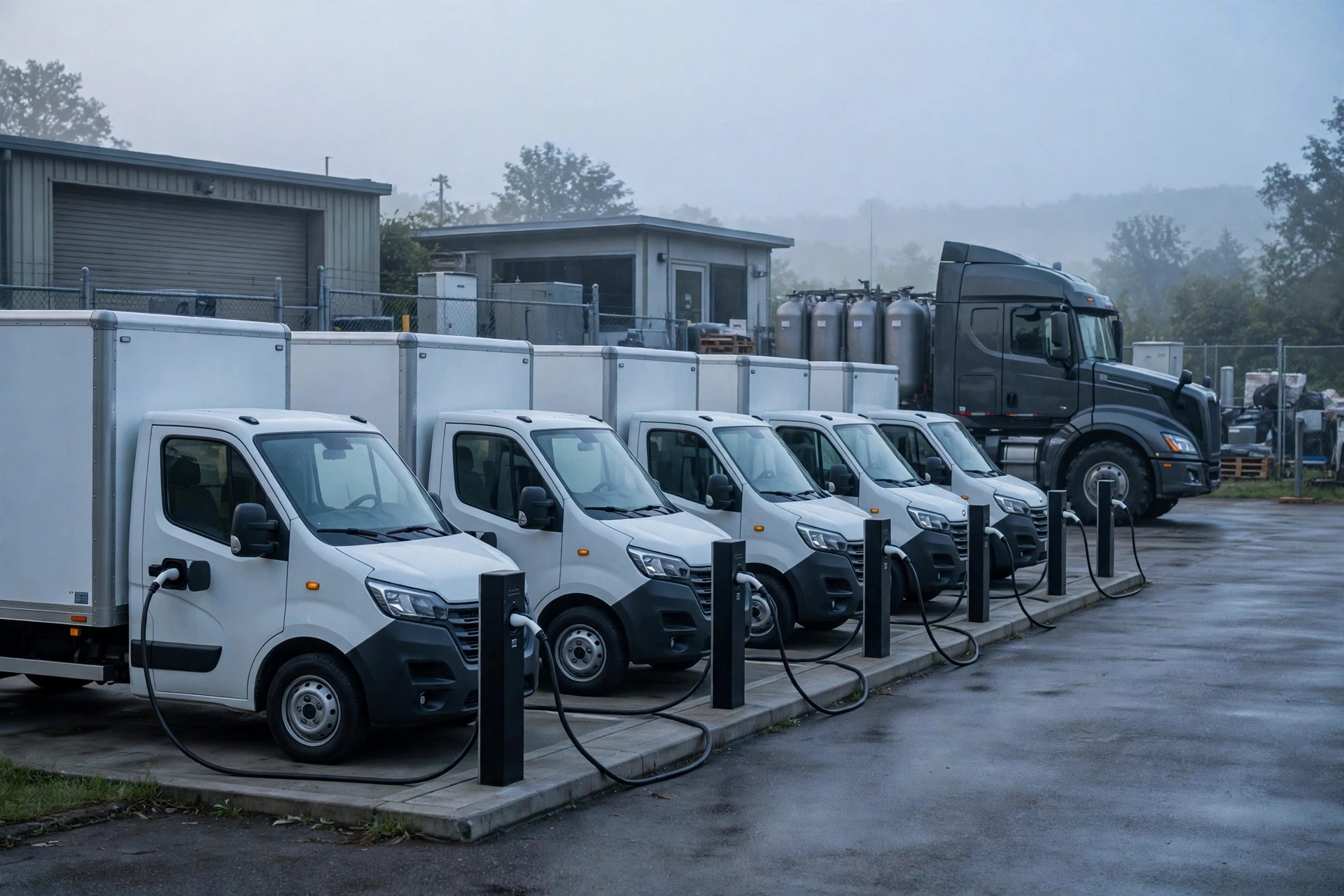
Image: Illustration: AI-generated by CDLWire
A dealer who sells hydrogen semis says the industry's clean-truck push is aimed at the wrong trucks: the ones ready to go electric today are medium-duty Class 4, 5 and 6 models, not Class 7 and 8 tractors, according to FreightWaves on Oct. 23.
Johannes Ariens is CEO of Range Zero Emissions, a dealer group that sells only zero-emission commercial vehicles, with brands running from Zero Motorcycles up to Class 8 trucks and no tie to Range Energy, the electric-trailer company that shares its name. In an interview with FreightWaves, Ariens argued that incentive programs and the broader industry are fixated on the heaviest trucks while most commercial truck users run medium-duty equipment — and many of them can charge on the kind of power a small business already has.
"Charging two vehicles on Level 2 is like, do you have a washing machine and an air compressor at your house? If you do, you can install two Level 2 chargers and charge them overnight and go to work every day for your shift," he said. "You're good to go if you're driving less than 150 miles a day." Class 8 is a different problem: "You cannot charge a Class 8 semi on a Level 2. It literally won't do it." Tesla, which formally opened its Semi factory in Sparks, Nevada, on Sept. 24, expects more than 30 Megawatt Charging System stations by the end of the year — but Ariens says it is years until that kind of charging is widely available and the legacy makers are all in.
His sequencing argument is about how electrification has always spread: from e-bikes and small cars up through larger vehicles, each step building charging the next one could use. "We are so focused on Class 7 and 8 that we're trying to jump a very natural progression of electrification," he said. Medium-duty, meanwhile, already has big buyers — in September, FedEx ordered 2,000 all-electric trucks from Harbinger, one of the brands on Range's roster. And trucking's own ranks are small: of nearly 580,000 active U.S. motor carriers, 91.5% operate 10 or fewer trucks, according to American Trucking Associations data drawn from U.S. Department of Transportation figures as of June 2025. Ariens would steer more voucher money their way: "We should increase the voucher amounts for Class 4, 5 and 6. Just get all these small businesses with five trucks or less into their EVs."
The money he is pointing at is state money. Federal support for zero-emission trucks is pulling back, Ariens said, while California and Washington run what he called the most significant medium- and heavy-duty incentive programs in history. California's Clean Truck and Bus Voucher Incentive Project, known as HVIP, has delivered more than $1 billion since its 2009 launch, and in May the state added the California Clean Fuel Reward, a rebate for electric medium- and heavy-duty trucks with $250 million available this year and more than $1 billion expected through 2030. Washington launched its Zero-Emission Incentive Program on April 29 with $112 million in vouchers. These are continuous, recycled funding streams designed to refill, Ariens said — which fits fleets that replace trucks on a five- to seven-year cycle. Once a technology reaches 5% of new adoption, he said, it tends to stick.
Range has been expanding while it makes the argument. In August it became an authorized dealer for Hyundai's XCIENT Fuel Cell, a hydrogen Class 8 truck, with Washington as its primary territory. It also folded Ziegler Truck Group's zero-emissions business into the Range brand and bought the West Coast operations of Ethero Truck & Energy, moving the company from one Pacific Northwest location into the Midwest and California. On Class 8 itself, Ariens calls the battery-versus-hydrogen debate binary thinking: "I think the future of Class 8 is absolutely both." Battery-electric works for drayage, he said, but weight is the trade-off — federal law gives battery-electric trucks a 2,000-pound allowance on the power unit, up to 82,000 pounds gross, and every added pound is a pound of freight the truck cannot haul. Hydrogen is starting at ports, where trucks run consistent routes from a single fueling point: Long Beach, Oakland and the Vancouver area are the main places a heavy-duty hydrogen truck can fuel today, and the 30-truck NorCAL ZERO project has run XCIENTs in drayage out of the Port of Oakland since May 2024.
For a CDL holder, the near-term meaning is not a new tractor to spec — it is where the first electric work is most likely to appear. Short, return-to-base medium-duty routes under 150 miles a day are the segment a working dealer says can charge overnight today, backed by state vouchers that refill rather than expire. Class 8 electrification, on his account, follows the charging and fueling build-out at ports and along megawatt-charging corridors over years, not buying cycles. "That's my party line, and the thing I stomp my feet about every day," Ariens said. "Why are we not making it as easy as possible to go to Class 4, 5 and 6, and then Class 7 and 8 will solve its own problem?"
Sources
Related coverage
 October 23, 2026 · EquipmentMunich court orders Daimler Truck and MAN to repay cartel-era truck buyers
 October 22, 2026 · EquipmentInternational to add a second shift at San Antonio in early 2027 as output nears 100 trucks a day
 October 20, 2026 · EquipmentVolvo folds powertrain repairs into its service contract as repair costs hit $0.215 a mile
Comments
Loading comments…