The $8 billion diesel aid for farmers won't arrive until after the election, a USDA official says
USDA official Richard Fordyce told Reuters the payments will come after Nov. 3, probably close to the end of the year — while diesel rose again to $6.28 and truck stop operators call the red-dyed diesel guidance murky.
Summarized from Reuters.

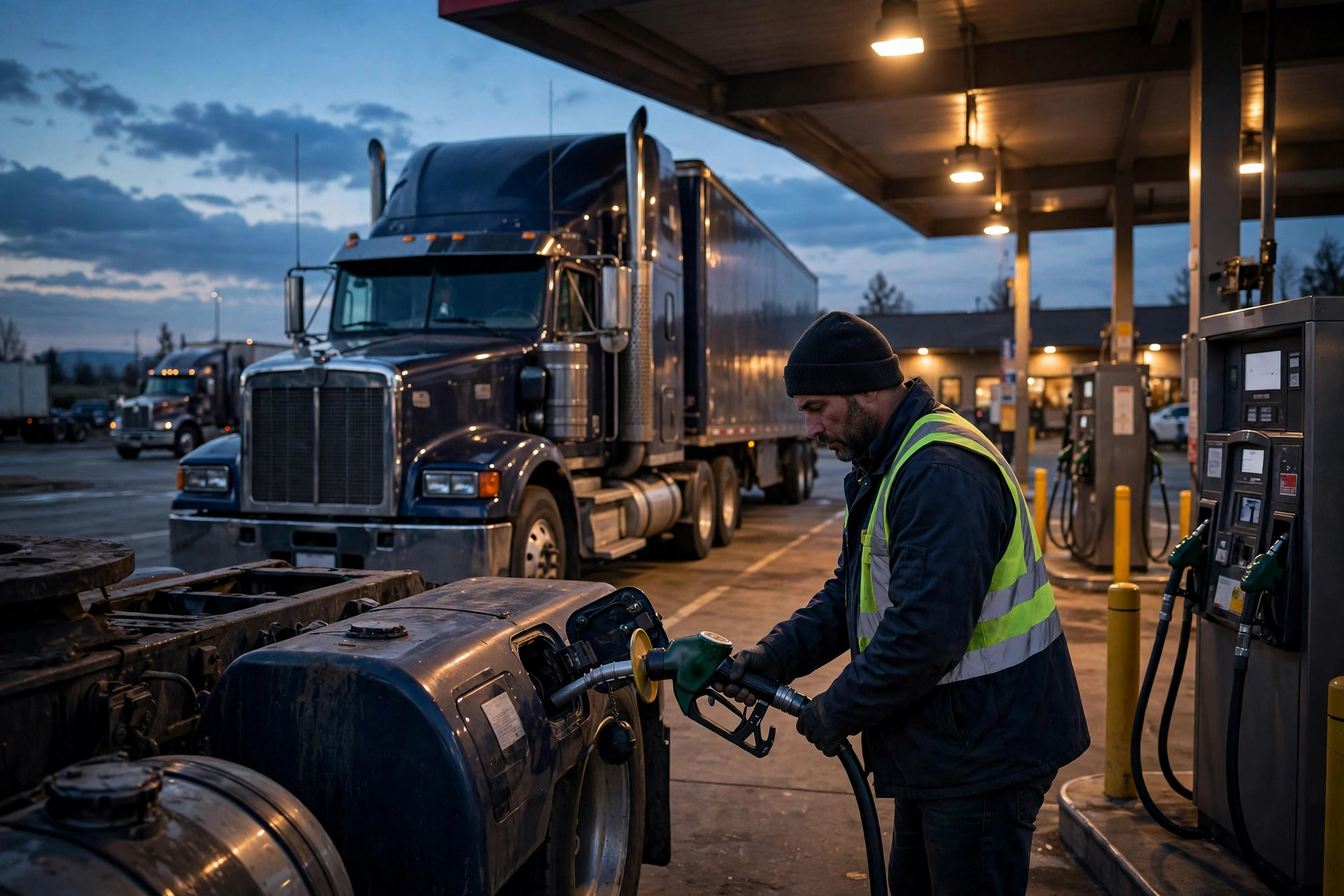
Image: Illustration: AI-generated by CDLWire
The $8 billion in diesel aid for farmers that President Donald Trump announced this week will not be paid until after the Nov. 3 midterm elections, according to Reuters on Oct. 23.
U.S. Department of Agriculture official Richard Fordyce told Reuters on Friday that the exact timing of the payments is still to be determined. "It's going to be close to the end of the year, would be my guess," Fordyce said. "That is a little unclear at this point." Trump announced the aid at a rally in Kansas on Monday as part of a suite of measures aimed at high fuel prices driven up by the war in Iran. Reuters reports it remained unclear how the money would be allocated, when exactly payments would reach farmers, or whether congressional approval would be required.
The timing lands in the middle of a price problem that has not moved. U.S. diesel prices rose nearly $0.10 a gallon in the latest week to an average of $6.28, reversing two weeks of declines and remaining near record highs, according to the Energy Information Administration figures cited by Reuters. An October Reuters/Ipsos poll found nearly 80% of Americans blame Trump for higher costs, and the political pressure is sharpest in Farm Belt states such as Iowa and Kansas, where fuel and fertilizer costs, trade disruptions and weak farm economics have fueled discontent among core supporters.
The aid is large even by recent standards. Government payments to farmers were already expected to top $47 billion this year, buoyed by commodity payments and $12 billion in tariff relief distributed by the USDA earlier this year. The $8 billion diesel program would push the total to a record $55.4 billion, above the previous high of $45 billion in 2020, when farmers received pandemic assistance. National Farmers Union President Rob Larew called it "the second round of emergency aid this year to address losses that were largely foreseeable," saying one-time payments cannot provide the stability family farmers need to plan.
Truckers should read the other half of the Reuters report just as closely, because it concerns the red-dyed diesel order. Trump signed an executive order this month allowing truckers to use red-dyed diesel — fuel normally intended for off-road use such as farm equipment — for highway driving while temporarily avoiding certain federal tax reporting and record-keeping requirements. But the IRS has not eliminated the federal diesel tax; it has temporarily waived related reporting requirements and penalties through year-end, leaving uncertainty for truck stops and fuel sellers about what is actually permitted at the pump.
David Fialkov, the top lobbyist at NATSO, the trade group representing the largest U.S. truck stop operators, told Reuters members appreciate the effort to tackle diesel costs but the guidance remains "murky" and carries too much risk. "I really don't see any of these dyed diesel announcements making a meaningful dent in diesel prices," Fialkov said. The White House attributed high diesel prices to "pre-existing issues," including years of refinery closures and damage from Russia's war in Ukraine. "The President wants diesel prices to fall, which is why he has taken historic actions to save American farmers, truckers, and workers every hard-earned penny," White House spokeswoman Taylor Rogers said.
The practical takeaway for drivers is twofold. First, do not plan cash flow around relief that has no date: the farm payments are now officially a late-year prospect at the earliest, and nothing in the announcement puts money into trucking directly. Second, treat dyed diesel as a compliance risk, not a discount, until the IRS and your fuel network say otherwise in writing — the tax itself has not been waived, only reporting and penalties, and the truck stops that would have to sell it call the guidance murky. At $6.28 a gallon on the national average, the levers that actually move a driver's week remain the unglamorous ones: fuel surcharge terms, routing, and where the truck stops.
Sources
Related coverage
 October 23, 2026 · DieselFirst Russian diesel tanker is on the water: 40,000 tons bound for New York
 October 20, 2026 · DieselEIA: diesel benchmark rises $0.097 to $6.276, ending three weeks of declines
 October 18, 2026 · DieselFuel prices vault 17 spots to No. 1 on ATRI's 2026 Top Industry Issues list
Comments
Loading comments…