Mexico's carriers call a national stoppage for Monday — and border freight is in the path
CANACAR, AMOTAC, FEMATRAC and INDECO have called a partial, indefinite national stoppage from 8 a.m. Monday, Oct. 26 over highway robbery, extortion and a 2027 fiscal change — with Nuevo Laredo and Tamaulipas among the places expecting the heaviest effects.
Summarized from Reporte Ágora.
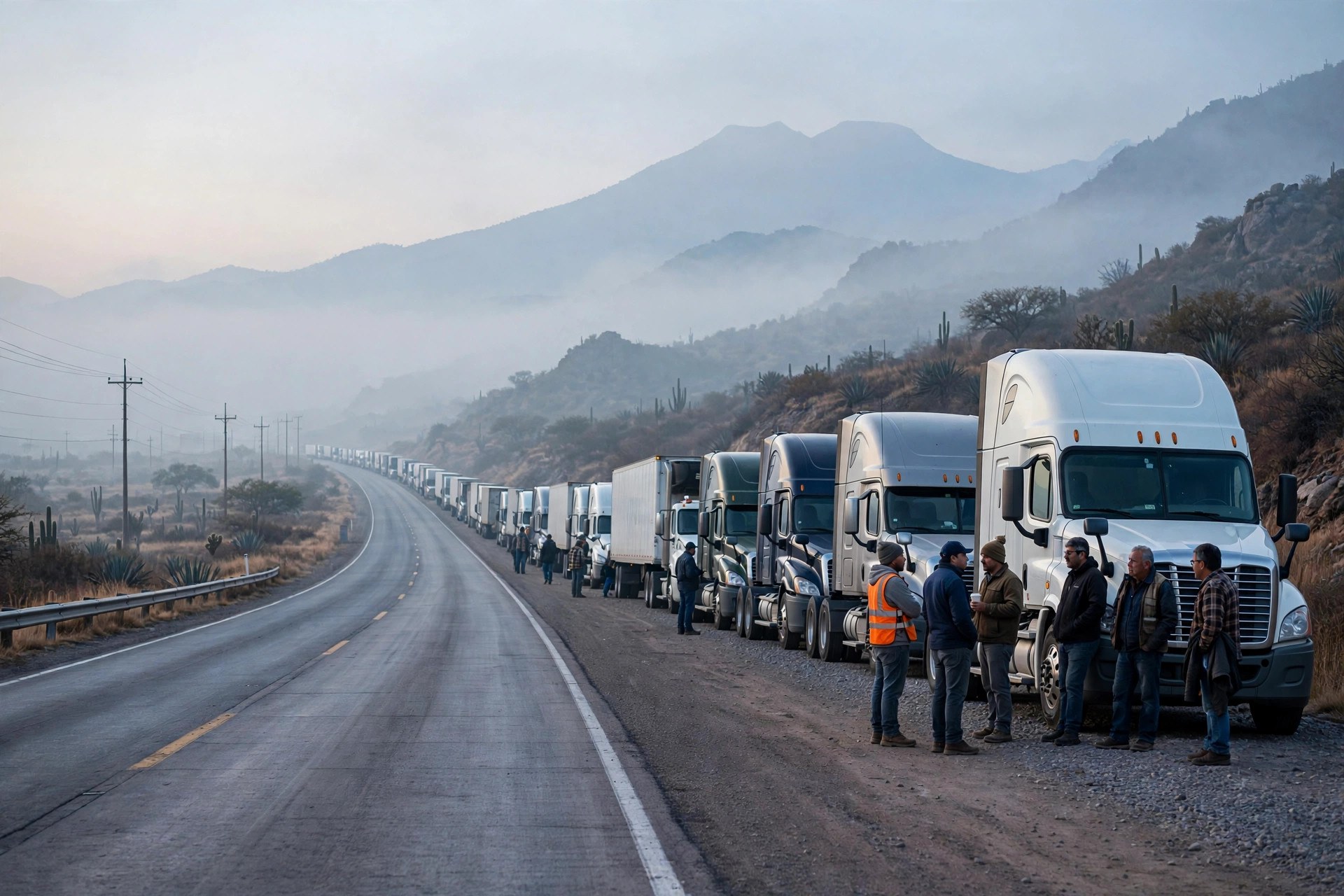
Image: Illustration: AI-generated by CDLWire
Mexico's freight carriers have called a national stoppage for Monday, Oct. 26, a move that could slow cross-border freight through Laredo and other ports of entry just as the week begins, according to Reporte Ágora on Oct. 23.
The call is backed by the Cámara Nacional del Autotransporte de Carga (CANACAR), the Alianza Mexicana de Organización de Transportistas (AMOTAC), the Federación Mexicana de Transportistas (FEMATRAC) and the Organización Integradora de Derechos Convencionales (INDECO). The groups say the suspension of activities will be partial and indefinite, starting at 8:00 a.m. on Monday, and staged peacefully: trucks are to be parked in the far-right lane at strategic logistics points and at the accesses to major cities, with no total closure of federal highways in the announced plan.
The demands start with security. The organizations point to a high rate of cargo robbery, violent assaults on drivers, and extortion attributed to some authorities. El Faro, in its Oct. 24 report on the same call, adds long-running complaints about abusive tow-truck and impound-lot charges, denounced especially in the state of Morelos. For Mexican drivers, the argument is that running freight under current conditions has become untenable; CANACAR president Augusto Ramos Melo warned that the proposed fiscal changes could further cut the sector's operating capacity.
The fiscal fight is specific. Under the 2027 economic package, the annual income limit for a toll-related tax stimulus would fall from 300 million pesos to 250 million pesos, shrinking the number of companies that can claim the benefit. Paired with poor federal highway conditions and high tolls, the groups say operating costs keep climbing while margins do not. Organizers were set to finalize meeting points and logistics at meetings on Friday, Oct. 23, in Culiacán, Sinaloa, and in Mexico City.
CANACAR also drew a line around its own role. The chamber clarified that a suspension of activities by some companies should not automatically be read as a strike formally called by CANACAR itself, and it is not an announcement of highway blockades. Separately, the Honorable Alianza Mexicana Organización de Transportistas (HAMOTAC) called peaceful demonstrations from 6:00 a.m. on Monday in all 32 states; whether AMOTAC joins that particular call had not been confirmed in the Oct. 24 reports. The Secretaría de Gobernación, Mexico's interior ministry, said dialogue tables with the competent authorities remain open, recognized the sector's concerns, and urged that citizens, traffic and the movement of goods not be harmed.
The footprint, if participation is broad, is national. El Faro reports units are expected at the roadside in more than 20 states, with the heaviest effects anticipated around Mexico City, the State of Mexico, Hidalgo, Guanajuato, Querétaro, Zacatecas, Jalisco, Michoacán, Sinaloa, Tamaulipas and Nuevo Laredo. Guanajuato's organizers agreed to keep the highway presence outside morning and afternoon peak hours. CANACAR cited roughly 21,000 Mexico–U.S. truck crossings a day, according to a Particle News summary of the announcement published on Oct. 23 — the cross-border volume the sector presents as at risk.
What it means on this side of the border: any load that depends on a Mexican carrier leg, a transload in Nuevo Laredo, or a Monday pickup in Mexico's industrial center should be treated as at risk until the scope of the stoppage is visible Monday morning. The announced design — parked trucks, no planned total closures — points to slowdowns at city accesses and logistics zones rather than sealed highways, but the organizers themselves concede the real impact depends on turnout at each concentration point. Dispatchers running cross-border freight should confirm Monday appointments before drivers roll, build buffer time into border-adjacent schedules, and watch for Segob and carrier-group statements over the weekend that could narrow, widen or call off the action.
Sources
Related coverage
 October 21, 2026 · BorderAs B-1 drivers lose visas, Mexican freight shifts to transloading — and U.S. carriers get the second leg
 October 14, 2026 · BorderMexico's heavy-truck exports surge 144.6% in September as U.S. buyers get ahead of EPA 2027
 October 13, 2026 · BorderCross-border capacity to stay tight into 2027 as driver shortages and visa pullbacks bite
Comments
Loading comments…