221 trucking companies have filed for bankruptcy this year — and nearly 40% of small carriers say they may be out within six months
Bloomberg data compiled for an Oct. 28 report puts 2026 bankruptcy filings at 221 trucking companies, extending a three-year spike at levels not seen in decades. A Truckstop and Bloomberg Intelligence survey of hundreds of small carriers found two-thirds with revenue flat or down, squeezed by diesel, insurance and the cost of the money they borrowed to get started.
Summarized from Transport Topics.
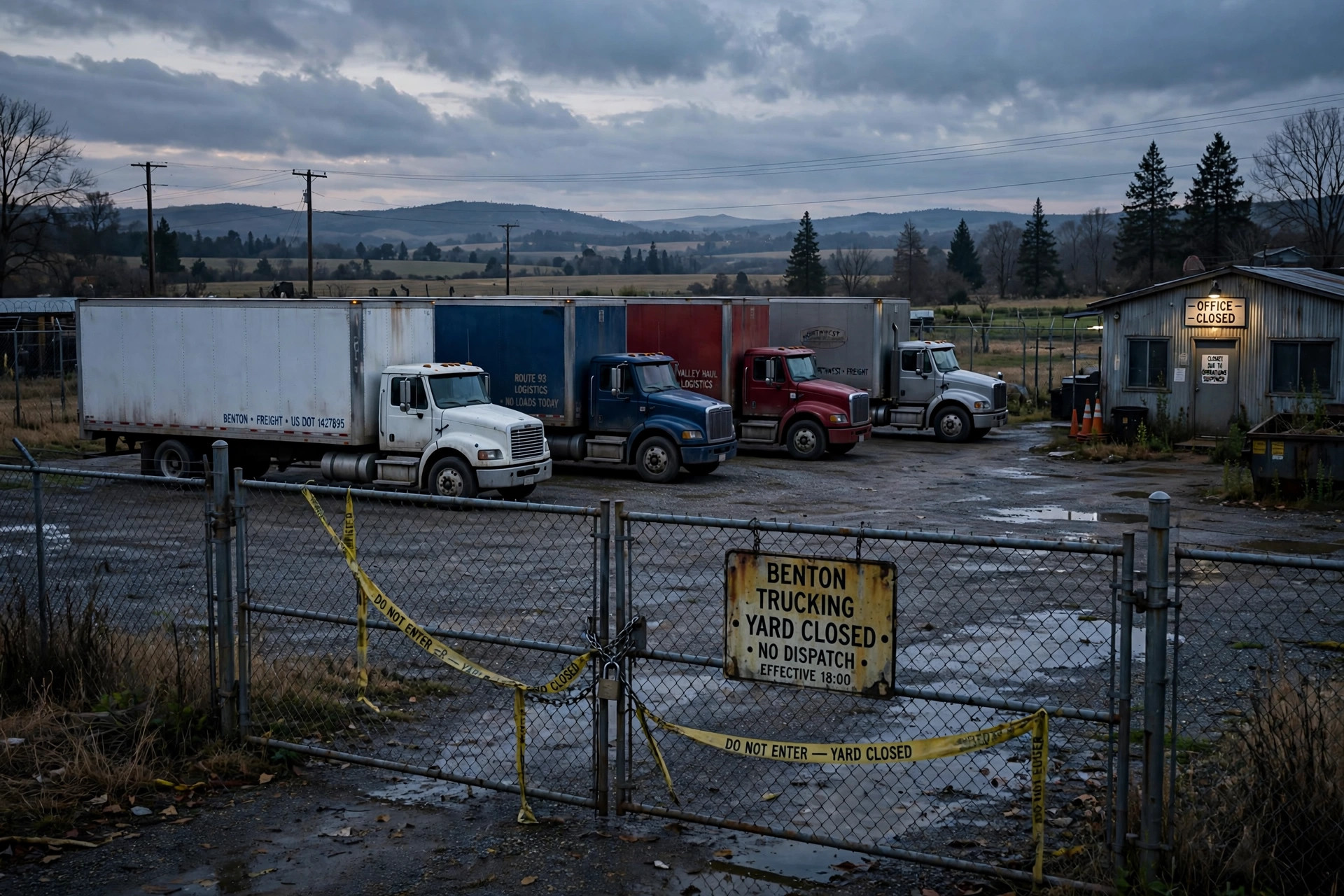
Image: Illustration: AI-generated by CDLWire
Some 221 trucking companies have filed for bankruptcy so far this year as small carriers faced mounting financial pressure, according to Transport Topics on Oct. 28, reporting data compiled by Bloomberg. The filings extend a three-year spike at sustained levels not seen in decades. Around two-thirds of small U.S. carriers — typically operating 20 or fewer tractors, and oftentimes only just one — report that revenue is either flat or down compared with the year-ago period, according to a survey of hundreds of such companies conducted over the past two months by freight-management firm Truckstop and Bloomberg Intelligence. Almost 40% of these operators said that in six months, they expected to be out of trucking or weren't sure where they'd be.
The report's central case is a carrier drivers will recognize. Justin Stoneman has been in the trucking industry for 27 years, operating out of central Michigan's agricultural heartland, hauling grain and fertilizer around the Midwest. His 12-odd tractor-trailers generated more than $3 million in annual revenue during their best times. In the past year, his business has been squeezed by war-fueled spikes in diesel prices, rising insurance costs and onerous debts. In May, his company, Stoneman Trucking, filed for bankruptcy protection, but he has since lost hope and is shifting to Chapter 7, to fully shut down operations. 'I'm so frustrated,' Stoneman said. 'It's like, what about all this 'Drill, baby, drill'?' The move from a reorganization filing to a liquidation filing is the detail that matters: it is the point at which a carrier stops trying to restructure its way out and starts winding the business down.
How a carrier like Stoneman's got trapped is a financing story as much as a freight story. Stoneman took out equipment loans when he opened his own business, then took out two merchant cash advances totaling around $125,000 in 2023, when his cash was low. Now, he says, he feels duped by bankers who offered him complicated loans he couldn't pay back, and that a normal line of credit might have saved his business. Chip Lane, managing partner at the bankruptcy-focused Lane Law Firm in Texas, said he has seen a 'massive uptick' in trucking companies approaching his firm to explore restructuring, sometimes as many as three or four in a week. Lane described a 'triple whammy' for the operators who survived the freight recession: higher fuel prices, rising interest rates and burdensome credit arrangements — including what he called 'bad money': variable interest-rate loans and short-term, high-interest loans designed to cover shortfalls that put debtors deeper in the red, alongside merchant cash advances and factoring, two ways to get cash quickly that pile on extra costs later.
Insurance delivered the finishing blow in Stoneman's case, and the figure is worth reading slowly. Stoneman decided to liquidate his business after an insurance company quoted him $155,000 to back two trucks and three trailers after one of his drivers got in an accident. Jennifer Lockett, operations manager at factoring company altLINE, said insurance can increase when carriers are defrauded or get a single speeding ticket, and that prices for equipment and labor have also gone up. Fraud is its own line item: the freight recession accelerated the industry's identity-theft problem, Lockett said, as fraudsters find a trucker's identification number — valuable because it shows a long history of operation with a clean safety record — and either sell it or use it to intercept loads and carry off cargo. Freight fraud costs the industry an estimated $18 million per day, per Highway's Freight Fraud Index, as cited in the report.
The divide inside the industry is the report's other through-line. 'It's much easier for the large J.B. Hunt to absorb higher fuel prices than it is for the $2.5 million dollar mom-and-pop trucking company that has five trucks doing local deliveries,' said Christopher Ward, a bankruptcy partner at Lowenstein Sandler. Companies with no equipment debt and qualified safety records, usually larger companies, are doing well, said Aaron Graft, chief executive of Triumph Financial, a payment and banking platform for the freight industry. 'It's a feast or famine,' he said. The background is the contraction from the COVID-era boom, when delivery demand, near-zero interest rates and generous government loans created dream conditions to enter trucking; after the pandemic subsided, many of those businesses could no longer find enough work, rates plummeted, and the industry endured a deep downturn including a wave of bankruptcies.
The practical takeaway for a small carrier or owner-operator is to treat the financing terms, not the rate sheet, as the survival document. The pattern in case after case in this report is the same sequence: equipment debt taken on in good times, then expensive short-term money — merchant cash advances, variable-rate and short-term high-interest loans — taken on to cover a cash squeeze, until a single insurance renewal or accident quote makes the whole stack unpayable. Before signing any fast-cash product, price what it costs over its full term against a conventional line of credit, and know your insurance renewal exposure before it arrives, especially after any accident or ticket. And protect the asset fraudsters are actually stealing in this market: your DOT identity and operating history — a carrier whose number is hijacked can lose loads, revenue and insurability without ever missing a payment itself.
Sources
Related coverage
 October 21, 2026 · ClosuresAt least 16 carriers file for bankruptcy in a month as small fleets carry the debt
Comments
Loading comments…