A driver reset his hours by phone in front of FMCSA and state police — the agency vows to 'hold violators fully accountable'
At a Wednesday meeting with Illinois State Police in DeKalb, a Meiborg driver parked at police headquarters, called a federally registered ELD provider and had his hours reset in about 10 minutes, on video. The carrier staged the demonstration to show regulators how ELD fraud works; FMCSA answered with its registry record and a promise of accountability.
Summarized from Overdrive.
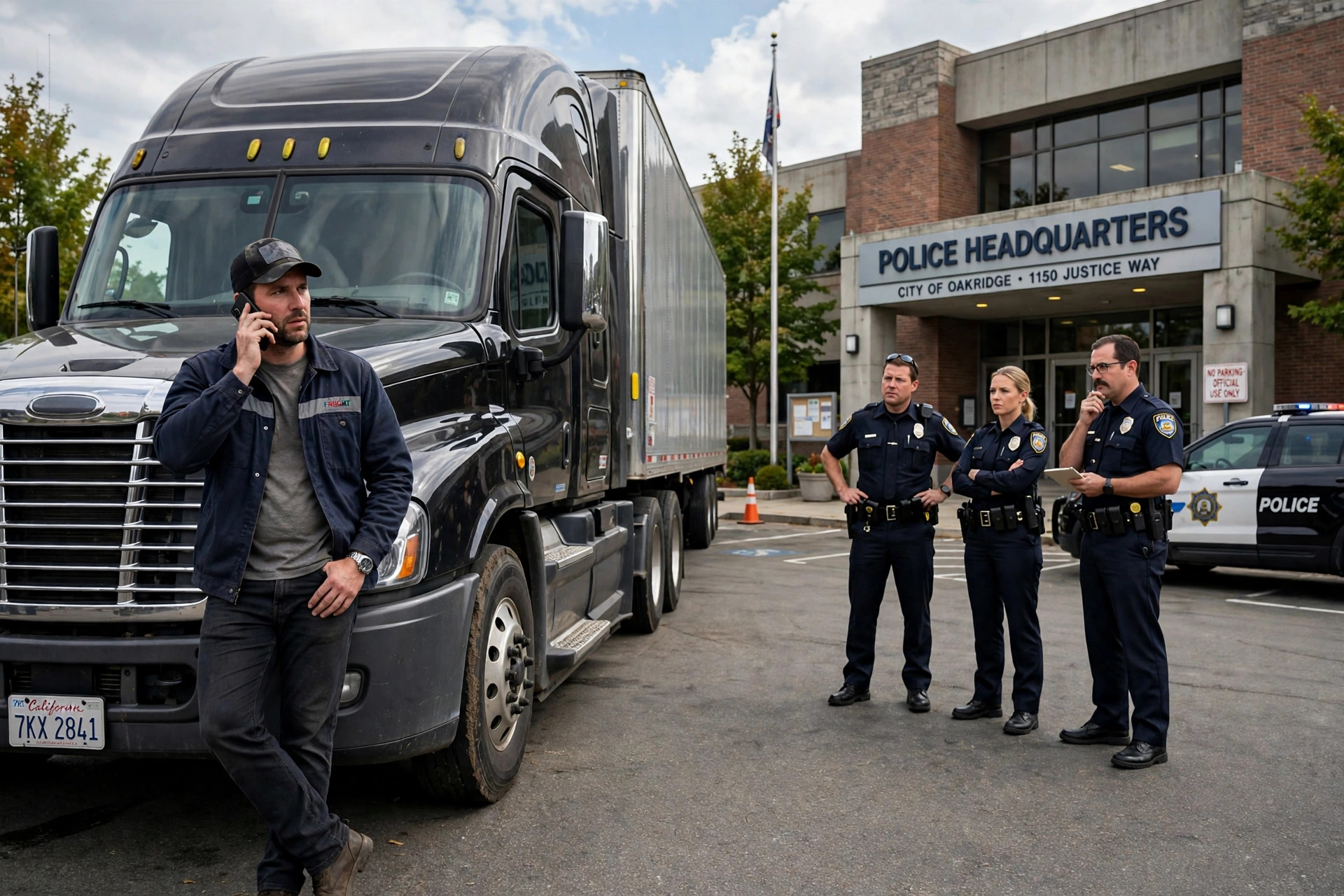
Image: Illustration: AI-generated by CDLWire
A motor carrier confronted federal investigators with firsthand evidence of electronic logging device fraud this week — by committing it in front of them, at police headquarters, on video — according to Overdrive on Oct. 28. At a meeting with Illinois State Police on Wednesday in DeKalb, Illinois, Meiborg Inc. driver Francis Buchanan parked at police headquarters, called a federally registered ELD provider, and had his hours reset on the spot. Prompted to select English or Punjabi, he gave the operator his company and truck numbers and asked for his hours reset; in about 10 minutes, his logs showed perfect compliance and a fresh set of hours. The episode was captured on video. 'I always figured if I was surrounded by state police, it would be for something different,' Buchanan said as he waited on hold.
For the state police gathered, Overdrive reported, the meeting was an education session on how to spot the new breed of ELD cheats that invent logs to cover violations nearly without a trace. For Zach Meiborg, chief executive of the Meiborg Companies, it was a cry for help — and he put his cost case in plain numbers. 'A truck costs $200,000, a trailer is $50,000 to $100,000, a compliant English-speaking driver costs $100,000' a year all-in, Meiborg said. 'It costs us $300,000 to send a truck down the road, and if I can only work it eight hours a day, then my cost-per-mile is tremendously higher than these guys overseas that are running guys 16, 18, 20 hours a day.' His thesis, and the reason he bought and runs a fraudulent ELD and brought it to police headquarters, is that hours cheating has broken the industry: 'We're getting our asses kicked by these guys because we simply can't compete.'
FMCSA's answer came in a statement after the meeting. 'FMCSA aggressively investigates and cracks down on fraud across every corner of the commercial motor vehicle industry including electronic logging device manipulation,' a spokesperson for the agency said. 'Deliberately manipulating hours-of-service records is a crime that endangers American lives.' The agency said that since January 2025 it has significantly accelerated enforcement, revoking more than 95 non-compliant ELDs from the federal registry for failing to meet minimum standards, and that enhanced vetting implemented in 2025 has blocked 552 additional applications. 'FMCSA and our law enforcement partners will hold violators fully accountable,' the spokesperson said.
Meiborg's counter is that the registry cleanup has locked the front door while the house stays packed — his phrase was 'The front door is locked, but the house is packed.' Of the 900 or so registered ELDs, about two thirds of which some estimate allow tampering, he argued, 'we need to get the bad guys out now.' By his estimate, fully one million trucks could be running fraudulent e-logs. 'Those one million trucks are running twice as much as compliant carriers, so they're really hauling two million trucks' worth of loads,' he told police and FMCSA. 'This is a real problem really affecting American-owned and -operated surface transportation companies.' Those figures are Meiborg's estimates, presented as his, not an agency count.
The roadside side of the problem is newer and narrower than the fraud itself. As of April 1, 2026, the Commercial Vehicle Safety Alliance's out-of-service criteria include a new ELD tampering violation as a separate out-of-service code, distinct from simply misusing personal conveyance or other false-logs violations, recorded as the 395.8e-HOSPELDT violation. Overdrive's accounting with its sister company RigDig shows the violation being found in intensified volumes since April, with several thousand different carriers' DOT numbers represented. Illinois records the violation differently and shows zero under the new code to date; officers on hand said they are enforcing it but lack authority to tow a truck for it. Even when a manipulated-ELD operator is caught, the driver mostly just needs to sit for 10 hours before driving again.
Meiborg also proposed a simplified hours system of 14 hours on and 10 hours off to reduce the cheats' advantage; FMCSA has not commented on that proposal, Overdrive reported. The troopers' practical point was about speed at the stop itself: because a reset takes only minutes, officers emphasized getting a read on the logs as soon as possible. 'With such a massive problem, the best thing I've come across is to stop the truck immediately, get out of the car as fast as possible,' one officer said. 'I would love to have discretion to tow a truck if the driver is doing something shady.'
The practical takeaway depends on which side of the logbook you run. If you run compliant, Wednesday's demonstration is the strongest public evidence yet that the agency has now watched the fraud happen live, in a police parking lot, and answered on the record — and the tampering code that has existed since April gives inspectors a specific violation to write when they can prove it, so expect log transfers at roadside to be treated as time-sensitive evidence, not paperwork. If anyone — a dispatcher, a safety department, an ELD vendor — offers to reset, edit or 'fix' your hours by phone, understand what Buchanan's call actually was: the deliberate manipulation of a federal hours record, which FMCSA calls a crime, performed here only because the carrier staging it wanted it exposed. The 10 hours a caught driver sits is the smallest part of that file.
Sources
Related coverage
 October 28, 2026 · EnforcementArkansas Highway Shield blitz runs through 6 a.m. Thursday: unqualified drivers, unsafe trucks and fraud are the targets
 October 28, 2026 · EnforcementDriver pleads guilty in the I-35 construction-zone deaths: the cab camera showed Netflix as he reached slow traffic at 68 mph
 October 28, 2026 · EnforcementNew charges detail in the fatal I-81 pileup: driver admits he hid a narcolepsy diagnosis to keep his CDL, troopers say
Comments
Loading comments…