Canada's 50% tariff list swapped at midnight Oct. 30 — 100 classifications added, 22 removed — and the entry date now decides what a cross-border load costs
Proclamation 11076, published in the Federal Register on Oct. 30, took plywood, packaging and refrigeration equipment off the Section 338 list and put lubricants, flooring, paints, valves and carpets on it. The duty stacks on top of Section 232 tariffs, applies regardless of USMCA status, and is set by when a load is entered — not when it was loaded.
Summarized from The Trucker.
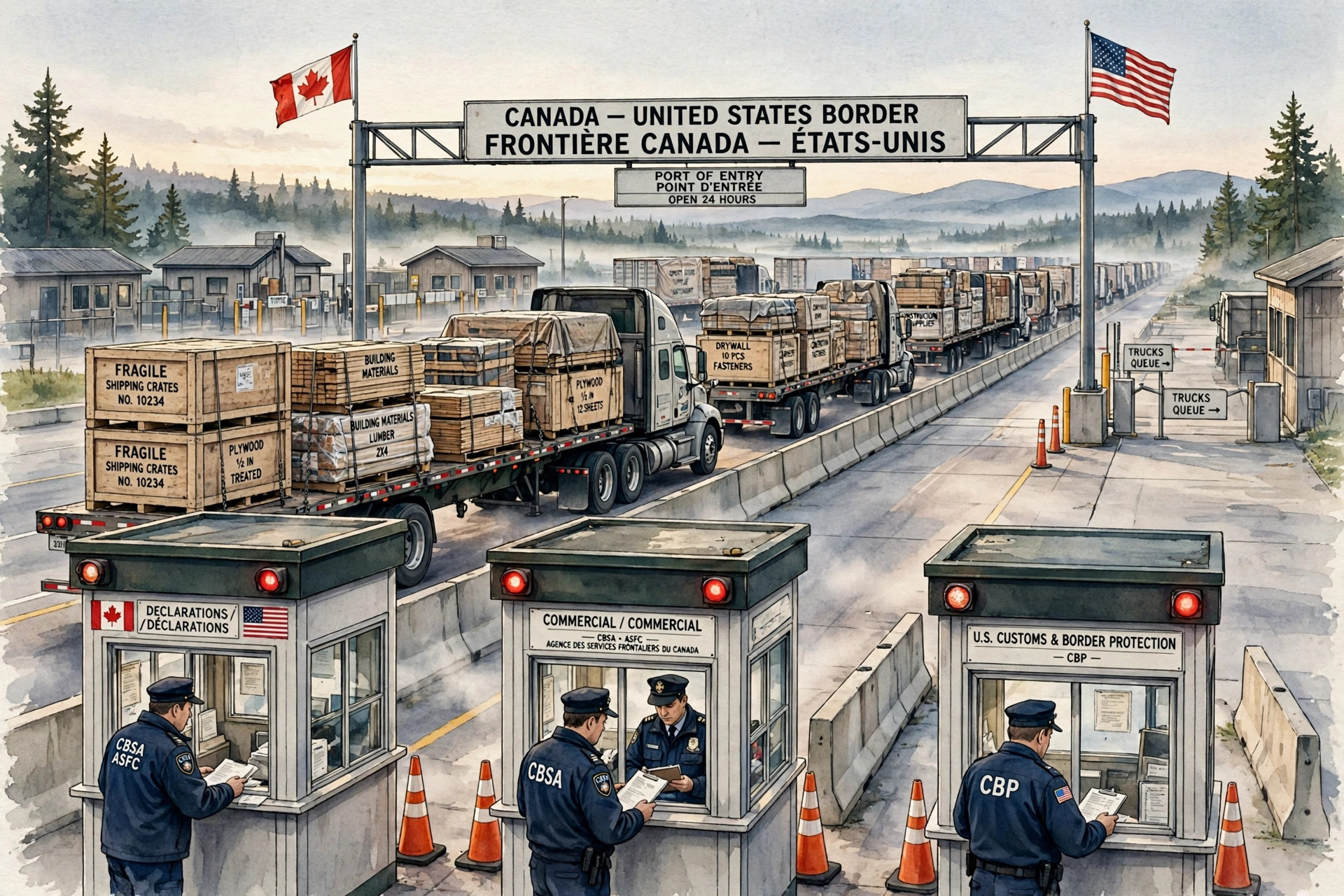
Image: Illustration: AI-generated by CDLWire
The list of Canadian goods paying an additional 50% tariff to enter the United States changed at midnight on Oct. 30 — 100 product classifications were added to the duty and 22 were removed — in a swap that now sets the landed cost of the building materials, packaging, flooring and manufactured freight that fills cross-border trucks, according to The Trucker on Oct. 31.
The change is Proclamation 11076, signed by President Donald Trump on Oct. 23 and published in the Federal Register on Oct. 30. It modifies Proclamation 11048, the July order that imposed the additional 50% duties under Section 338 of the Tariff Act of 1930, and it took effect for goods entered for consumption, or withdrawn from a customs warehouse, at 12:01 a.m. Eastern time on Oct. 30. According to U.S. Customs and Border Protection, as reported by The Trucker, the revision removes 22 product classifications from the additional tariff and adds 100 others. Nothing in the proclamation changes trucking regulations or border-crossing requirements for drivers — what changes is what the freight itself costs when it is entered.
Coming off the list are certain types of plywood, plastic packaging materials, paperboard, cartons, bags and refrigeration equipment, along with specified industrial machinery used for packaging, processing and agricultural production. The White House fact sheet describes the removals as plywood sheets, some paper products, certain machinery and refrigeration equipment, and certain packing crates and boxes. For U.S. buyers of those goods, the additional 50% charge simply disappears: a Canadian plywood load entered on Oct. 30 or later no longer carries a duty that the same load entered a day earlier would have owed in full.
Going onto the list are certain lubricating preparations, wood products, flooring materials, paper products, paints and other manufactured goods; the fact sheet names certain valves, carpets and waste products among the additions. Those products now carry the additional 50% duty on top of whatever they already owed. The proclamation states expressly that the Section 338 duties apply in addition to duties imposed under Section 232 of the Trade Expansion Act of 1962, and the White House fact sheet states that the Section 338 tariffs apply to all covered goods regardless of whether a good originates under the United States-Mexico-Canada Agreement — qualifying under the trade agreement does not shelter a covered shipment.
The detail that matters most at the border is the clock. Because the change applies by entry date, the duty on a load is set by when it is entered for consumption, not by when it was loaded, dispatched or even when it crossed. A trailer of newly listed flooring that was entered before 12:01 a.m. Eastern on Oct. 30 is treated under the old list; the identical trailer entered an hour later owes the additional 50%. CBP has issued updated instructions for importers and customs brokers, including the revised tariff classifications, and the proclamation authorizes CBP to make any further technical corrections to the lists through the Federal Register.
This is the third version of the list in just over three months. Proclamation 11048, signed July 20, found that Canada's motor vehicle tariff scheme discriminates against U.S. commerce and imposed the 50% duties under Section 338, a provision that authorizes additional duties of up to 50% to offset a foreign country's discrimination. The duties were briefly suspended for three days in August after Canada expressed a commitment to remove the discrimination; the proclamation record states that Canada reneged on Aug. 21, and the duties became effective Aug. 22. Proclamation 11065 then modified the product scope on Sept. 8. Canada has answered with retaliation of its own — the White House fact sheet notes that Canada imposed new retaliatory tariffs on about $20 billion of U.S. exports — so cross-border carriers are now working inside a tariff fight that runs in both directions and rewrites its own product lists every few weeks.
For trucking, the exposure is by commodity, not by corridor. The Trucker notes that the proclamation provides no estimates of how the revisions might affect freight volumes, truck traffic or rates, and that the actual impact will depend on the value of the affected imports, customer demand and how businesses respond. The carriers with the most at stake are those serving construction, manufacturing, agricultural and industrial customers — the sectors whose inputs dominate both lists. Removing the duty from plywood and packaging products could reduce import costs and support demand from U.S. buyers; adding it to flooring, paints, lubricants and other manufactured goods could raise costs enough to change purchasing and shipping decisions on those lanes.
The practical takeaway for anyone hauling Canada lanes: find out which side of the new list your freight is on before you quote it. Ask your shipper or broker, in writing, which classifications your regular loads carry and how the duty is being handled, because a load's cost now turns on its entry date and its tariff line, not on the lane. Loads of plywood, packaging and refrigeration equipment just got cheaper to bring in; loads of flooring, paints, valves, carpets and lubricating preparations just picked up an additional 50% duty at the border. Expect demand to shift commodity by commodity as buyers re-price — and expect this list to change again, because it has already changed twice since July.
Sources
Related coverage
 October 30, 2026 · RegulationsMotus reclassified a flatbed carrier as a hazmat hauler and suspended it — and roughly 6,475 carriers got the same insurance-change suspension this week
 October 28, 2026 · RegulationsFMCSA has removed more than 10,000 training providers since December — and kept nearly 600 ELDs off the market entirely
 October 28, 2026 · RegulationsPAM Transport wants to be the eighth carrier with a learner's-permit exemption — comments are open through Nov. 27
Comments
Loading comments…