Aurora cuts its 2026 revenue forecast to about $9 million after a six-week truck-building delay — and still promises 1,000+ driverless trucks by the end of 2027
Third-quarter revenue was $3 million against a $257 million operating loss as material shortages and quality problems at Roush pushed the 20-trucks-a-week milestone from October to early December. The company says 200 trucks by the end of February and more than 1,000 by the end of 2027 still hold.
Summarized from FreightWaves.
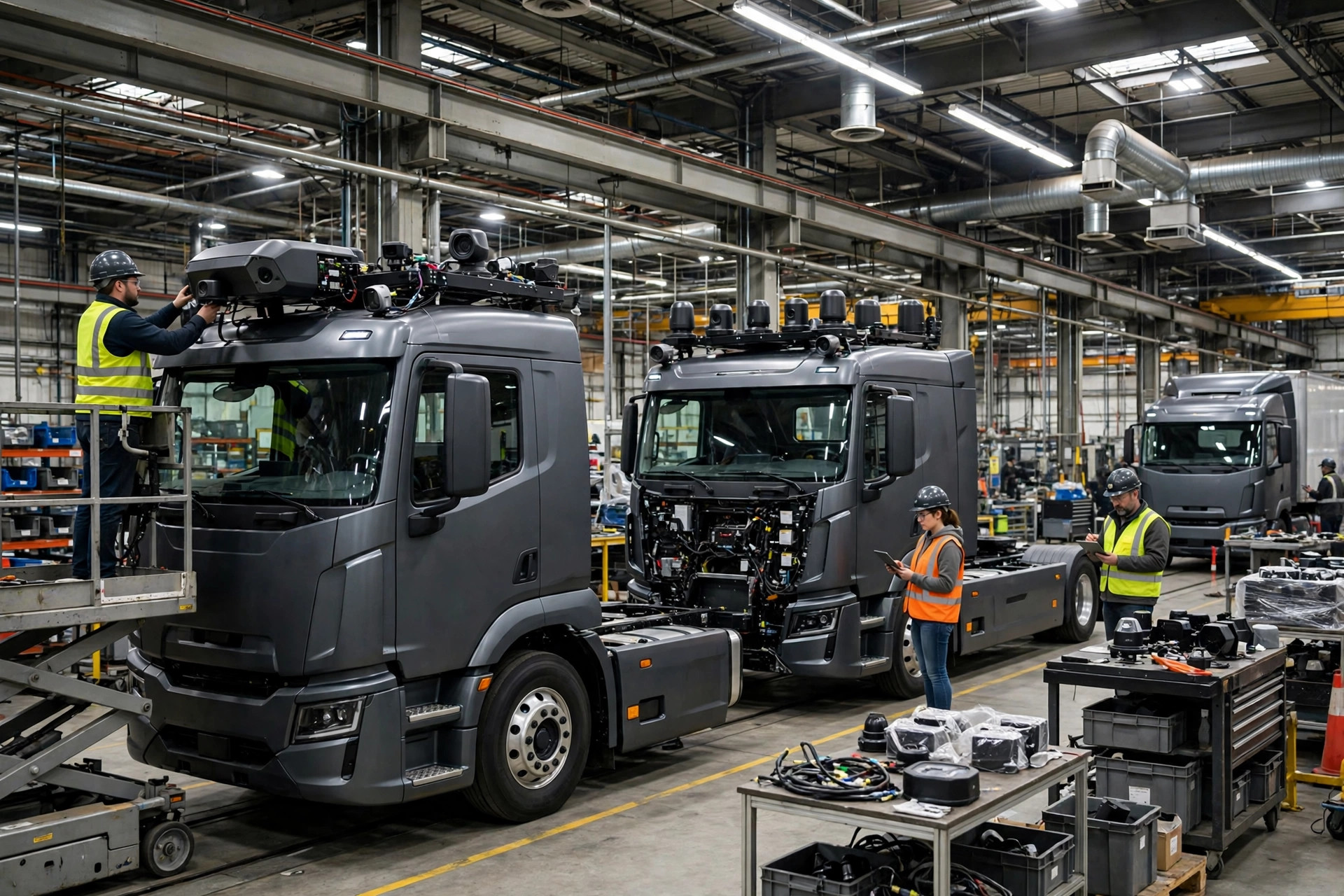
Image: Illustration: AI-generated by CDLWire
Aurora Innovation has cut its 2026 revenue forecast to about $9 million, down from $14 million to $16 million, after a six-week manufacturing delay at the plant upfitting its driverless trucks — but the company insists it will still put more than 1,000 trucks on the road by the end of 2027, according to FreightWaves on Oct. 30, reporting the company's third-quarter results and earnings call on Wednesday.
The delay sits with Roush, which upfits Aurora's trucks in Livonia, Michigan. Over the past month, output was held back by material shortages, component quality problems and issues found in end-of-line testing, CEO Chris Urmson said on the call. Some complex components arrived late or below Aurora's quality bar; Aurora moved some parts, including wire harnesses, to what it called a more capable production supplier, a change it said was cost-neutral in most cases or could save money once reduced rework is counted. Aurora Driver kits from supplier Fabrinet are running ahead of truck builds, and Roush is adding a second shift.
The ramp dates have moved, not the destination. Aurora now expects Roush to reach 20 trucks a week in early December, and to be delivering 200 trucks by the end of February. “Instead of producing 20 trucks a week in October, we're going to do that in December, it really has no impact on our ability to go and scale and deliver a thousand trucks next year,” Urmson told Bloomberg. “We still expect to get 200 trucks out of this in February, and we see this still enabling the 1,000+ trucks we expect on the road by the end of next year.”
The financials show a company spending to build a fleet before the fleet earns. Third-quarter revenue rose to $3 million from $1 million a year earlier, but the operating loss widened to $257 million from $222 million, including $54 million in stock-based compensation. The net loss was $234 million, compared with $201 million a year earlier. Aurora used about $170 million in operating cash during the quarter and spent $36 million on capital expenditures, which it said was within its quarterly average target. It ended September with just over $1 billion in cash and short-term investments, down from nearly $1.2 billion at the end of June, after selling 6 million shares for $41 million in net proceeds and using $23 million of that to cover taxes on vesting employee stock. Executives said the spending increase is mostly hardware kits, components and truck builds, and that Aurora should reach positive cash flow in 2028.
The customer structure behind the ramp is worth separating from the headline number. Aurora's announced memoranda of understanding now cover 1,000 trucks — 500 with Charger Logistics and 500 with Hirschbach Motor Lines from April — but both are nonbinding; executives said pricing and volumes are agreed and the remaining terms are operational, such as who services the trucks and how they are disposed of, and that they fully expect the MOUs to convert. The initial 200 trucks, by contrast, are fully contracted, and Aurora says it has 10 driverless customers. Roush is only the first production step: Volvo Autonomous Solutions plans to launch driverless trucks with the Aurora Driver in the first quarter of 2027 and deploy more than 300 that year, with full production also being prepared with PACCAR, and AUMOVIO starting production of the third-generation hardware kit in the second half of 2027.
Operationally, the shareholder letter described trucks that are getting better at acting like trucks. Autonomous trucks have relied on voluntary enhanced pre-trip inspections to bypass weigh stations; Aurora says its system can now determine whether a station is open, pull into an available scale lane and handle different scale layouts. In November, Aurora trucks will begin running directly to sites for several driverless customers, navigating security checkpoints on their own. The letter also noted the five-year FMCSA exemption granted Oct. 7 letting Level 4 autonomous trucks use cab-mounted amber beacons instead of reflective triangles — an exemption other Level 4 carriers can use after notifying the agency.
For working drivers, the honest read is in the dates, not the slogans. The near-term fleet is 200 contracted trucks by the end of February, built at a rate that only reaches 20 a week in December — real, but small against a national fleet, and arriving first on the lanes Aurora already runs. The 1,000-truck figure for the end of 2027 now depends on a later start, a second shift, a new wire-harness supplier and two nonbinding MOUs converting to contracts. December's 20-truck week at Roush is the next verifiable checkpoint: if it slips again, the 2027 target slips with it; if it holds, driverless capacity on Aurora's corridors stops being a pilot and starts being a schedule.
Sources
Related coverage
 October 29, 2026 · AutonomyCharger Logistics signs on for up to 500 Aurora driverless trucks — a nonbinding MOU bigger than its entire U.S. fleet today
 October 28, 2026 · AutonomyA California produce carrier just signed to run 75 driverless trucks it owns itself — a first for interstate trucking
 October 27, 2026 · Autonomy'I didn't realize our laws are so lacking': New Mexico lawmakers hear that autonomous trucks can test with five days' notice and no permit
Comments
Loading comments…