Georgia opens its $134 million Gainesville Inland Port — built to move 26,000 containers a year off Atlanta highways and onto rail
The terminal, opened Oct. 29 by Gov. Brian Kemp and the Georgia Ports Authority, handles up to 200,000 containers a year with truck access from I-85 and I-985. Shippers can choose rail for heavier, cheaper moves or truck-only for speed — GPA expects 26,000 containers to shift to rail in year one.
Summarized from CDLLife.
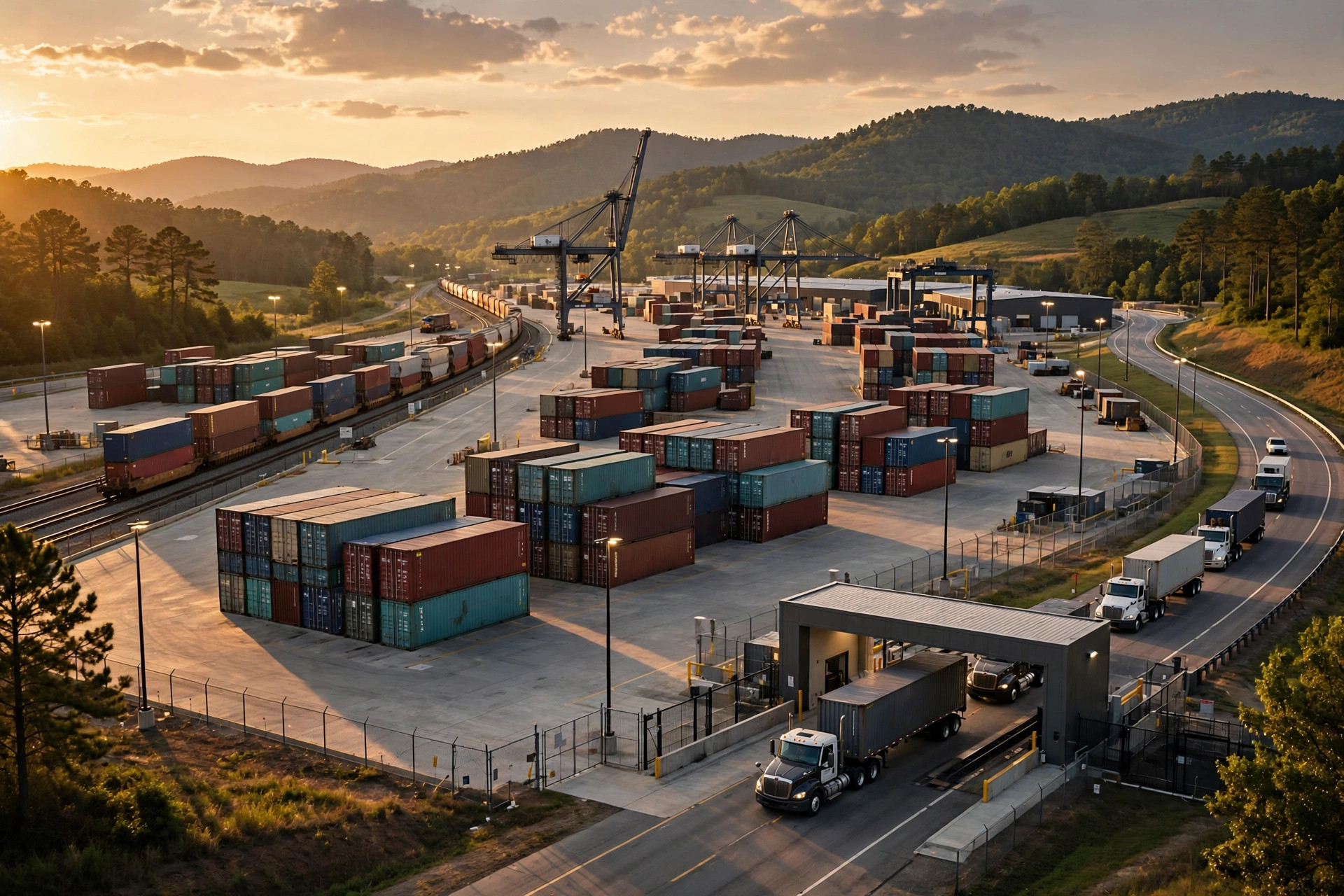
Image: Illustration: AI-generated by CDLWire
Georgia has opened a $134 million inland port in Gainesville designed to pull containers off the Atlanta highways and onto rail — a 200,000-container-a-year terminal that state officials expect to shift 26,000 containers to rail in its first year alone, according to CDLLife on Oct. 30.
Governor Brian Kemp and the Georgia Ports Authority officially opened the Gainesville Inland Port on Oct. 29 at a ceremony at the site in northeastern Georgia. The facility is accessible to trucks from Interstates 85 and 985, which matters for how the freight actually moves: an inland port does not eliminate trucks, it shortens them. Containers that once rode a truck the full distance between the Port of Savannah and Northeast Georgia's manufacturers and warehouses can now ride rail for the long leg and trucks for the shorter regional pickup and delivery legs at each end.
“Georgia's ports are a major reason companies choose to invest and create jobs here, and the Gainesville Inland Port brings that advantage directly to Northeast Georgia,” said Gov. Kemp. “Connecting this region to the Port of Savannah with new supply chain options makes it easier for Georgia businesses to reach customers around the world and helps ease congestion on our highways.”
The Georgia Ports Authority was specific about the mechanism and the first-year expectation. “Customers can now choose rail for greater affordability and for heavier loads, or truck-only for faster transit,” the authority said. “The Georgia Ports Authority expects to shift 26,000 containers to rail in the terminal's first year of operation, improving emissions and reducing trucks on Atlanta and Georgia highways.” That 26,000 figure is about 13% of the terminal's stated 200,000-container annual capacity — a first-year ramp target, not a ceiling, which tells you the authority expects the rail shift to grow as shippers re-route freight through the new terminal.
“GPA's new inland terminal is another important investment in Georgia's statewide logistics network,” said Georgia Ports Chairman Alec Poitevint, thanking the governor, the General Assembly and the Georgia Department of Transportation. Georgia Ports President Kevin Price added that the authority is “working with customers and the logistics community to create more business opportunities for them,” and praised the City of Gainesville and Hall County leadership.
For drivers, the honest analysis is a change in the shape of the work, not its disappearance. Every container that shifts to rail for the Savannah–Gainesville leg still needs a truck at the Gainesville end — and drayage and regional work around a new 200,000-container terminal is steadier, more predictable freight than chasing long-haul port loads through Atlanta congestion. The loads most exposed are the long one-way truck hauls between the coast and Northeast Georgia that the rail service is priced to undercut, especially for heavier boxes where the authority is explicitly pitching rail on affordability. The loads least exposed are the time-sensitive ones: the authority itself keeps truck-only in the menu for faster transit.
The practical takeaway: if you run Georgia port freight, watch how your customers route through Gainesville over the next two quarters. The first-year rail target is 26,000 containers; if the terminal beats it, expect more short regional drayage postings around Hall County and fewer long Savannah turns, and position for the work that grows around the terminal — gate queues, chassis moves and warehouse shuttles on the I-85 and I-985 corridors — rather than the through-hauls the state is deliberately designing out of the Atlanta highway system.
Sources
Related coverage
 October 30, 2026 · InfrastructureLong Beach set its own container record in September — and rail, not the gate, is where San Pedro Bay backed up
 October 14, 2026 · InfrastructureUSDOT awards $200 million for 14 truck parking projects in 12 states
 October 14, 2026 · InfrastructureNew York City puts $5 million behind off-hour truck deliveries
Comments
Loading comments…