Cabotage enforcement is 'really ramping up,' Knight-Swift's CEO warns — as Nuevo León halves the Colombia Bridge truck toll
Adam Miller told FreightWaves at the WEX OTR Summit that drivers have had visas taken away over alleged cabotage violations committed for previous carriers, and that cross-border capacity will get tighter. In the same weekly roundup: Nuevo León cut its state toll for trucks heading to the Colombia-Solidarity Bridge by 50%, and Walmart plans a $400 million distribution center near San Antonio creating at least 425 jobs.
Summarized from FreightWaves.
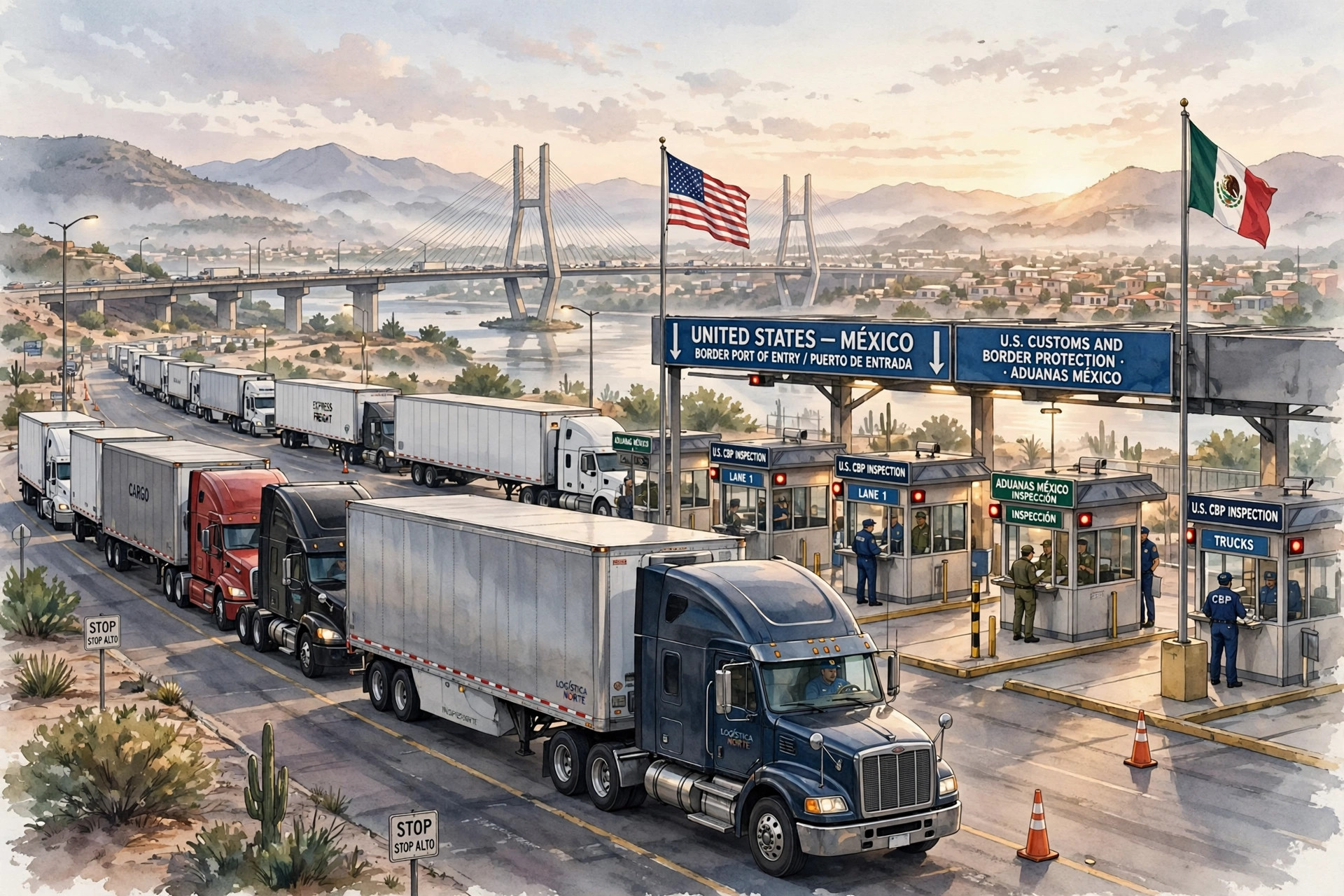
Image: Illustration: AI-generated by CDLWire
Enforcement of U.S. cabotage restrictions on Mexican drivers is ramping up — and it is now reaching back to violations drivers allegedly committed for previous employers, Knight-Swift Transportation Chief Executive Adam Miller told FreightWaves in an interview on Tuesday at the second annual WEX OTR Summit in Jacksonville, Florida, according to FreightWaves on Nov. 1, in its weekly Borderlands Mexico roundup.
“We're seeing the enforcement really ramp up on cabotage,” Miller said. Cabotage generally refers to domestic transportation between two points within a country by a foreign carrier, an activity subject to restrictions under U.S. law. Miller said U.S. authorities have intensified scrutiny of Mexican drivers operating across the border, including reviewing potential cabotage violations involving their previous employers. Knight-Swift, which operates in Mexico through its TransMex subsidiary, has observed cases in which drivers faced visa revocations over alleged violations committed while working for other carriers. “I've seen them take visas away from drivers from really a previous carrier, not even cabotage with our trucks, with our company,” Miller said. The word that matters in that sentence is “alleged”: on Miller's account, the revocations he has seen rest on potential violations under review, attributed to an earlier employer — not on violations committed for the carrier the driver works for now.
The scale behind the warning is the largest truckload operation in the country. Knight-Swift runs a fleet of more than 26,000 tractors, 96,000 trailers and 28,000 employees, and its Nogales, Mexico-based TransMex subsidiary operates over 1,100 tractor-trailers and more than 3,000 trailers. Miller said Knight-Swift maintains strict compliance policies governing its cross-border operations, but the increased scrutiny could discourage some Mexican drivers from entering the United States at all. “I do feel like that type of capacity is going to get a little bit tighter as enforcement ramps up,” he said. He remains optimistic about the long term — “I think long term I think Mexico is going to play a bigger role. I think you'll see more opportunities because of the nearshoring” — but he cautioned that uncertainty around tariffs and trade policy could affect freight volumes and investment decisions. “Tariffs are a big unknown,” Miller said, adding that customer strategies are changing as the tariff situation develops. Knight-Swift transports significant automotive freight across the border.
The same roundup carried a cost change on the Texas border that cross-border carriers can price today. The Mexican state of Nuevo León has announced a 50% reduction in state-imposed toll charges for commercial trucks traveling to the Colombia-Solidarity International Bridge, a move aimed at lowering transportation costs and boosting exports to the United States. The reduction applies to an additional state toll collected about 500 meters before the existing bridge tollbooth on the Mexican side of the border — a fee introduced on April 14, 2025, under the administration of Nuevo León Governor Samuel García. The discount does not affect tolls collected by the city of Laredo, Texas. The initiative is designed to make the Colombia crossing more competitive for freight shipments and to encourage logistics companies to route additional commercial traffic through that port of entry. “By working together to reduce tolls and fees, we can help lower transportation costs, support businesses, and strengthen the movement of goods through our region,” Treviño said, according to the Laredo Morning Times. The Colombia-Solidarity bridge connects Nuevo León with the Laredo area and serves as an alternative route for cross-border truck shipments between Mexico and the United States.
And the roundup's third item is future freight, dated and sized. Walmart is planning a $400 million distribution center in Cibolo, Texas, northeast of San Antonio, according to the San Antonio Express-News. The proposed facility, identified as “Project Theo,” would include a 712,500-square-foot warehouse and a connected 31,933-square-foot office building on approximately 126 acres at 3641 S. Santa Clara Road, according to a filing with the Texas Department of Licensing and Regulation. Construction is scheduled to begin in February 2027, with completion expected in August 2029. The project is expected to create at least 425 full-time jobs paying above the San Antonio metropolitan area's median salary. Cibolo officials previously approved an incentive package valued at approximately $32.5 million to attract the development, including a 75% property tax abatement for 10 years. City officials have described the proposed facility as a next-generation distribution center that will use robotics and advanced warehouse equipment. The development would expand Walmart's distribution footprint along the Interstate 35 and Interstate 10 corridors, the major freight arteries connecting San Antonio, Austin and other Texas markets.
The practical takeaway splits by lane. If you run cross-border, Miller's account changes what a clean record has to cover: a driver's cabotage history now apparently follows the driver across employers, so a carrier's compliance file on a Mexican driver needs to reach back to previous carriers, not just to the driver's time on its own trucks — and a visa revocation can arrive over an alleged violation the current carrier never dispatched. If you route through Laredo, re-run the Colombia Bridge math: the state toll on the Mexican side just halved, the Laredo-side tolls did not change, and the crossing is being priced to pull traffic. And the Walmart center is a 2029 freight fact, not a 2026 one — useful for where San Antonio capacity will be needed, useless for this quarter's lanes.
Sources
Related coverage
 October 31, 2026 · BorderOhio will downgrade all 5,000 reviewed non-domiciled CDLs — 2,000 already done — as Louisiana and Wyoming confirm they will never resume issuing
 October 28, 2026 · BorderMexico truckers reach a deal for talks after the strike disrupted 19 states — but no one has confirmed the protests are over
 October 26, 2026 · BorderMexico's stoppage starts split: most groups took the government's table, CANACAR holds — and the state counts are uneven
Comments
Loading comments…