Truck parking is named in a $1 billion federal safety package — but only four grants mention it, none promises a new space, and they total about $21.6 million
The U.S. Department of Transportation says 10 of the 297 Safe Streets and Roads for All projects it announced Thursday will help address the truck parking shortage. The Trucker's review of the full awards list found only four projects that specifically reference truck parking — in Pecos and Reeves County, Texas, Fort Collins, Colorado, and Miami Township, Ohio — and every one of them is corridor work, a study, or a plan.
Summarized from The Trucker.
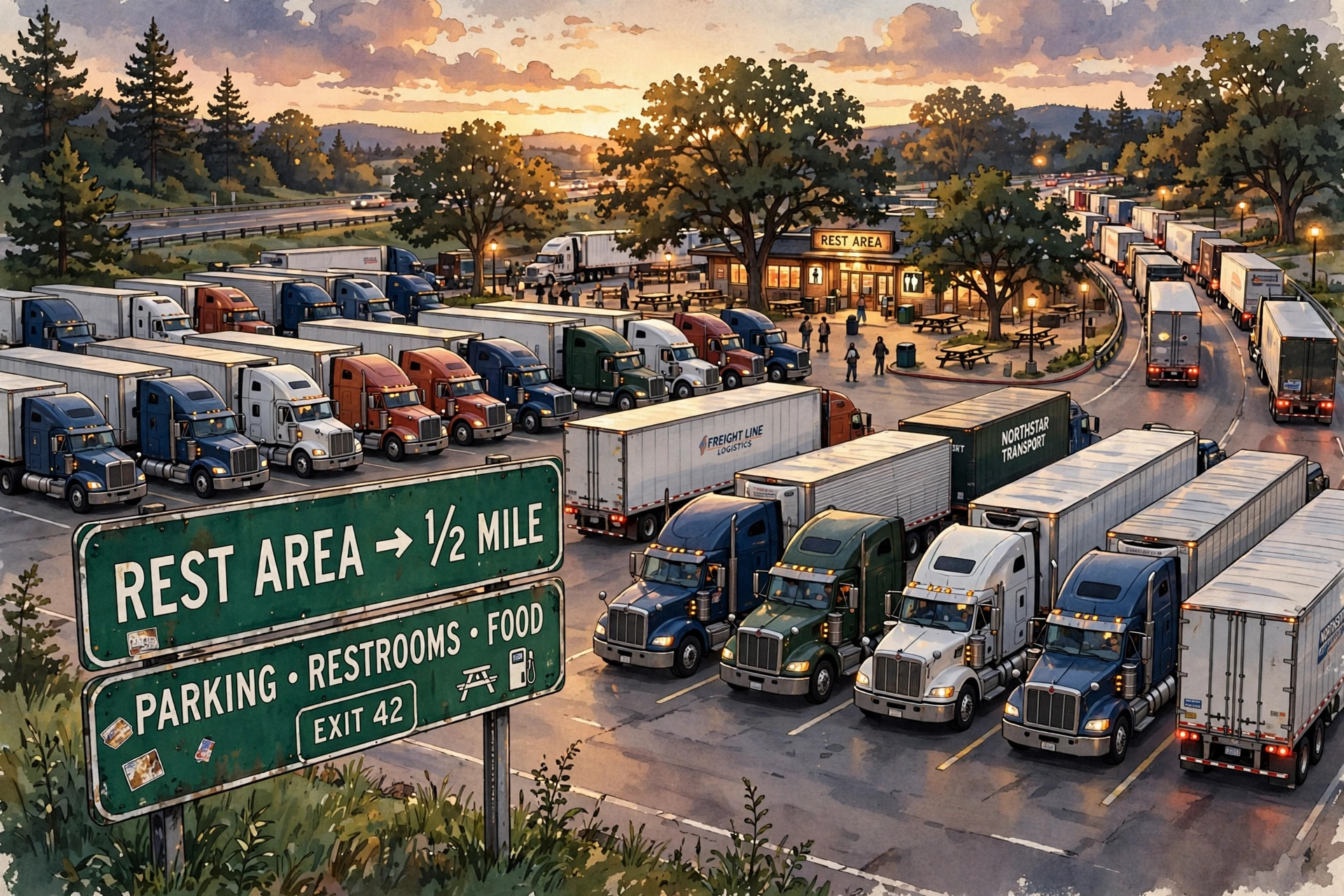
Image: Illustration: AI-generated by CDLWire
The nationwide shortage of safe truck parking is among the problems targeted by more than $1 billion in federal roadway safety grants the U.S. Department of Transportation announced on Thursday, Oct. 29 — but how much of that money will ever become a place to park a truck is, on the department’s own published descriptions, an open question, according to The Trucker on Nov. 1. The awards come through the Safe Streets and Roads for All program, known as SS4A, and the gap between the headline and the project list is the story.
Secretary of Transportation Sean Duffy framed the package in driver terms. “This historic investment doubles down on our progress by equipping communities with the infrastructure and programs necessary to continue saving lives,” Duffy said. “We’re also making major investments in the truckers’ quality of life by reversing the nation’s severe parking shortage.” According to the department, 10 of the 297 projects selected for funding will help address that shortage. But a review of the complete awards list identified only four projects that specifically reference truck parking, with combined federal grants totaling approximately $21.6 million — 2.1% of the overall funding package. And that $21.6 million figure is itself generous: it represents the total awards for those four projects, which include other roadway safety improvements, not funding dedicated exclusively to truck parking.
The four identifiable projects show what kind of help this round actually buys. The largest is a $12 million award to Pecos, Texas, for freight corridor safety improvements along U.S. Highway 285 and Interstate 20 frontage roads — access management, upgraded lighting, speed monitoring and a roundabout — whose description says the improvements are intended in part to reduce unauthorized truck parking on those heavily traveled corridors. That is a project about managing the symptoms of trucks stopping where they should not, in the heart of Permian Basin freight country; it is not a parking lot. The second Texas award, $4.1 million to Reeves County, is a planning and demonstration grant: freight corridor and truck parking safety studies, roadway safety audits and an updated safety action plan. In Fort Collins, Colorado, approximately $5.2 million will fund safety improvements on a 2.5-mile segment of Shields Street, strengthen post-crash care, and pay for a truck parking study aimed at the Interstate 25 parking shortage, with the goal of reducing unsafe roadside stopping. And Miami Township, Ohio, will receive $240,000 to develop a comprehensive roadway safety action plan that includes an analysis of truck parking needs. A study, a study, a plan, and a corridor project: none of the four descriptions specifically identifies additional truck parking spaces to be constructed, and the remaining six of the department’s 10 parking-related projects could not be clearly identified from the published descriptions at all.
The structure of the package explains much of that softness. Of the $1.01 billion, approximately $683.7 million goes to 100 implementation grants, while $329.3 million goes to 197 planning and demonstration grants. Planning money is how a project starts, not how it ends. Beyond parking, the awards lean heavily toward what happens after a crash: 95 projects, representing more than $335 million, focus primarily on post-crash care and trauma support, including expanded emergency medical response and equipment and training for prehospital blood transfusions. The department also reports that 52% of the awards will benefit rural communities, with more than $425 million directed toward rural and Tribal areas. Truck parking is a named priority inside a broad roadway-safety program — it is not the program’s purpose.
The contrast worth holding onto is with the department’s other parking announcement of the month. On Oct. 14, USDOT invested $200 million through the Nationally Significant Multimodal Freight and Highway Projects program, known as INFRA, supporting 14 truck parking expansion projects across 12 states, including new parking facilities and expansions at existing locations — and unlike the SS4A awards, several of those INFRA projects specify the number of additional truck parking spaces planned. The two announcements come from separate federal programs with different objectives: INFRA targets freight infrastructure directly, while SS4A funds roadway safety in the round. Read together, they say the administration’s parking build-out, such as it is, runs through the freight program — and that the safety program’s contribution, at least in this round, is mostly to study the shortage and manage its edges.
For a driver, the working translation is simple. Do not count any new places to shut down from this $1 billion headline: on the published descriptions, the number of new truck parking spaces the SS4A round establishes is zero, and the four parking-related projects a reviewer can actually find are two studies, a planning document and a Texas corridor rebuild that counts reducing unauthorized parking among its goals. The studies are not worthless — Reeves County, Fort Collins and Miami Township now have federal money to document needs that future construction grants, including future INFRA rounds, will ask them to prove — but a documented shortage is not a space, and the timeline from a planning grant to a paved lot with lighting is measured in years. In the meantime the shortage the secretary calls severe stays exactly where Saturday night found it: on the ramps, the frontage roads and the shoulders, which is where drivers will keep having to manage it themselves.
Sources
Related coverage
 November 1, 2026 · InfrastructureThe Los Angeles–Long Beach watchmen strike is off for today — talks now run to 5 p.m. Wednesday, Nov. 4, and the gate risk is still live
 October 31, 2026 · InfrastructureGeorgia opens its $134 million Gainesville Inland Port — built to move 26,000 containers a year off Atlanta highways and onto rail
 October 30, 2026 · InfrastructureLong Beach set its own container record in September — and rail, not the gate, is where San Pedro Bay backed up
Comments
Loading comments…