A U.S. 160 bridge over the Piedra River has failed, Pagosa Springs is largely cut off, and CDOT says a workable replacement is a week or two away
The San Juan River is receding after rising to nearly 17 feet, the highest since 1911 — but the Colorado Department of Transportation is calling the damaged U.S. 160 bridge over the Piedra River a "bridge failure," U.S. 160 is closed on either side of Pagosa Springs, and the town's one reopening, the First Street Bridge, does not restore the through route.
Summarized from Colorado Public Radio.
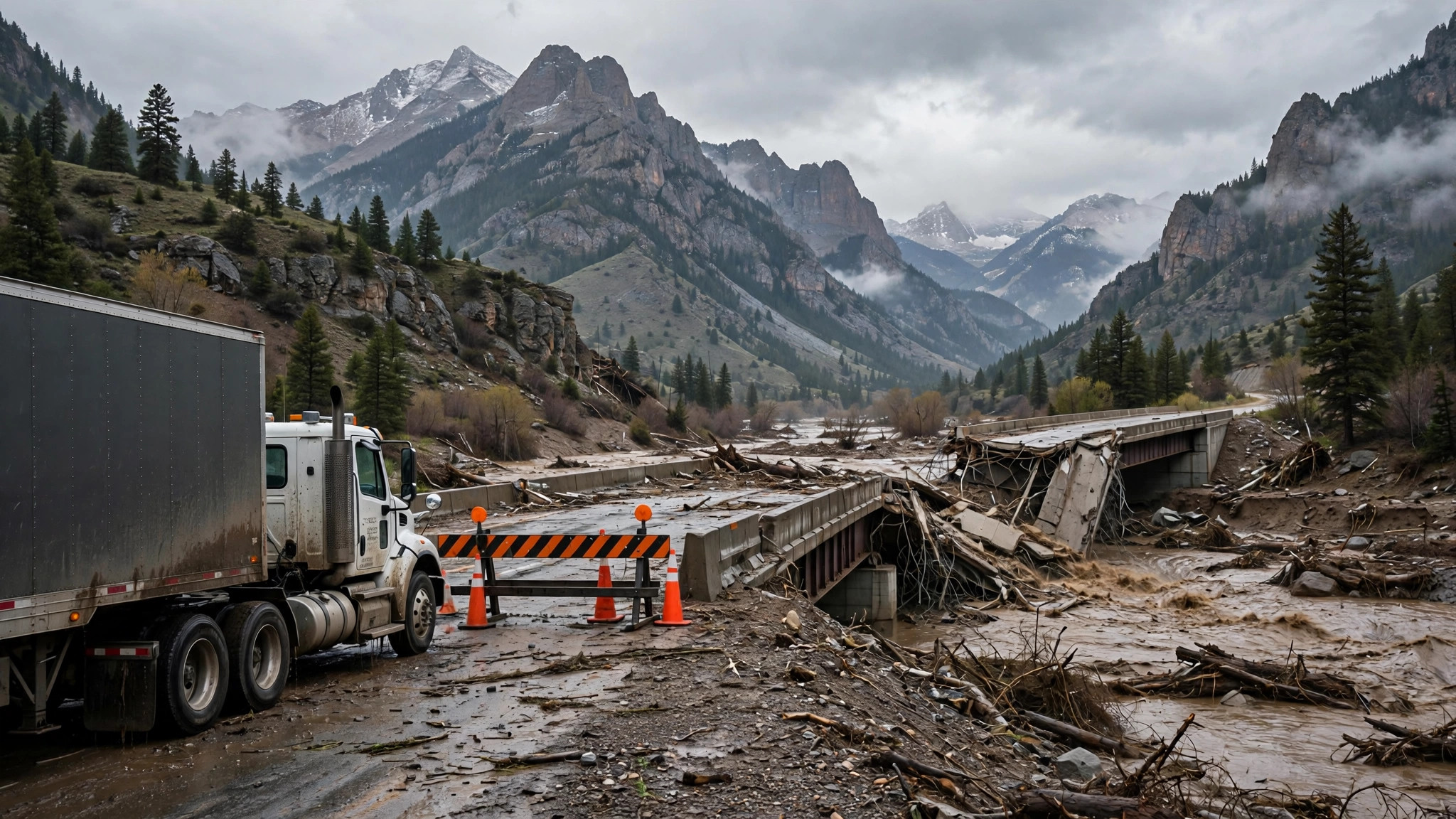
Image: Illustration: AI-generated by CDLWire
The flooding story in southern Colorado has a new, harder fact at its center: a bridge is gone. Floodwaters so badly damaged the U.S. 160 bridge over the Piedra River, west of Pagosa Springs, that the Colorado Department of Transportation is calling it a “bridge failure,” and the department will not have a workable replacement for a week or two, according to Colorado Public Radio on Nov. 2. Pagosa Springs is largely cut off from the rest of the state, with only one rural highway leading out of town toward New Mexico.
That is the material change from Monday’s edition and its evening update. The San Juan River’s crest is now known — it rose to nearly 17 feet, the highest since 1911, on preliminary gauge readings of 16.81 feet Sunday night — and the rivers are receding. What replaces the crest as the live fact is the damage inventory. In downtown Pagosa Springs, floodwaters washed away the ground under the Pagosa Springs Museum and forced the closure of a bridge, and U.S. 160 is closed on either side of town.
The one official reopening is real, and it is local. The Town of Pagosa Springs, in its Monday, Nov. 2 update at 6:35 p.m. MST, said U.S. 160 at the San Juan River — the First Street Bridge — and 14th Street reopened late Monday afternoon, with motorists told to use caution and follow posted traffic restrictions. The town’s earlier Monday update had that same bridge closed by CDOT over significant riverbank erosion near the museum, downtown evacuations still in effect, and cellular service down throughout town. Read together, the two reports describe a town that can cross its own river again while the highway remains broken in both directions outside it.
CDOT’s Lisa Schwantes, a public information officer for the department, explained to Colorado Public Radio what is at stake on these roads, and it is freight first: “This is how we get our freight, our supplies, our medical needs. It’s how we get our tourists and visitors that visit the area — that is a huge economy for us,” she said, adding that the roads are also vital for moving hay and livestock to the agricultural communities across this part of the state. That is the practical meaning of the Piedra River failure for a driver: the detour problem is not a slow zone on one highway, it is the supply line for a town and a farm region, severed west of Pagosa Springs by the failure reported in the Nov. 2 coverage.
The work list is regional, not local. Road crews are working to clear U.S. 160, as well as U.S. 550 outside of Hermosa, U.S. 285 north of Monte Vista, Colorado State Highway 112 north of Del Norte, State Highway 17 west of Antonito and State Highway 151 south of Chimney Rock — the same highway the evening update reported collapsed between Chimney Rock and an old mine site. “We’re trying to get them open as quickly as possible, even if it’s to one lane of alternating traffic, so that we can keep travelers and our residents moving through our region,” Schwantes said. Wolf Creek Ski Area, which opened on Halloween, has temporarily shut down because of the impassable roads.
Farther west, the Animas River hit Durango hard, with water running at nearly 13,000 cubic feet per second — about 50 times the typical flow. The Red Cross has opened three evacuation shelters across the region. This round of flooding arrived just over a week after the previous one, and on Saturday Gov. Polis requested federal disaster funds for those earlier floods. In Pagosa Springs, the emergency is also administrative: the town says Town Hall, Municipal Court, the Community Center, the Visitor Center and the Maintenance Building Offices are all closed to the public for regular business on Tuesday, Nov. 3, all Municipal Court proceedings scheduled for Nov. 3 are canceled, and communications disruptions mean internet service and virtual participation in Tuesday’s 5 p.m. meetings cannot be guaranteed.
The weather, at least, has turned. The National Weather Service forecasts that rain will mostly stop throughout the region; a quick-moving storm could blow through the high elevations on Wednesday bringing snow and light rain, but meteorologist Gillian Harrison explained that it should not lead to any additional flooding, and the rivers of concern in southwest Colorado are decreasing gradually over the next few days. The Durango and Silverton Narrow Gauge Railroad, whose tracks from Durango to Hermosa were damaged Sunday, said service should resume as normal once winter trains start later this month.
For drivers, the takeaway is unchanged in kind and longer in duration. Do not plan a through move on U.S. 160 across southern Colorado this week: the Piedra River crossing has no workable replacement for a week or two on CDOT’s own estimate, the parallel state highways are still being cleared toward possible one-lane alternating traffic, and the one reopening so far — the First Street Bridge inside Pagosa Springs — serves the town, not through freight. Check COtrip before dispatch, expect the New Mexico-side rural route to carry traffic it was not built for, and treat any “open” segment in the San Juans as a local opening until CDOT says the corridor itself is back.
Sources
Related coverage
 November 2, 2026 · Weather and roadsU.S. 160 is closed from Wolf Creek Pass through South Fork and in Pagosa Springs as the San Juan River heads for a forecast 22-foot crest — above the 1911 record
 November 1, 2026 · Weather and roadsFlash flooding closes Arizona highways and forces evacuations — I-17 is back open, four state routes are still shut, and Pagosa Springs braces for a record San Juan River crest
 November 1, 2026 · Weather and roadsWinter storm warnings for Colorado's San Juan passes: up to 18 inches and 50 mph gusts on U.S. 160 and U.S. 550 through Monday
Comments
Loading comments…