October truckload linehaul rates rose 9.9% from a year ago — and shipments grew for a third straight month
Cass Information Systems put October's truckload linehaul index up 0.9% from September and 9.9% year over year — the 22nd straight annual increase — with shipments up 5.9% from a year ago after 42 months of declines and total freight spend up 26.5%, its fastest growth since July 2022.
Summarized from FreightWaves.
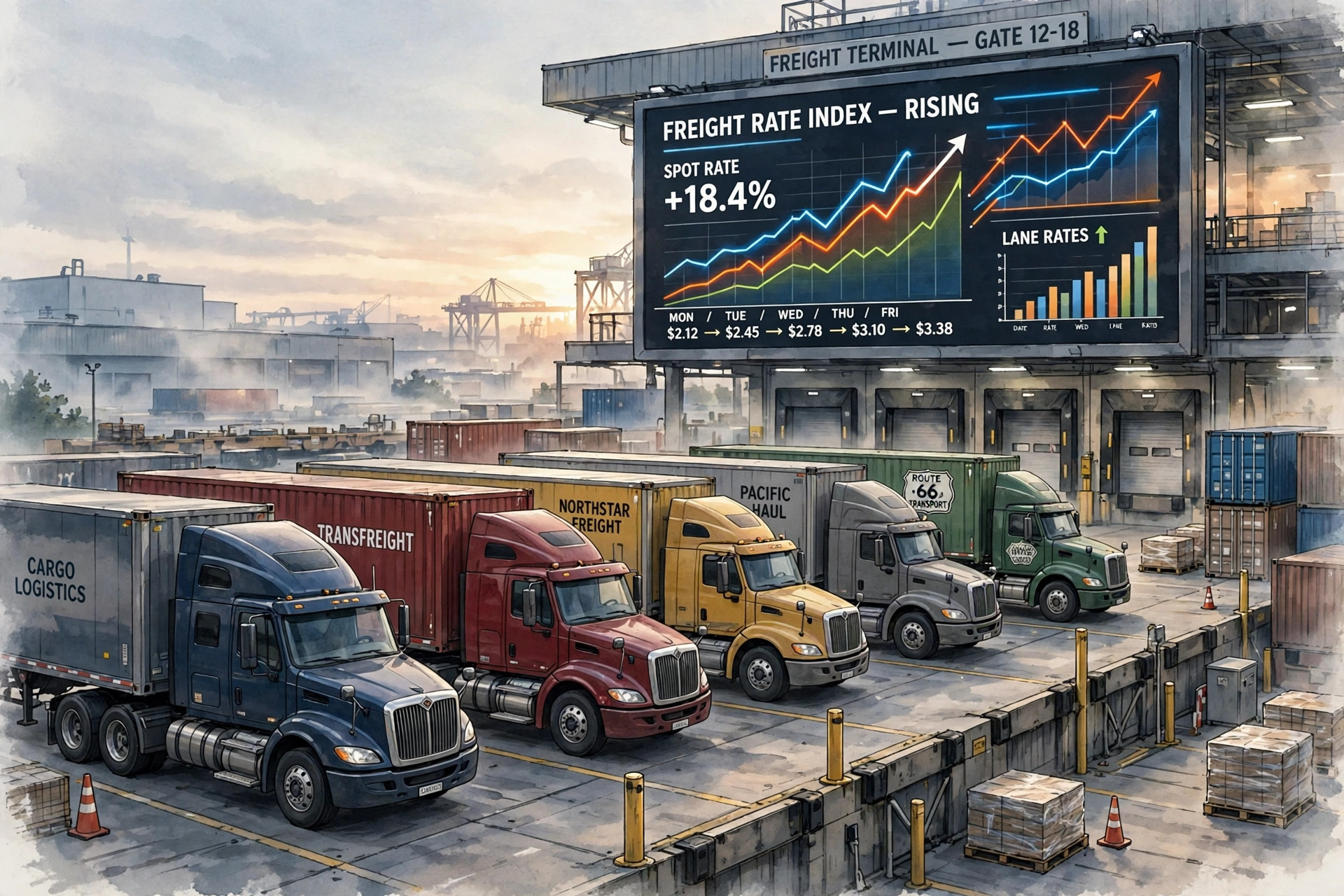
Image: Illustration: AI-generated by CDLWire
Truckload rates were up big again in October, with shipment counts extending a positive streak to three months, according to FreightWaves on Nov. 16 — a Monday report from Cass Information Systems that reads less like a seasonal blip and more like a market whose contract base has reset higher.
Cass' truckload linehaul index, which tracks rates excluding fuel and accessorial surcharges, increased 0.9% from September and 9.9% year over year. The index is historically heavily weighted to for-hire contract rates but also includes spot market rates, which makes it the closest monthly read on what most freight actually pays, as opposed to what the spot fringe prints load by load. October marked the 22nd straight year-over-year increase in the index, and the dataset was 13.2% higher on a two-year-stacked comparison — a measure Cass uses to smooth the noise in prior-year comparisons and show the momentum of change.
The volume side moved with it, more modestly. Freight shipments captured by Cass increased 5.9% year over year in October, a third straight year-over-year increase after 42 months of declines. Shipments slipped 0.6% from September but increased 1.7% when seasonally adjusted, and October marked the smallest decline on a two-year-stacked comparison in three years, at 2.3% lower. Cass' shipments index is forecast to increase 3% year over year in November if typical seasonal patterns hold. All domestic transportation modes are included in the index, with truckload and less-than-truckload shipments representing the bulk of the dataset, and the data itself comes from freight bills paid by Cass, which processes $37 billion in freight payables annually on behalf of customers.
Spend rose much faster than either rates or volume alone, because both were rising on top of fuel. Cass' expenditures index, which measures total freight spend including fuel, jumped 26.5% year over year, up 1.0% from September and 2.9% seasonally adjusted. That was the highest growth rate for the index since July 2022, the tail end of the boom cycle, and Cass forecasts the expenditures index to increase by 24% year over year in November. Higher transportation rates and fuel surcharges, along with the increase in shipment counts, are driving the surge in freight spend, the report said — retail diesel prices were 70% higher year over year in October, so a shipper moving the same freight as last fall paid more for the linehaul and far more again for the fuel burned moving it.
On demand, the report credited modest growth in retail and the industrial economy, along with IEEPA tariff refunds, with supporting freight — and then hedged it in the same breath. Demand "will be limited by elevated inflation and rising interest rates squeezing consumers and businesses," Cass said, and it noted that tariff refunds will only have a temporary impact. The broader read was still forward: "We continue to see the freight demand cycle gaining steam, and with record container imports and intermodal volumes, and growing LTL tonnage, the improvement has broadened out some in recent months," the report said.
Who is collecting the increase is uneven, and Cass' framing matches what third-quarter carrier results showed. Cost pressures were evident in third-quarter truckload results, but one-way fleets are logging large contractual rate gains after a multiyear downturn, and FreightWaves reports the outsized gains are allowing those fleets to repair margins quickly, while fleets under dedicated arrangements have been slower to offset cost inflation. Knight-Swift Transportation, which has 70% of its truckload fleet operating under non-dedicated agreements, is now targeting "at least double-digit increases" in the new bid season that began earlier this month. The carrier placed more units under non-contractual arrangements early in the year to take advantage of a crackdown on noncompliant capacity more quickly, said on its third-quarter call that its internal tender rejections were running two to three times higher than the industry average, and said the rates it was receiving on transactional business were also above market.
For drivers and small carriers, the practical read is about where the money is settling. A contract-weighted index up 9.9% year over year, in its 22nd straight month of annual gains, says the recovery is no longer only a spot-market story told by urgent holiday loads — the base rates under contracted freight have moved, and at least one of the largest fleets is bidding for double-digit increases on top of them. The caution is in Cass' own numbers: shipments are up 5.9% from a depressed base and still lower on a two-year comparison, demand support from tariff refunds is temporary by Cass' own account, and a 26.5% jump in shipper spend built partly on diesel running 70% above last year can unwind from the fuel side faster than from the rate side. Bid season is where this index becomes a paycheck: the fleets repairing margins on one-way freight are the ones with something to share, and the dedicated fleets still chasing cost inflation are not there yet.
Sources
Related coverage
 November 15, 2026 · Fuel & ratesSpot rates jump to their highest since July — and fuel is not the reason
 November 13, 2026 · Fuel & ratesAnalysts' third-quarter verdict: a supply-driven recovery, with about 70,000 drivers taken out of a pool of a million and a half
 November 11, 2026 · Fuel & ratesVan spot rate hits $3.05 a mile in October, highest since early 2022
Comments
Loading comments…