Spot rates jump to their highest since July — and fuel is not the reason
FreightWaves' National Truckload Index rose more than 4% since late October while diesel fell roughly 3.5%, a rare early holiday climb the analysis ties to last-minute retailer inventory, with the October Logistics Managers' Index inventory reading at 66.9, its highest since 2022.
Summarized from FreightWaves.
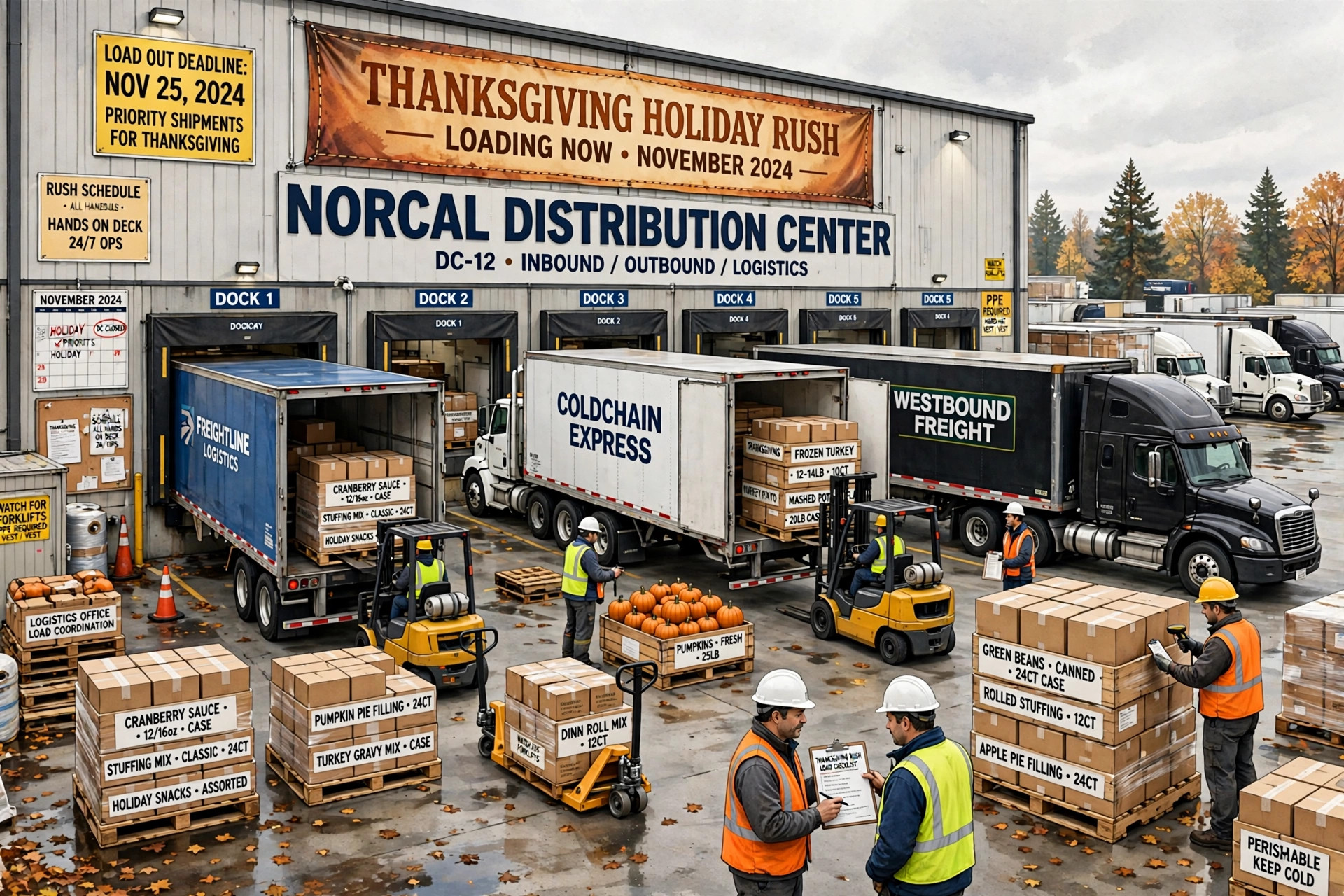
Image: Illustration: AI-generated by CDLWire
The National Truckload Index, which measures dry van spot rate movement across the United States, jumped to its highest level since July in early November, according to FreightWaves on Nov. 15 — an early climb that FreightWaves notes the index rarely makes ahead of the holidays, and one that is not being driven by fuel.
That last point is the heart of the FreightWaves Chart of the Week analysis. The index includes fuel, yet diesel costs have fallen roughly 3.5% since late October while the index has risen more than 4% over the same period. Fuel does influence rates with a lag, FreightWaves notes, but diesel has not seen a sharp increase since early September, which is well beyond the typical lag of a few weeks. Carriers cannot always pass along fuel costs unless the market will bear it, and FreightWaves concludes that this latest jump appears to be driven by market conditions rather than by the pump.
The picture is nuanced because there has been no corresponding rise in tender rejection rates. National dry van rejection rates have been trending lower since July, though they remain elevated, and FreightWaves notes that rejection rates above 10% are still a sign of insufficient capacity. Rejection rates and spot rates do not move in a one-to-one relationship: tender data represents the much larger contracted freight market, while the spot market is a fringe environment that accounts for roughly 10% to 25% of truckload freight, depending on the market. A spot index can therefore climb on a relatively small pool of urgent freight even while the contract market's rejection gauge drifts lower.
FreightWaves points to a possible explanation in inventory behaviour. On last week's episode of Freightonomics, Dr. Zac Rogers, co-author of the Logistics Managers' Index, said many retailers appear to have waited until the last minute to bring inventory into the country. That is reflected in a sharp jump in inventory level growth in the October index: the reading of 66.9 was the highest for that component of the index since 2022. Demand uncertainty has been the story of 2026, as many retailers expected consumers to pull back on spending due to ongoing inflation — a pullback that, in aggregate, has largely washed out, FreightWaves reports.
Shippers' own costs pushed in the same direction. The cost of holding inventory has increased significantly, which has pushed shippers toward just-in-time ordering — delaying freight, then paying to move it precisely when it is needed. Intermodal has benefited greatly from elevated trucking and warehousing costs, growing by double-digit percentages over 2025 levels, FreightWaves reports, while supply chains that became more streamlined and flexible after COVID let shippers move freight through their networks more precisely and delay orders further. Some of the spot freight may also be rail volume shifting back to truck after disruptions hit BNSF and CSX in recent weeks, FreightWaves notes, even as domestic container volumes still have not fully recovered and appear to be hitting a ceiling, unlike the previous two years, when domestic container volumes grew into December.
With the holidays approaching and the truckload market still not fully recovered, FreightWaves concludes that shippers likely know waiting until the week before Thanksgiving will be expensive, so some are trying to get ahead of the curve. Thanksgiving falls late in November this year, which compresses the window between this early-November strength and the holiday itself: freight that retailers delayed for months is now moving in a shorter period, and it is moving disproportionately outside contracted agreements, where spot prices are set load by load.
For drivers and small carriers, the practical read is narrow and should not be overstated. This is an index-level move — the highest dry van spot reading since July, up more than 4% while diesel fell roughly 3.5% — not a promise that every lane is paying more, and the falling rejection trend says contract capacity is not tightening in the same way. The loads most likely to carry the premium are the late, urgent, out-of-contract loads Rogers described. If you run spot freight, the week ahead is the window FreightWaves is describing: quote the urgent holiday freight at holiday prices, confirm the fuel component separately now that diesel is falling, and do not build a December plan on an early-November index that FreightWaves itself attributes to last-minute inventory behaviour.
Sources
Related coverage
 November 13, 2026 · Fuel & ratesAnalysts' third-quarter verdict: a supply-driven recovery, with about 70,000 drivers taken out of a pool of a million and a half
 November 11, 2026 · Fuel & ratesVan spot rate hits $3.05 a mile in October, highest since early 2022
 November 10, 2026 · Fuel & ratesDiesel drops $0.165 to $6.127 in EIA's week ending Nov. 9, but the agency raises its 2027 forecast 12% to $5.03 a gallon
Comments
Loading comments…