Oregon's three weigh-station operations sidelined 41 trucks and 16 drivers — including 84 trucks stopped for bypassing the Woodburn scales
The Oregon Department of Transportation shared results Nov. 19 from three multi-agency operations in October and November: 149 commercial vehicles stopped in total, with the Oct. 28 Woodburn operation stopping 84 trucks that had all bypassed the weigh station, the Oct. 5–7 Umatilla operation putting 38 vehicles out of service, and citations across the three details covering illegal bypass, suspended and missing CDLs, hours-of-service violations, overweight trucks and tampered logs.
Summarized from CDLLife.
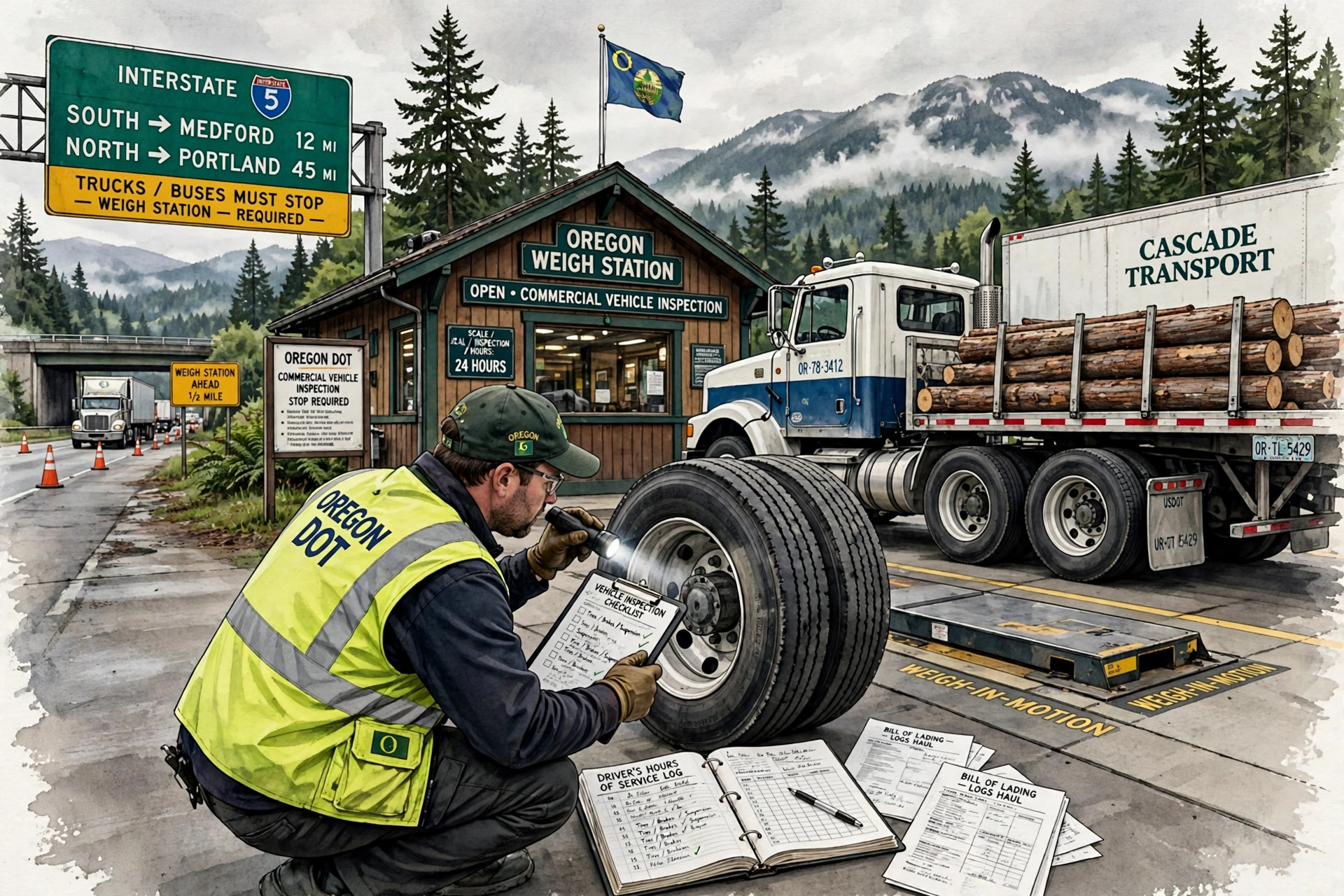
Image: Illustration: AI-generated by CDLWire
Oregon has published the combined results of its fall weigh-station operations, and the headline number is a behavior, not a defect: at one Interstate 5 scale, officers stopped 84 trucks in a single operation, every one of which had bypassed the weigh station, according to CDLLife on Nov. 19, reporting the Oregon Department of Transportation.
On Nov. 19, ODOT shared results from three trucking compliance details that took place in October and November 2026 at ports of entry and weigh stations across the state. Across the three operations, law enforcement stopped 149 commercial motor vehicles, placed 41 vehicles and 16 drivers out of service, and issued citations for a list of violations that runs from the mechanical to the documentary: illegal bypassing of a weigh station, driving while suspended, operating without a valid commercial driver's license, not having a commercial driver's license, operating in violation of hours-of-service regulations, overweight violations, tax violations, tampering with logs and electronic logging devices to produce fictional logs, speeding, and failure to yield to an emergency vehicle.
The Woodburn operation is the centerpiece. On Oct. 28, ODOT ran an illegal bypass operation at the Woodburn northbound and southbound weigh stations on Interstate 5, in partnership with the Molalla and Beaverton police departments and the Clackamas, Marion, Washington and Yamhill county sheriff's offices. Multiple agencies stopped 84 commercial motor vehicles, all of which had bypassed the weigh station. Law enforcement issued 78 citations for 114 violations; ODOT Commerce and Compliance Division officers issued seven more citations and identified an additional 121 vehicle violations. Three vehicles were placed out of service and nine drivers were placed out of service. The staffing tells the story of the tactic: a bypass operation needs officers positioned where the bypassing trucks actually go, which is why four county sheriff's offices and two city departments were working a state scale detail.
The Umatilla operation, held Oct. 5–7 at the Umatilla Port of Entry in partnership with Oregon State Police and the Morrow County Sheriff's Office, produced the opposite profile: fewer stops, far more iron condemned. Officers stopped 43 commercial motor vehicles, issued 26 citations for 58 violations, and ODOT's compliance officers found 138 vehicle violations. Thirty-eight vehicles were placed out of service — nearly nine of every ten trucks stopped — along with seven drivers. Where Woodburn was a net for a behavior, Umatilla was a deep inspection detail, and its out-of-service rate says the trucks it examined were in poor condition by the standard inspectors apply everywhere.
The third operation, at the Cascade Locks Port of Entry on Nov. 6 in partnership with Oregon State Police, stopped 22 commercial motor vehicles. State police issued 34 citations for 51 violations and compliance officers found 17 vehicle violations — but no trucks or drivers were placed out of service. Set side by side, the three details show the range of what a scale operation can be: a bypass sweep that writes citations, an inspection detail that sidelines almost everything it touches, and a compliance check that finds violations without finding out-of-service conditions.
ODOT's framing is explicit about why the bypass itself draws this level of effort. “Oregon takes weigh station compliance very seriously and we are continually taking enforcement action,” said ODOT Commerce and Compliance Division Administrator Carla Phelps. “The goal of these quarterly operations is to reinforce safety regulations and hold commercial drivers responsible for actions like illegal scale bypass. Removing unsafe drivers and vehicles from Oregon roads prevents property damage, injuries and fatal collisions.” The quarterly cadence is the operational fact for carriers: these are not one-off blitzes but a standing program, run several times a year, at rotating locations.
Oregon's stop requirement is broad, and the details matter for any driver crossing the state. Commercial vehicles and combinations exceeding 20,000 pounds must stop and weigh at an open scale when a sign posted before the scale reads “All Trucks Over 20,000# GVW Next Right.” All commercial vehicles and combinations with a gross vehicle weight of 10,000 pounds or greater must stop at an open scale even without that posted sign. The exemptions are narrow — military vehicles in convoy, an empty log truck with a bunked pole trailer, a vehicle turning off to a terminal or legitimate business between the sign and the scale, a vehicle directed to bypass by a weigh-in-motion system, fire equipment, personal recreational vehicles, and buses unless signage directs them in. One exception swallows a common assumption: vehicles transporting an oversize or overweight load must stop at open scales even if they receive a green light on their transponder.
The practical takeaway for running Oregon is therefore twofold. First, the bypass is the one violation this program is built to catch, and it is caught with saturation staffing on the routes around the scale — the 84 Woodburn stops were not trucks that failed an inspection, they were trucks that tried not to have one. Second, what the inspections found once trucks were stopped — fictional logs among the citation list, 41 vehicles and 16 drivers out of service across three details — is the reason the state gives for treating a bypass as a safety signal rather than a paperwork shortcut. If the scale is open and your combination is over 10,000 pounds, Oregon's answer is to stop; the quarterly operation you have not heard about yet is the enforcement of that answer.
Sources
Related coverage
 November 19, 2026 · EnforcementOperation DISS-rupt runs all 179 miles of I-95 in Virginia today and Friday — distracted, impaired, speed and seat belt enforcement
 November 19, 2026 · EnforcementA USPS contract driver pleaded guilty to stealing mail from his own route — attempted loss put at a minimum of $4,466,000
 November 18, 2026 · Enforcement30 months and $2,210,055 in restitution: a sentencing in the scheme that bought trucking companies to steal $7,210,056 in cargo
Comments
Loading comments…