73% of trucks inspected at a one-day Texas Motor Speedway detail were placed out of service — cracked frames, cracked crossmembers, broken leaf springs
The Texas Department of Public Safety's North Texas Region released results Nov. 19 from a single-day inspection detail at the Texas Motor Speedway in Fort Worth: 30 inspections — 29 of them full Level 1 inspections — put 22 commercial vehicles out of service, a rate of more than 73%, along with 2 drivers, on 7 citations and 168 warnings. The out-of-service violations named are structural: broken leaf springs, cracked frames and cracked crossmembers.
Summarized from CDLLife.
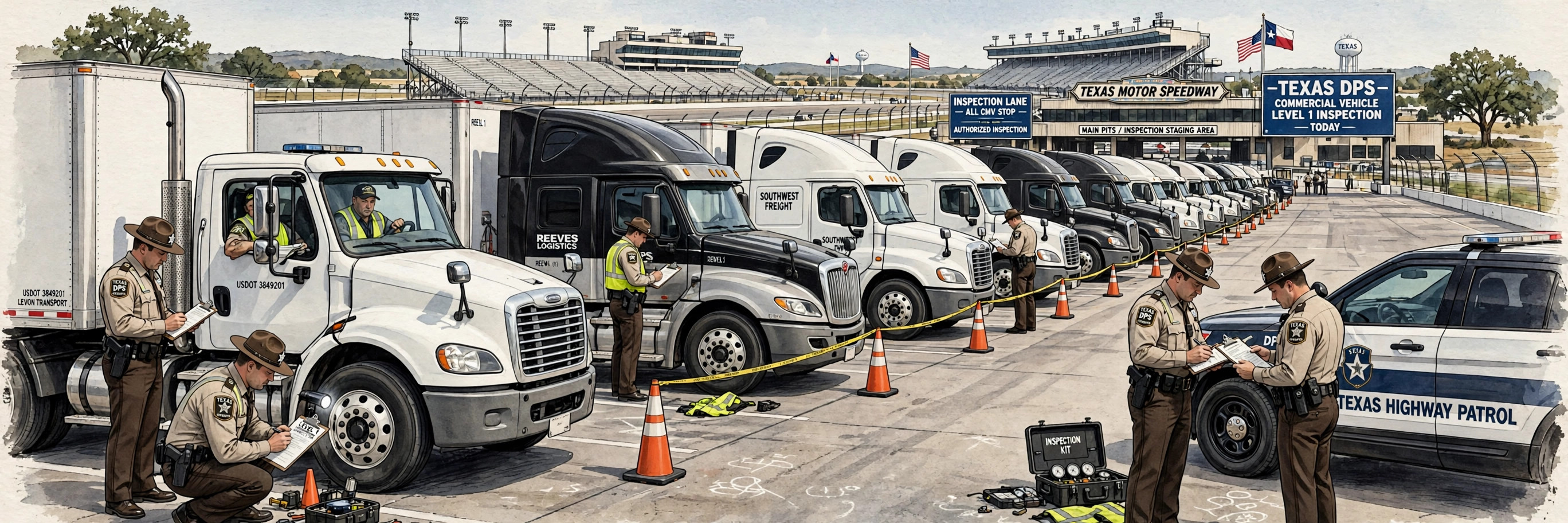
Image: Illustration: AI-generated by CDLWire
A one-day inspection detail in Fort Worth produced the kind of out-of-service rate that makes safety directors wince: nearly three of every four trucks troopers inspected were ordered off the road, and the violations named are not paperwork — they are the structure of the vehicle itself, according to CDLLife on Nov. 19, reporting the Texas Department of Public Safety.
On Nov. 19, the Texas Department of Public Safety's North Texas Region released results from a single-day truck enforcement detail that took place at the Texas Motor Speedway in Fort Worth. Troopers conducted a total of 30 inspections, and the vehicle out-of-service rate for the operation was more than 73%. The full results: 29 Level 1 inspections and 1 Level 4 inspection; 22 commercial vehicles placed out of service; 2 drivers placed out of service; 7 citations issued; and 168 warnings issued. The venue is part of the method — a speedway's paved acreage gives a detail room to pull trucks in, inspect them thoroughly and hold the ones that fail, at a scale a shoulder or a scale-house lot cannot match.
The inspection mix explains the severity of the findings. A Level 1 inspection is the most complete roadside examination in the North American standard system: the inspector works through the driver's documents, hours of service and credentials, and then goes over the vehicle system by system — brakes, steering, suspension, frame, tires, wheels, lights, coupling devices and the rest — including time spent under the vehicle. Twenty-nine of the 30 inspections at the speedway were Level 1, which means this detail was not sampling for obvious defects from a walk-around; it was putting nearly every truck it stopped through the full examination, and the full examination is what finds cracked frames.
What it found, on the department's own summary, is structural. “Out-of-service violations include broken leaf springs, cracked frames, and cracked crossmembers, which compromise the structural integrity of the vehicle and its load, and can result in a serious or deadly crash,” the Texas Department of Public Safety said. Each of those defects shares a property that matters for how a driver should read this story: none of them is a surprise failure that happens between the yard and the scale. A cracked frame rail, a cracked crossmember and a broken leaf spring are conditions that develop over time, that a thorough pre-trip and a periodic inspection are designed to catch, and that a truck can carry for weeks while still rolling, loaded, at highway speed — until the day the compromised structure is asked for more than it has left.
The ratio of warnings to citations is the other number worth a driver's attention. Troopers issued 168 warnings against only 7 citations across 30 inspections — an average of more than five warnings per inspected truck. Warnings are how an inspection detail documents the long tail of lesser defects: the lamps, markers, minor leaks, adjustment and wear items that do not sideline a truck today but are recorded against the carrier's safety record and become tomorrow's out-of-service violation if they are left to age. A detail that writes five warnings per truck is describing a fleet population whose maintenance is being deferred across the board, not a few bad actors with broken frames — the 22 out-of-service trucks are the front edge of a much wider pattern of wear.
Context keeps the 73% figure honest. Thirty inspections is a small sample, and a detail staged at a fixed location, worked by troopers who can choose which trucks to pull in, is not a random survey of the Texas fleet — inspectors direct their attention, and their attention is trained on the trucks that look like they will fail. The rate should not be read as “73% of trucks on Texas roads are unsafe.” What it does establish is narrower and still uncomfortable: when experienced inspectors at a full-inspection detail picked 30 trucks and examined them completely, 22 of them had at least one violation serious enough to forbid further operation until it is repaired, and the named examples were cracks in the parts that hold the vehicle together.
For drivers and small carriers, the practical lesson is about where these defects are found before a trooper finds them. Frame and crossmember cracks and broken springs are exactly the findings of the under-vehicle portion of an inspection — the part of a pre-trip that requires a light, a creeper or a pit, and time. They are also findings that follow the carrier, not just the truck: out-of-service results feed the safety scores that shippers, brokers and insurers read, and a vehicle ordered out of service at a detail is repaired on the detail's schedule, at roadside prices, with the load still on it. The cheapest frame inspection is the one done in your own yard, on your own schedule — the Texas Motor Speedway detail is what the alternative looks like, 22 trucks at a time.
Sources
Related coverage
 November 19, 2026 · EnforcementOperation DISS-rupt runs all 179 miles of I-95 in Virginia today and Friday — distracted, impaired, speed and seat belt enforcement
 November 19, 2026 · EnforcementA USPS contract driver pleaded guilty to stealing mail from his own route — attempted loss put at a minimum of $4,466,000
 November 18, 2026 · Enforcement30 months and $2,210,055 in restitution: a sentencing in the scheme that bought trucking companies to steal $7,210,056 in cargo
Comments
Loading comments…