CHP's Sonora obstructed-window blitz wrote 53 tint citations and 45 other vehicle-code citations in one day — and the law it enforced is narrower than the headline
A Nov. 17 operation by the California Highway Patrol's Sonora Division, the Tuolumne County Sheriff's Office and the Sonora Police Department produced 53 citations for window tint, 45 citations for other vehicle code violations, 43 verbal warnings, 4 arrests for outstanding warrants and 1 impounded vehicle. CHP quoted Vehicle Code Section 26708(a)(1) — and clarified that it does not apply to the passenger rear windows.
Summarized from CDLLife.
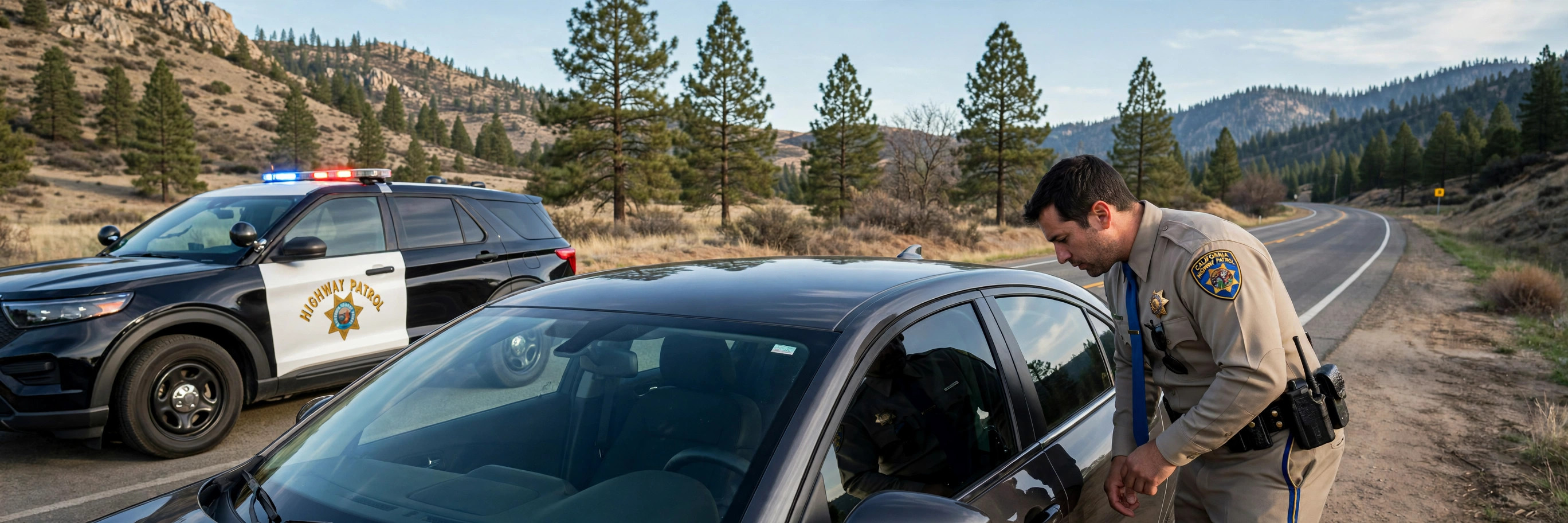
Image: Illustration: AI-generated by CDLWire
Nearly a hundred citations came out of a single day of window-obstruction enforcement in the Sonora area, according to CDLLife on Nov. 20 — and the operation is a useful reminder that in California, what is on your glass is itself a vehicle code violation, whether or not anything else about the vehicle is wrong.
On Nov. 17, 2026, the California Highway Patrol's Sonora Division partnered with the Tuolumne County Sheriff's Office and the Sonora Police Department to enforce laws related to vehicles with obstructed windows, with special emphasis on illegal window tint. The itemized results the agencies released are these: 53 citations issued for window tint, 45 citations issued for other vehicle code violations, 43 verbal warnings given, 4 arrests for outstanding warrants, and 1 vehicle impounded. One caution belongs right next to those numbers: the headline on the source article puts the citation total far higher than its own itemized list supports. The figures CDLWire is publishing are the itemized ones — 53 plus 45 is 98 citations — because those are the numbers the agencies actually broke out, and a driver planning around enforcement deserves the arithmetic that adds up.
The legal basis CHP cited is California Vehicle Code Section 26708(a)(1), which the patrol quoted in its release: a person shall not drive any motor vehicle with any object or material placed, displayed, installed, affixed, or applied upon the windshield or side or rear windows. Read quickly, that sounds like a ban on everything everywhere on the glass. CHP's own clarification, issued with the results, is narrower and is the part worth memorizing: the law does not apply to the passenger rear windows. The patrol's stated safety logic is about the driver's own view — tint on the front side windows and the windshield reduces what the driver can see, increasing the risks of crashes involving pedestrians, bicyclists and all other vehicles. In other words, the enforcement target is the glass the driver looks through, not the glass behind the driver.
For truck drivers, the direct exposure is smaller than for the car fleet — a tractor's cab glass is factory glass, and few company trucks run aftermarket front tint — but it is not zero, and the wider lessons of the operation apply to every commercial driver in California. First, personal vehicles count too: a citation written in a driver's own car is still a vehicle code conviction on the record of a person whose livelihood is a clean license, and 53 tint citations in one day in one foothill division shows how ordinary this stop is. Second, the operation's other numbers show what a themed blitz actually is: 45 citations for other vehicle code violations, 43 warnings and 4 warrant arrests came out of stops that began with glass. A window stop is a full stop — license, registration, warrants, equipment — and whatever else an officer can see from the window that started it.
Third, CHP said plainly that this was not a one-day posture: officers will continue to enforce obstructed window violations along with all other vehicle code violations on a daily basis. That sentence, attached to a joint operation with a county sheriff and a city police department, describes how these details work in practice — a publicized joint day that advertises the law, followed by ordinary daily enforcement by every agency that participated. Sonora sits in Tuolumne County in the Sierra foothills, on the State Route 49 and 108 corridors that carry both local traffic and trucks working the foothill and mountain routes, so the audience for the message is not only commuters.
The practical takeaway fits on an index card. If your front side windows or windshield carry aftermarket tint or any applied material, California law treats the glass itself as the violation, and the fix — removal — is cheaper than the citation and the stop that comes with it. Rear passenger windows are outside the law as CHP itself clarifies it, so there is no need to overcorrect and strip legal glass. Keep anything from being displayed or affixed on the windshield that the code does not allow. And treat any themed enforcement day you hear about — tint today, something else next month — as what it is: not a curiosity, but a preview of the stops that will keep happening, on ordinary days, long after the press release is forgotten.
Sources
Related coverage
 November 20, 2026 · EnforcementThe lead defendant in the $100 million Brinks truck heist pleaded guilty — his crew followed truckers to their stops for five months
 November 20, 2026 · Enforcement37 stolen or re-vinned tractors and trailers worth $3.6 million recovered from a Brampton yard — four charged, two wanted
 November 20, 2026 · EnforcementOregon's three weigh-station operations sidelined 41 trucks and 16 drivers — including 84 trucks stopped for bypassing the Woodburn scales
Comments
Loading comments…