Oregon's undercover mover sting found eight uncertified companies — and trucks with a cracked frame, a bad steering tire and a driver with no medical card
ODOT, Oregon State Police and Grants Pass police met unauthorized movers at a November 19 undercover operation in Josephine County. Eight companies offered to transport household goods without a required certificate. Additional violations included operating without a medical certificate and an unsafe steering tire, both out of service, plus no active USDOT number, no proof of liability insurance and registration expired in 2020. Oregon's fine for unauthorized moving is $3,000, and 67 movers have been fined since 2020.
Summarized from The Trucker.
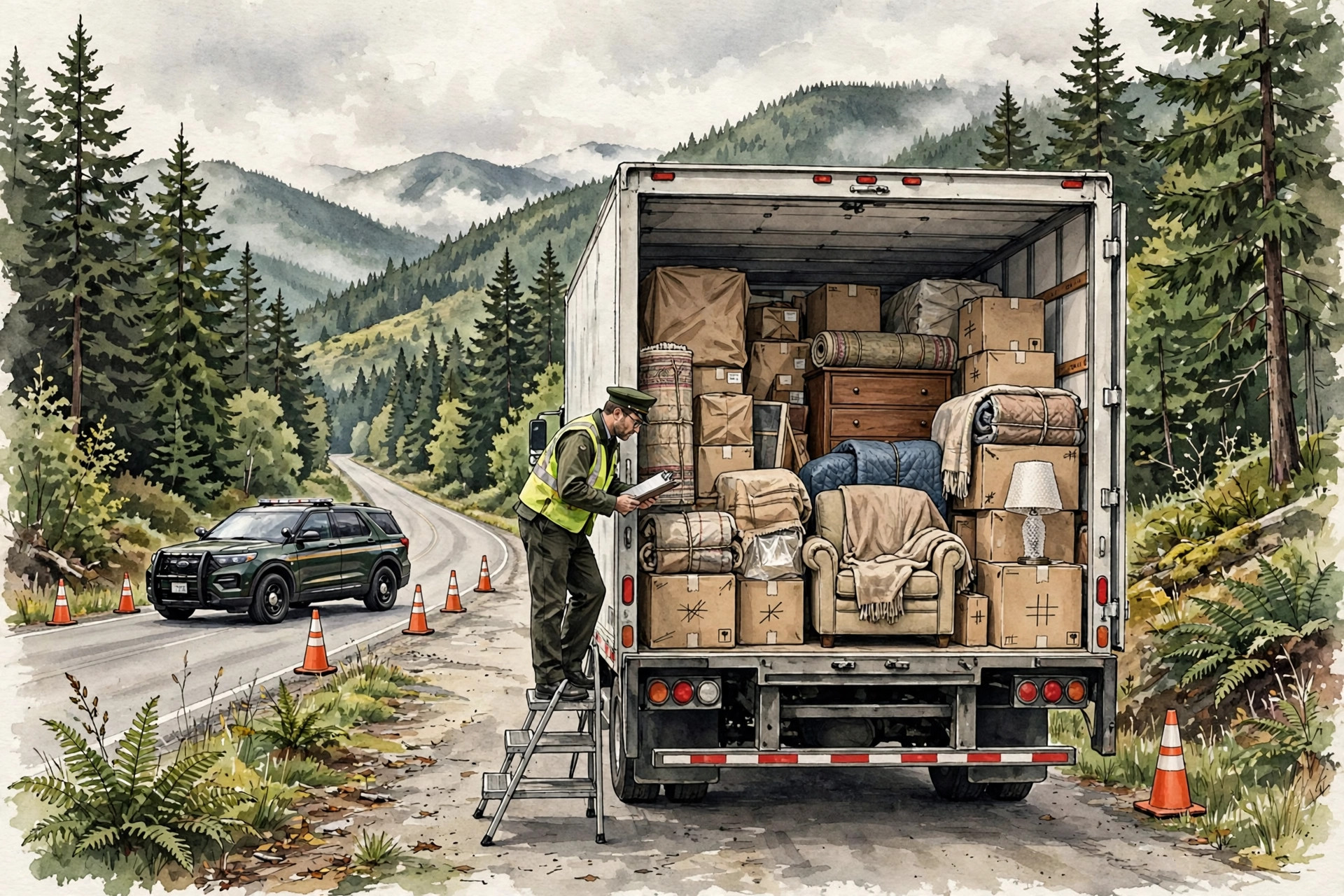
Image: Illustration: AI-generated by CDLWire
Eight Oregon moving companies showed up to an undercover operation in Josephine County and offered to haul household goods without the state certificate the law requires — and the trucks and drivers who met investigators carried a list of violations that went well past paperwork, according to The Trucker on Nov. 27, reporting the Oregon Department of Transportation.
ODOT, in partnership with the Oregon State Police and the Grants Pass Police Department, met with several unauthorized moving companies at the undercover operation in Josephine County on November 19. Eight movers offered to transport household goods without a required certificate: American Independent Movers, Rogue Valley Movers, Family Moving LLC, Good Guys Moving LLC, RockSolidMovers LLC, Back Savers Moving LLC, Back2Back Moving Company and Almighty Movers LLC. ODOT's warning to consumers is the reason the operation exists: hiring an unauthorized moving company could lead to damaged or stolen property, poor service and unexpected charges.
The additional violations investigators recorded are the part of this story a professional driver should read twice, because they describe equipment and credentials, not just a missing certificate. The list includes operating without a medical certificate, which ODOT marks as an out-of-service violation; operating without an active USDOT number; operating a commercial motor vehicle without the legal name or trade name displayed; failure to carry proof of liability insurance; expired registration — expired in 2020, in the case recorded; operating without documentation of periodic inspection; and failure to carry or maintain a proper fire extinguisher. The equipment findings are worse: a leaf spring clamp visibly cracked, a cracked, loose, sagging or broken frame or chassis, and an unsafe steering tire, also marked out of service. A household-goods truck that arrives at a customer's home with a cracked frame, a bad steering tire and a driver without a medical card is not a paperwork problem that happens to involve a truck — it is an uninspected commercial vehicle operating in public, which is exactly the condition the certification system is supposed to keep off the road.
The legal framework is specific to Oregon intrastate moving. Under state law, any individual or company offering to transport household goods within Oregon must be certified by ODOT, and companies offering, advertising or transporting household goods without authorization are subject to a $3,000 fine — an increase from $1,000 under Senate Bill 839, which also expanded the scope for penalties. Since 2020, 67 unauthorized movers have been fined. Certification involves background checks and adherence to an approved tariff of rates, and authorized movers are required to provide consumers with the state's General Information Bulletin for Moving Household Goods in Oregon.
ODOT frames these operations as enforcement and education at once. Leah Cisneros, the agency's Commerce and Compliance Division investigation and compliance manager, said transportation of household goods in Oregon is a heavily regulated industry that protects consumers and their possessions, and that the agency holds these operations to enforce regulations, educate moving companies on the correct way to operate in the state and uphold the integrity of certified moving companies. Staff at the operations give unauthorized companies detailed information on how to operate in compliance, including how to become an authorized mover, and Cisneros said several companies have gone on to receive certification or to provide pack-and-load services only — leaving fewer unauthorized movers to take advantage of consumers.
For legitimate carriers and drivers, the competitive point is the one Cisneros names last: every uncertified mover quoting a household job in Oregon is bidding against certified companies while carrying none of the costs certification imposes — no tariff, no background checks, and, on the evidence of this operation, in some cases no insurance proof, no inspection documentation and no medical qualification either. That is not a lower-cost business model; it is the same job priced without the compliance that makes the job legal.
The practical takeaway for drivers and small carriers working Oregon: the certificate is the business. If you haul household goods intrastate in Oregon, ODOT certification is required before the first offer to transport, the fine for operating without it is $3,000, and an undercover operation is a realistic way to be caught — investigators in Josephine County booked the jobs themselves. And if you are the consumer on the other side of a move, ODOT's advice is the checklist this operation was built around: confirm the mover is certified, expect the state information bulletin from an authorized company, and report complaints to ODOT's Commerce and Compliance Household Goods team or the Oregon Department of Justice's Consumer Protection Division.
Sources
Related coverage
 November 25, 2026 · EnforcementCargoNet's Thanksgiving warning: 252 thefts in five holiday periods, and the 2026 scheme is a fake driver or dispatcher hired off social media
 November 23, 2026 · EnforcementA written 'playbook' told drivers to divert customs-exam containers to warehouses first — three arrested in a Southern California port smuggling case
 November 22, 2026 · EnforcementCalifornia trucker sentenced to 151 months for hauling cocaine and fentanyl in his sleeper — he admitted he was paid $30,000 for the run
Comments
Loading comments…