CargoNet's Thanksgiving warning: 252 thefts in five holiday periods, and the 2026 scheme is a fake driver or dispatcher hired off social media
Verisk CargoNet recorded 252 Thanksgiving-period thefts from 2021 through 2025 worth about $23.9 million, with 62 percent falling on the Tuesday and Wednesday before the holiday and the Monday after. This year's highlighted scheme: criminals answer a carrier's social media job post, get hired without ever being met, take over the company's email and phone, and bid on freight in its name. The average stolen shipment through September was worth $448,456, up 72 percent.
Summarized from Verisk CargoNet.
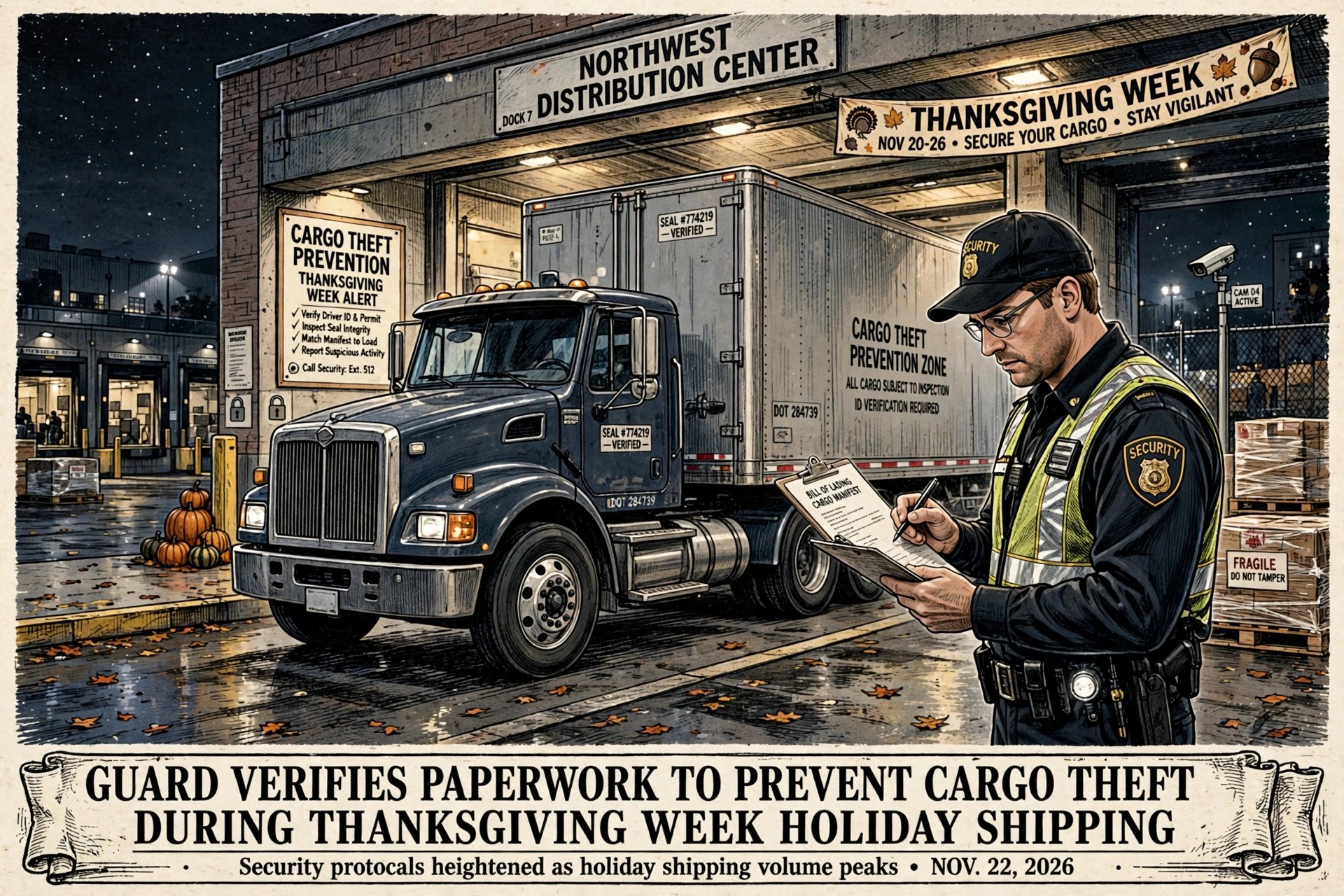
Cargo thieves work the days around Thanksgiving, not the holiday itself — and this year the tactic carriers need to watch is a fake hire. Verisk CargoNet released its Thanksgiving cargo theft analysis on Nov. 24, 2026, according to Verisk CargoNet, recording 252 cargo theft incidents in the United States during the Thanksgiving holiday periods from 2021 through 2025, with an estimated commodity value of about $23.9 million. The annual count rose from 29 incidents in 2021 to a five-year high of 79 in 2024, then fell to 58 in 2025 — still twice the 2021 total.
The calendar pattern is the first thing to plan around. The Tuesday and Wednesday before Thanksgiving and the Monday after it accounted for 62 percent of the incidents; Thanksgiving Day itself was the quietest day of the period, with 17. The geography is concentrated, too: California, Illinois and Texas accounted for 56 percent of incidents, led by San Bernardino and Los Angeles counties in California. Over the five years, thieves mostly targeted food and beverage shipments, followed by household goods and electronics, and theft of unattended trailers and break-ins to parked trucks and trailers remain common methods.
What has changed is the value of what is being taken and how the thieves get to it. CargoNet says thieves in 2026 continue to favor full truckloads of metals and the enterprise computing hardware used in data centers — fully assembled racks and computing platforms, networking and security appliances, and components such as fiber optic transceivers, central processors, graphics processors and memory chips. Through September 2026, the average documented value of a stolen shipment was $448,456, up 72 percent from the same period in 2025. CargoNet is explicit that its figures cover only incidents reported to it, that dollar figures are estimates, and that the data is as of Oct. 28, 2026 — but the direction is not in doubt.
The scheme CargoNet is highlighting for 2026 starts with a job posting. Cybercriminals posing as drivers and dispatchers respond to carriers' job postings on social media. Once hired, they work to gain access to the company's official email and phone systems. Then they use those systems — the carrier's real email address and real phone number, the identifiers brokers use to know who they are dealing with — to bid on shipments in the carrier's name and steal the freight. CargoNet says it has traced reports of fraudulent employees back to hiring posts the carriers had recently made on social media, and that in most cases the carrier hired the driver or dispatcher online without ever meeting the candidate.
Fraudulent hires are one door; CargoNet lists the others alongside it. Criminals operate under the identity of a legitimate carrier by compromising a carrier's email account, by deceiving a carrier that is already hauling a shipment into delivering it somewhere else, or by buying an existing carrier's credentials. The common thread is that the theft runs through standard carrier practices and a trusted identity, not through a broken lock — which is why CargoNet's Keith Lewis, its vice president of operations, says no single shipper, broker or carrier can see the whole picture, and that when one company spots a suspicious load, a fake dispatcher or a cloned carrier and reports it quickly, everyone else benefits.
The holiday timing is part of the method. CargoNet says criminals understand that short staffing around the holidays makes these tactics more likely to succeed: fewer people are available to vet a new hire, verify a caller, or notice an unusual email. Its recommendation is that every party in the supply chain put additional security and verification measures in place for the Thanksgiving window, which it dates from Tuesday, Nov. 24 through Monday, Nov. 30. Meeting candidates in person, conducting thorough background and reference checks, and validating contact information may have prevented some of the fraudulent-hire cases, CargoNet says. Lewis puts the standard plainly: a carrier's email address and phone number are how brokers know who they are dealing with, so guard access to them the way you guard the keys to your trucks.
For drivers and small carriers, the takeaway for this week is concrete. The highest-risk days are the ones immediately around the holiday — today and tomorrow on the front end, and Monday on the back end — and the highest-risk freight is a full truckload of metals or data center hardware sitting in an unattended trailer. If your company is hiring off a social media post this week, the person on the other end of that hire is exactly who CargoNet is warning about. Verify before you hand over system access, confirm delivery changes through a second channel, and treat an unfamiliar dispatcher voice on your own company's line as a reason to check, not a reason to roll.
Image: Illustration: AI-generated by CDLWire
Sources
Related coverage
 November 23, 2026 · EnforcementA written 'playbook' told drivers to divert customs-exam containers to warehouses first — three arrested in a Southern California port smuggling case
 November 22, 2026 · EnforcementCalifornia trucker sentenced to 151 months for hauling cocaine and fentanyl in his sleeper — he admitted he was paid $30,000 for the run
 November 22, 2026 · EnforcementMore than a dozen charged in an alleged $22 million train heist ring — crews busted the brakes, stopped the trains and offloaded cargo onto trucks
Comments
Loading comments…