A California produce carrier just signed to run 75 driverless trucks it owns itself — a first for interstate trucking
Kodiak AI and Fresno-based DTL Transport announced Wednesday what Kodiak calls the first publicly announced definitive Driver-as-a-Service agreement by an interstate carrier: 75 DTL-owned trucks running the Kodiak Driver for a per-mile fee, on I-10 between Dallas and El Paso and I-20 between Dallas and Atlanta. No start date was announced.
Summarized from Overdrive.
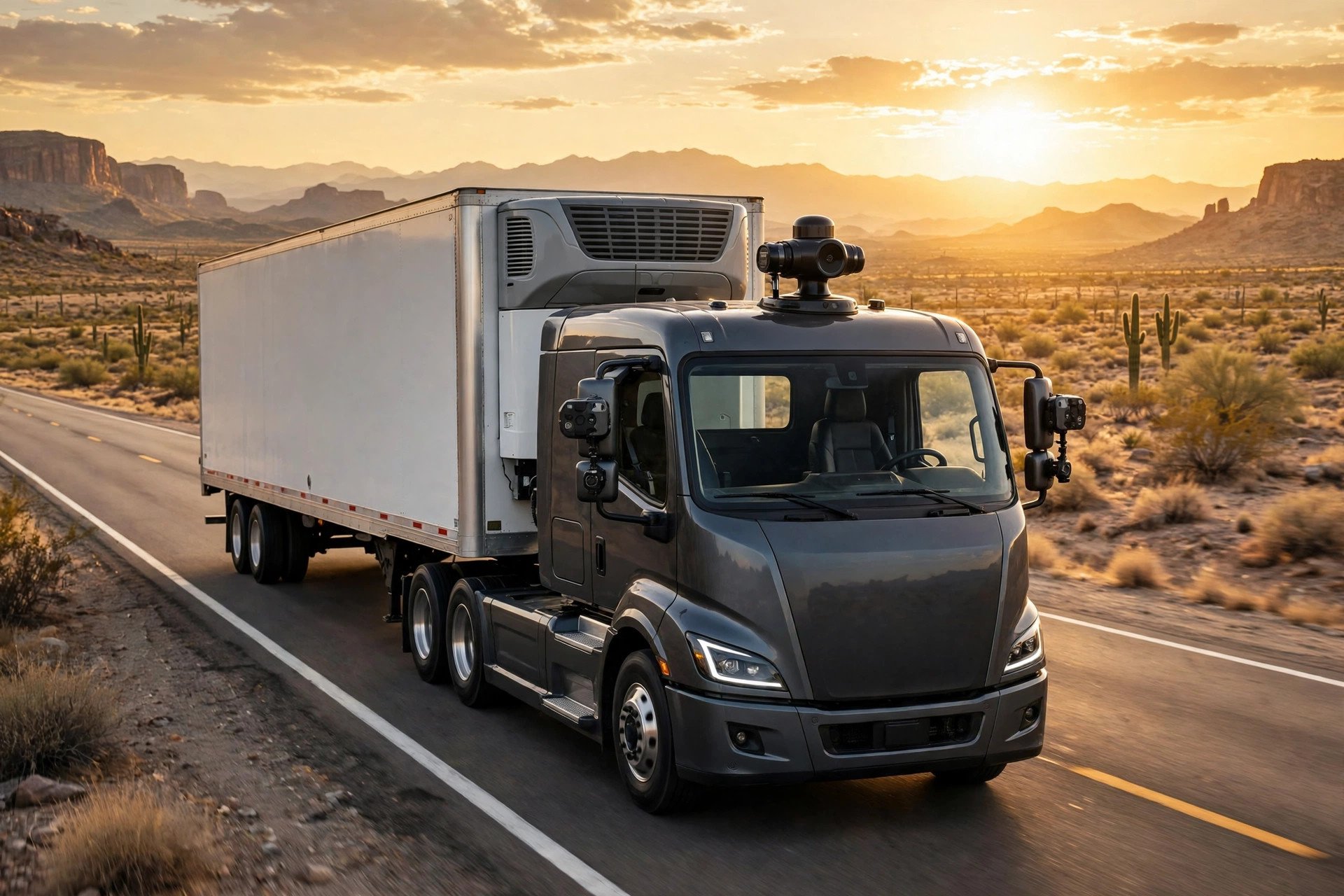
Image: Illustration: AI-generated by CDLWire
An interstate trucking company has signed a binding agreement to run driverless trucks inside its own fleet — 75 of them, paid for by the mile — according to Overdrive on Oct. 28. Autonomous truck developer Kodiak AI announced the agreement Wednesday with DTL Transport, a Fresno, California-based long-haul carrier, to deploy the Kodiak Driver, Kodiak's autonomous driving system, in 75 trucks owned and operated by DTL. Kodiak said the deal is the first-ever publicly announced definitive agreement by an interstate trucking company to operate driverless trucks within its own fleet under the Driver-as-a-Service model, in which the carrier owns and runs the trucks and pays a per-mile fee for the driving system.
The structure is the story. Until now, driverless trucking has mostly meant technology companies operating their own test fleets or running freight for customers under their own authority. Under this agreement, the trucks belong to a working produce carrier. DTL specializes in cross-country team runs and hauls produce for several of the nation's largest grocers; its own company profile describes a fleet of more than 100 trucks built over more than 36 years, led by second-generation owner Lucky Dosanjh, with his son Jovan representing the third generation as head of dispatch. 'This binding agreement reinforces what I have said from the beginning: The Driver-As-A-Service business model is tailor-made for commercial trucking,' said Don Burnette, Kodiak's founder and chief executive. 'Kodiak is executing on that vision, and we are thrilled to continue growing our relationship with DTL.'
The lanes named on Wednesday are long, straight and relentless — exactly the freight autonomy has always targeted. DTL will deploy its driverless trucks on two routes on which Kodiak has already conducted testing: Interstate 10 between Dallas and El Paso, Texas, and Interstate 20 between Dallas and Atlanta, with additional lanes to be added over time. Kodiak noted that those routes give DTL the opportunity to operate beyond current hours-of-service limitations — the economic heart of the pitch, since a truck that is not limited by a driver's clock can keep team-freight moving without a second driver in the bunk. The announcement did not give a start date for the DTL driverless runs or disclose the per-mile price or total contract value.
DTL is not starting from zero with the technology. In September, DTL became Kodiak's first autonomous customer in California after the state cleared the way legislatively for autonomous trucks to begin testing there. In a pilot program, the Kodiak Driver autonomously hauled perishable goods for DTL 225 miles along the I-5 and CA-99 freight corridors between Fresno and Los Angeles — freight Kodiak described as the first commercial goods ever autonomously hauled by a Class 8 truck in California, run under a heavy-duty autonomous vehicle testing permit the California Department of Motor Vehicles granted earlier this summer. 'Working with Kodiak underscores our commitment to affirming our leadership position in the industry,' said Dosanjh, DTL's president and chief executive. 'By integrating this technology into our fleet, complementing our experienced, professional workforce, we can expand capacity, enhance safety and drive innovation forward.'
Kodiak has run the customer-owned model once before, in a very different setting. It first launched a Driver-as-a-Service offering in an industrial application in December 2024 with Atlas Energy Solutions; as of June 30, 2026, the Kodiak Driver was integrated on 35 driverless trucks owned and operated by Atlas, and Kodiak has committed to growing that fleet to 100 trucks by mid-2027. Separately, Kodiak plans to launch driverless highway service by the end of this year, carrying goods on behalf of IKEA on Interstate 45 between Dallas and Houston. The DTL agreement takes that same model out of the oilfield and onto public interstate freight lanes for a grocery supply chain — the difference between a controlled industrial site and a Dallas-to-Atlanta produce run is most of what has kept autonomy a pilot story until now.
The timing lands in the middle of an argument the industry is having with itself. In the American Transportation Research Institute's most recent Top Industry Issues survey, drivers and owner-operators ranked autonomous trucks among their top 10 concerns for all of trucking, while the issue did not register in the fleet respondents' top 10 at all. Wednesday's deal shows why both rankings can be true at once: to a fleet, 75 driverless trucks are capacity that never goes home; to a team driver running Dallas to Atlanta, they are the first driverless trucks that belong to a company like the one that signs his checks, hauling the same produce on the same interstates.
The practical takeaway is to watch the two named corridors and keep the timeline honest. Nothing about Wednesday's announcement puts a driverless DTL truck next to you tomorrow: no start date was announced, and Kodiak's own first driverless highway launch, the IKEA work on I-45, is still scheduled for the end of this year. What changed is the paperwork. A named interstate carrier with more than 100 trucks has committed, in a definitive agreement its partner announced publicly, to paying by the mile for 75 driverless trucks of its own. If you run team produce on I-10 or I-20, that is the segment and the geography where the pressure will arrive first — and it is now a signed plan, not a conference prediction.
Sources
Related coverage
 October 27, 2026 · Autonomy'I didn't realize our laws are so lacking': New Mexico lawmakers hear that autonomous trucks can test with five days' notice and no permit
 October 8, 2026 · AutonomyUSDOT grants Aurora a five-year exemption for cab beacons on driverless trucks
 October 3, 2026 · AutonomyAutonomous-truck warning-beacon waiver nears Oct. 9 renewal as court challenge plays out
Comments
Loading comments…