DHS says Operation Guardian arrested more than 230 people across 15 states in 72 hours — including more than 40 CDL holders taken off the road
The U.S. Department of Homeland Security announced the results Monday in Tulsa, Oklahoma: a three-day ICE and state-patrol operation, Oct. 26–28, targeting people the department says were in the country illegally with unauthorized CDLs and other public safety threats in trucking. Oklahoma officials say more than 1,000 commercial vehicles were inspected, and the multi-state design was built specifically so drivers could not route around one state's checkpoints.
Summarized from U.S. Department of Homeland Security.
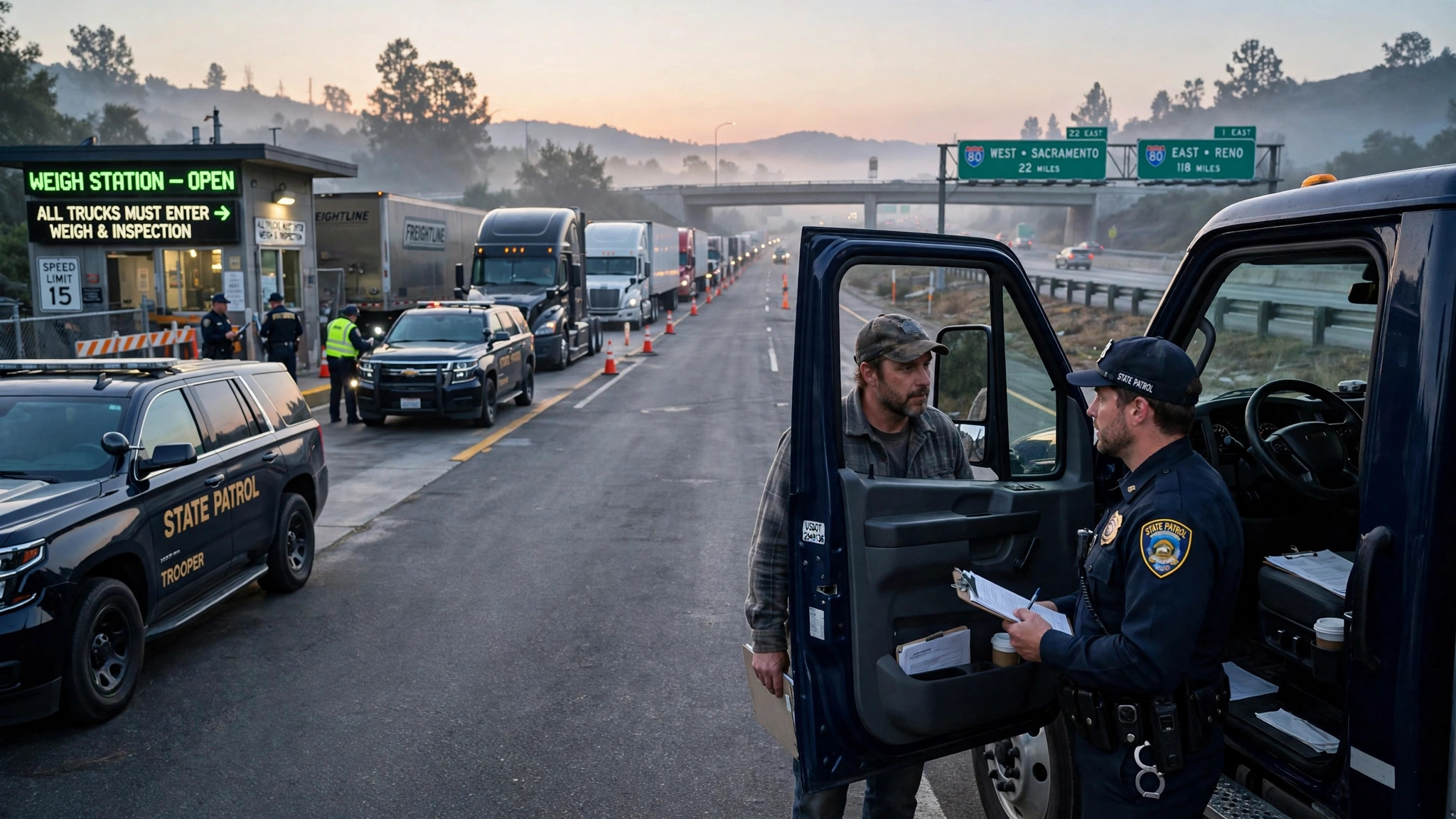
Image: Illustration: AI-generated by CDLWire
The federal government’s campaign against unqualified commercial drivers went multi-state last week. Operation Guardian, a three-day operation run by U.S. Immigration and Customs Enforcement with state and local partners from Oct. 26 through Oct. 28, arrested more than 230 people the government says were in the country illegally — including more than 40 who held commercial driver’s licenses — across 15 states, according to the U.S. Department of Homeland Security on Nov. 2. The department said the operation targeted people with unauthorized CDLs and other public safety threats in the trucking industry.
Secretary of Homeland Security Markwayne Mullin announced the numbers Monday at a press conference at the Tulsa, Oklahoma headquarters of Melton Truck Lines, joined by Melton executives, ICE Assistant Director Russell Hott, Oklahoma Public Safety Commissioner Tim Tipton and state patrol colonels from Texas and Oklahoma. “In just three days, we arrested more than 230 illegal aliens, including over 40 illegal aliens with commercial driver’s licenses, across 15 states,” Mullin said. “Our roads are safer with these illegal aliens no longer behind the wheels of semi-trucks.” The 15 participating states, as the department listed them, were Alabama, Arkansas, Florida, Georgia, Indiana, Iowa, Louisiana, Mississippi, Missouri, Nebraska, North Dakota, Oklahoma, South Dakota, Tennessee and Texas.
Oklahoma was the operation’s hub, by design. The sweep was spearheaded by the state Department of Public Safety under Commissioner Tipton, with Gov. Kevin Stitt’s support, according to The Oklahoman on Nov. 2, and grew out of Oklahoma’s February 2025 agreement deputizing its estimated 704 troopers to enforce federal immigration law. Officials said more than 1,000 commercial vehicles were inspected, with 40 of those arrested operating commercial trucks. Tipton explained the multi-state shape directly: analysts kept seeing social-media posts telling drivers to divert around Oklahoma when the state ran its own sweeps. “So our goal was to really try to stop this diverting,” he said. The Indiana State Police made the same point, saying the operation “targeted secondary and bypass routes to eliminate avenues criminals typically use to evade high-level enforcement activities on major interstate corridors,” as CDLLife reported on Nov. 2.
The department’s own examples show the mix officers said they were pulling out of traffic. On Oct. 26, an Oklahoma trooper stopped a vehicle on Interstate 35 after seeing the driver looking down at a cell phone; a registration check showed the vehicle had been reported stolen in Texas, and when the trooper moved to arrest the driver — identified by the department as Luis Armando Garlo Rodriguez, of Honduras — he resisted, broke the trooper’s arm and fled on foot before other officers tracked him down. ICE’s Homeland Security Investigations office in Tulsa has filed charges accusing him of assaulting, resisting and impeding officers. On Oct. 27, troopers stopped a vehicle on Interstate 40 and determined that all seven occupants were in the country illegally, including an unaccompanied child; the driver, Arturo Alvarado-Islas, of Mexico, was turned over to ICE custody the same day. The Oklahoma Highway Patrol, as CDLLife reported it, said the wider concerns uncovered included people with outstanding felony warrants and a suspected human-trafficking vehicle carrying six occupants, including a juvenile female. Those are the agencies’ accounts of arrests and filed charges, not convictions, and the department has not published a state-by-state breakdown of the arrests.
Guardian is one piece of a broader federal push the department laid out in the same announcement. ICE launched Operation Guardrail, a nationwide operation targeting commercial vehicles operating in violation of U.S. laws, on Sept. 25, and had arrested 303 people through it as of Oct. 29. From Jan. 20, 2025 through Oct. 28, 2026, ICE has made 4,795 CDL-related arrests nationwide, the department said, including 1,233 arrests involving CDL holders. That is the same enforcement climate CDLWire has been tracking from the licensing side: tighter federal rules for non-domiciled CDLs, a nationwide audit of how states issued them, and states such as Ohio now downgrading thousands of credentials that no longer qualify. Mullin used the announcement to call out California and New York for, in the department’s words, issuing CDLs to people not qualified to drive; officials at the press conference noted that legal permanent residents and work-visa holders remain eligible for a CDL when they meet the testing standards.
For a working driver, the practical read is about geography and paperwork. This operation was built so that the usual workaround — routing around a state running a blitz — stops working: 15 states ran it at once, on the interstates and, in states like Indiana, on the secondary and bypass routes drivers use to get around weigh stations. Expect that template to be reused, because the federal and Oklahoma officials presenting it described it as a model. What an officer at one of these checkpoints can ask for is what a driver should already be carrying in order: a valid CDL of the right class, a current medical card, and — for any driver whose license is non-domiciled — the immigration and work-authorization documents that support it, because those are the credentials this campaign is checking. Carriers running the 15 Guardian states should treat driver-qualification files the same way: if a driver’s paperwork would not survive a roadside document check, this fall’s operations are designed to find that out at the scale, not at the audit.
Sources
Related coverage
 October 29, 2026 · Enforcement22 and a half years for the I-71 stopped-traffic crash — and a CDL investigators say was built on identity fraud
 October 29, 2026 · EnforcementA driver reset his hours by phone in front of FMCSA and state police — the agency vows to 'hold violators fully accountable'
 October 28, 2026 · EnforcementArkansas Highway Shield blitz runs through 6 a.m. Thursday: unqualified drivers, unsafe trucks and fraud are the targets
Comments
Loading comments…