22 and a half years for the I-71 stopped-traffic crash — and a CDL investigators say was built on identity fraud
Modou Ngom, 50, was sentenced Thursday in Delaware County, Ohio, for the April 11 crash that killed two parents and their young son in an I-71 construction zone. A jury convicted him in September on all eight counts. The case behind the sentence is a records story: a license obtained fraudulently in 2003, a CDL obtained under a different identity in 2007, a brake citation three weeks before the wreck, and an earlier unsafe-vehicle conviction that never reached federal records.
Summarized from CDLLife.
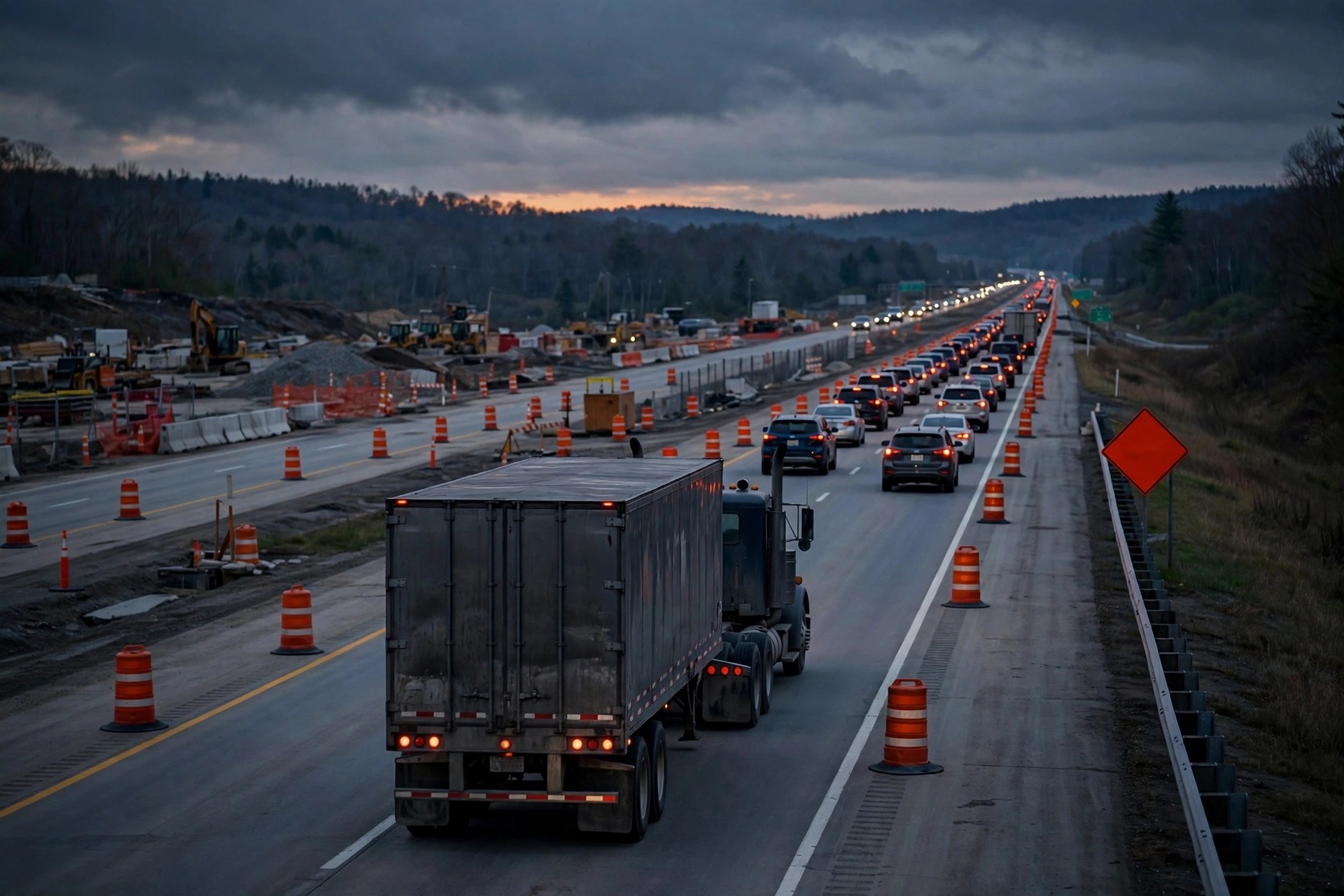
Image: Illustration: AI-generated by CDLWire
Correction — October 29, 2026, 5:21 PM CT: Geographic fix in the takeaway: the I-35 construction-zone guilty plea referenced alongside this case was in Minnesota (Faribault), not on an Ohio corridor.
A truck driver who ran into the back of stopped traffic in an Ohio construction zone in April, killing a family of three, was sentenced to 22 and a half years in prison on Thursday, according to CDLLife on Oct. 29. Modou Ngom, 50, was sentenced in Delaware County for the April 11 crash on Interstate 71, in which his truck slammed into a line of stopped traffic. He had been found guilty in September on all eight charges — three counts of aggravated vehicular homicide and five counts of vehicular assault. At Thursday’s sentencing hearing, prosecuting attorneys accused him of “making up lies” during his trial testimony, CDLLife reported, citing ABC 6. The judge sentenced him after considering victim impact statements, the severity of the crash, Ngom’s apparent lack of remorse and his history of fraudulent CDLs, and imposed a lifetime license suspension on top of the prison term. He will be eligible for parole in 2048, per NBC 4’s reporting as cited by CDLLife. “You wiped out an entire family. The effects of that will be lifelong, life altering, life changing,” the judge told him, according to The Fatu Network’s report of the hearing. The three people killed were a husband, his wife and their one-year-old son; five other people were injured.
The crash itself, as investigators described it in the months after April 11, was a failure to slow for traffic that was already stopped. CDLLife’s earlier reporting on the case said Ngom slammed into standstill traffic in the construction zone near Columbus without touching the brakes, and that a part of his truck’s air brake system — an air reservoir — came loose from the brake system, a detail FMCSA confirmed to reporters at the time. Three weeks before the wreck, federal investigators say, Ngom had been cited in Kansas for a brake violation: a malfunctioning ABS warning light. None of that record reached the sentencing court as a surprise, because the investigation after the crash pulled the whole file apart — and what it found underneath the crash is the part of this case the industry should read twice.
Ohio investigators concluded that the license behind the wheel that day had been built on fraud going back decades. According to the Ohio Department of Public Safety investigation as reported by CDLLife, citing 10WBNS, conflicting identity information in state and federal records led investigators to conclude Ngom entered the United States in the 1990s and used multiple names and dates of birth to obtain state and federal identification. He fraudulently obtained his driver’s license in 2003, and fraudulently obtained his CDL in 2007 using a different identity. He was then naturalized as a U.S. citizen in the mid-2010s using the same identity he had used to obtain the CDL, and reportedly changed his name back to Modou Ngom in 2015. Ohio Department of Public Safety Director Andy Wilson said state investigators’ findings were handed over to U.S. Immigration and Customs Enforcement Homeland Security Investigations, and that the U.S. Attorney’s Office for the Southern District of Ohio and the Delaware County Prosecutor’s Office were also notified.
The second records failure is quieter and, for carriers, more uncomfortable. Investigators discovered that Ngom had previously been convicted of driving an “unsafe vehicle” in a crash involving a malfunctioning drive shaft — a conviction reported to state agencies but not included in federal records, CDLLife reported, citing ABC 6. The Ohio State Highway Patrol’s explanation of a related gap, given to reporters in May, describes exactly how a record falls between the systems: a May 2024 crash involving Ngom was not reported to FMCSA because, under FMCSA guidelines, a commercial crash is reportable when it is fatal, causes serious injuries, or the commercial vehicle is towed — and in that crash the vehicle was not towed, completing a slow roll to a pull-off instead. A driver can therefore carry a state-level safety history that a federal-records check, run exactly as designed, does not surface.
The practical takeaway runs in two directions. On the road, this case joins this month’s I-35 construction-zone guilty plea as the second construction-zone reminder in two days that stopped traffic in a work zone is the deadliest ordinary situation a driver faces — the sentence was built on a truck that never slowed. In the office, the case is the vetting argument in its starkest form: a fraudulently obtained CDL from 2007, a brake citation three weeks before the fatal crash, and an unsafe-vehicle conviction invisible to federal records all sat behind one driver’s paperwork. Every layer of the screening surge carriers have described this week — the application rejections up 170% at Werner, the carrier pools cut by 70% at Knight-Swift — exists because cases like this one kept passing the checks that were supposed to catch them.
Sources
Related coverage
 October 28, 2026 · EnforcementArkansas Highway Shield blitz runs through 6 a.m. Thursday: unqualified drivers, unsafe trucks and fraud are the targets
 October 28, 2026 · EnforcementDriver pleads guilty in the I-35 construction-zone deaths: the cab camera showed Netflix as he reached slow traffic at 68 mph
 October 28, 2026 · EnforcementNew charges detail in the fatal I-81 pileup: driver admits he hid a narcolepsy diagnosis to keep his CDL, troopers say
Comments
Loading comments…