Colorado troopers stopped 119 drivers who ran past I-70 chain checks — 262 citations in two Dotsero details, and the next one is Tuesday
CDLLife reports Colorado State Patrol results from proactive chain-law operations held Oct. 23 and Oct. 28 on I-70 near Dotsero: 703 commercial drivers contacted, 262 citations issued — 63 of them for violating the must-carry chain law — and traffic stops on 119 professional drivers who failed to stop at the chain operation. Compliance with the must-carry rule was 91%. Another enforcement event is planned for Tuesday, Nov. 10, at the same location.
Summarized from CDLLife.
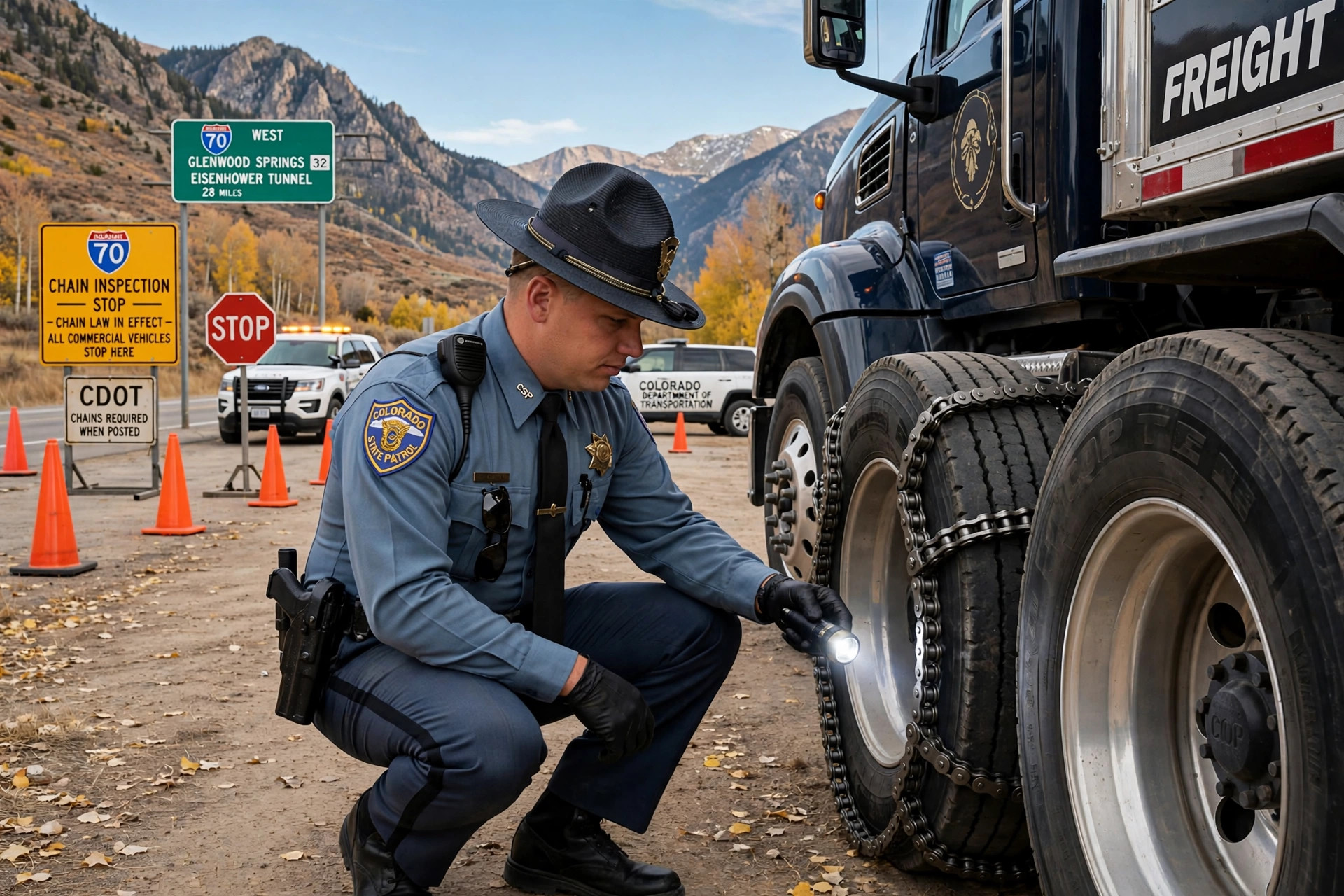
Image: Illustration: AI-generated by CDLWire
Colorado troopers are checking for tire chains on Interstate 70 in dry weather, on purpose — and in two October details near Dotsero they stopped 119 professional drivers who did not stop for the check at all, according to CDLLife on Nov. 6, reporting results released by the Colorado State Patrol. The proactive chain-law enforcement operations took place Oct. 23 and Oct. 28 in Eagle County, in mild conditions, and the patrol says another chain enforcement event is planned for Tuesday, Nov. 10, near Dotsero on I-70 — two days from now, on the same stretch of the mountain corridor.
The results describe an operation aimed at readiness rather than at a storm. Troopers contacted 703 commercial drivers across the two details and issued 262 citations. Of those, 63 citations were for chain violations — drivers not adhering to the state’s must-carry law. The 119 traffic stops were a separate failure: drivers who failed to stop at the chain operation were pulled over, issued citations and checked for chains. The patrol put overall compliance with the must-carry rule at 91%, which means roughly one driver in eleven who came through was not carrying what Colorado law requires — in October, before the first serious snow of the season on the corridor.
The patrol explained the dry-weather timing in its own words. “Each year, CSP regularly implements chain checks at the ports of entry, active chain-up stations, and daily roadside contacts. However, the Patrol also conducts proactive enforcement operations during mild weather conditions, including proactive chain-carry checks, to send a clear message to commercial drivers to stay prepared for impending winter weather along the I-70 mountain corridor,” the patrol said. OTR News, in a Nov. 7 account of the same results, added the scale of a full season: from Sept. 1, 2025 through May 31, 2026, 2,405 commercial drivers were cited in Colorado, troopers wrote 586 of those citations, and 522 of the trooper citations were on the I-70 corridor — which is why the corridor gets its own recurring details.
The law underneath the checks is a carry requirement, not just a use requirement, and it is already in force. Every year from Sept. 1 to May 31, commercial vehicle drivers must carry chains or approved alternate traction devices on I-70 west of mile marker 259 at Morrison to the Utah border; on Colorado Highway 9 from Frisco to Fairplay; on U.S. Route 40 from Empire to the Utah border; on U.S. Route 50 from Salida to the Utah border; on U.S. Route 160 from Walsenburg to the New Mexico border; on U.S. Route 285 from Morrison to the New Mexico border; and on all of U.S. Route 550. The requirement applies to vehicles with a combined weight of more than 16,000 pounds used in commerce, or carrying at least 16 passengers including the driver. A driver can be fully legal on traction in the moment — dry pavement, no chain law activated — and still be citable for not having the chains on the truck.
The money is not trivial, and it escalates with the consequences. According to the patrol, the penalty for noncompliance with winter driving restrictions is up to a $500 fine plus a $79 surcharge — and if a truck gets stuck and blocks any traveled portion of the roadway, the fine rises to a $1,000 fine plus a $157 surcharge. That second number is the one to plan around on the I-70 corridor: the fine for blocking is double the fine for the violation itself, and it arrives on top of the tow, the delayed load and the hours lost at the scene.
The practical takeaway for any driver dispatched across Colorado between now and May 31 is short. Carry chains or approved alternate traction devices that actually fit your drive tires, count them before you load, and stop at every chain check and port of entry you are directed to — running past one converts a two-minute compliance check into a traffic stop and a citation, as 119 drivers learned in October. With the next Dotsero detail set for Tuesday, Nov. 10, and ports of entry running chain checks through the season, the time to discover a missing or broken chain is in your own yard, not at mile marker 133 in Eagle County.
Sources
Related coverage
 November 7, 2026 · EnforcementIndiana police and the FBI are investigating a 45-truck carrier over alleged ELD cheating and pay-skimming — and the owner says fired employees invented it
 November 6, 2026 · Enforcement1 in 7 trucks parked for brakes: CVSA's Brake Safety Week puts 2,369 vehicles out of service, and the 15.3% failure rate barely moved from last year
 November 6, 2026 · EnforcementThe Brenham DPS attack ends in a plea: Clenard Parker gets life without parole for driving a stolen rig through the office that denied his CDL renewal
Comments
Loading comments…