1 in 7 trucks parked for brakes: CVSA's Brake Safety Week puts 2,369 vehicles out of service, and the 15.3% failure rate barely moved from last year
CVSA released its 2026 Brake Safety Week results on Nov. 6: 15,528 brake inspections across North America during Aug. 23–29, with 2,369 vehicles placed out of service — 15.3% overall and 15.1% in the U.S. Half the parked trucks failed under the 20% defective brake rule, hoses and tubes were the biggest named category at 600 violations, and drum and rotor out-of-service orders rose from last year. Next year's week runs April 18–24, 2027.
Summarized from Commercial Vehicle Safety Alliance.
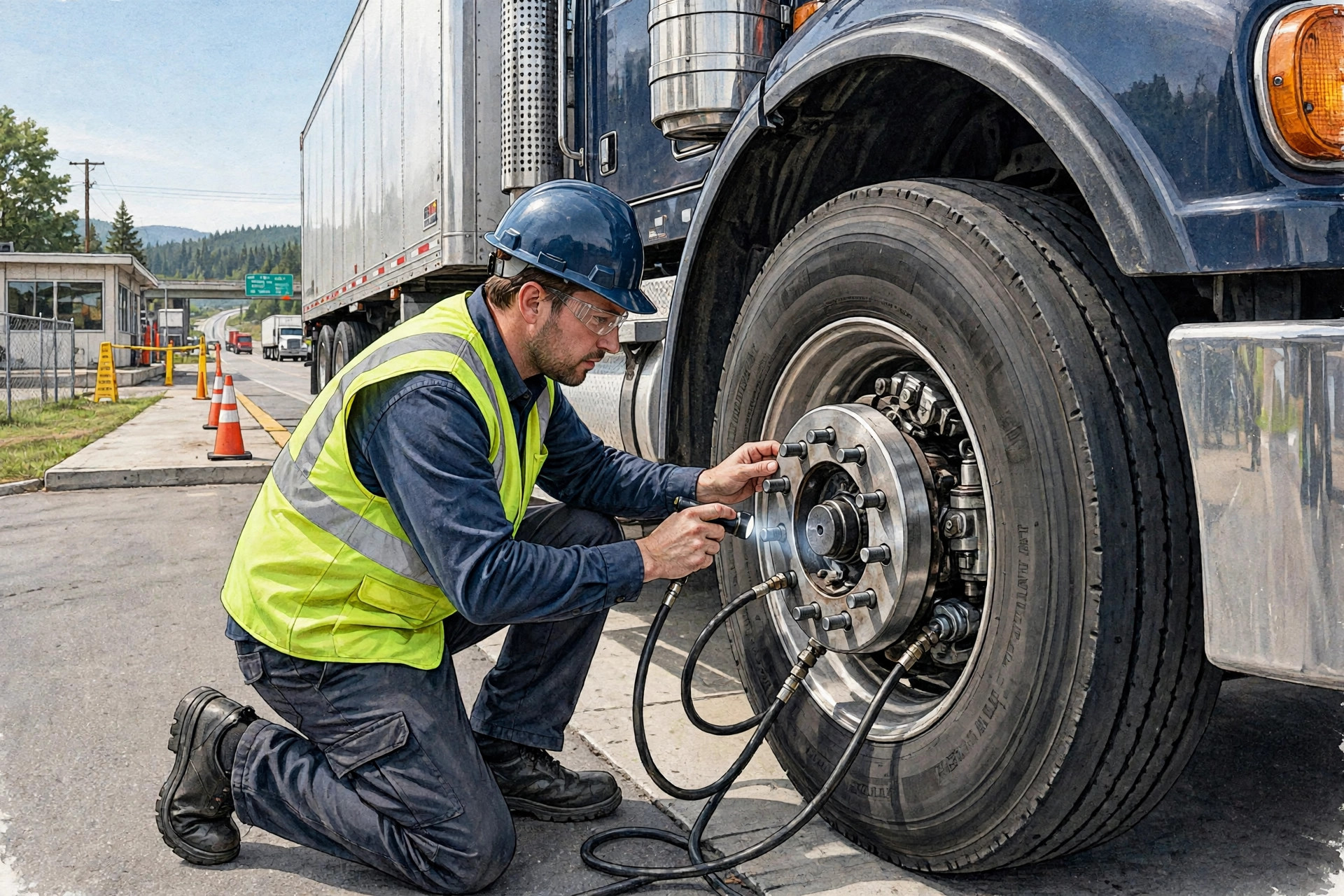
Image: Illustration: AI-generated by CDLWire
One in seven trucks checked during this year’s Brake Safety Week could not leave the inspection site until its brakes were fixed, according to the Commercial Vehicle Safety Alliance on Nov. 6. CVSA released the results of the Aug. 23–29 campaign on Friday: inspectors conducted 15,528 commercial motor vehicle brake inspections in Canada, Mexico and the United States, and placed 2,369 vehicles out of service for brake-related violations — a 15.3% out-of-service rate. The other 13,159 vehicles, 84.7% of those inspected, had no brake-related out-of-service violations. Fifty-one jurisdictions took part in the seven-day campaign, CVSA’s annual brake inspection and education push under its Operation Airbrake Program.
The United States ran most of the week and landed near the continental average. U.S. inspectors conducted 14,165 inspections and placed 2,134 vehicles out of service, a 15.1% rate. Canada’s rate ran higher — 232 of 1,306 inspections, 17.8% — while Mexico’s small sample produced 3 out-of-service orders in 57 inspections, 5.3%. Most of the work was done at the deepest level of roadside inspection: 91% of the week’s inspections, 14,150 in all, were North American Standard Level I inspections, the 37-step procedure that examines the driver’s operating requirements and the vehicle’s mechanical fitness. The brake portion of a Level I checks brake adjustment, slack adjusters, linings, pads, return springs, brake chambers and cam shafts, air pressure and air loss, the tractor protection system, air tanks, tubing, hoses and fittings, and the anti-lock braking system.
Half of the trucks parked were not stopped by one dramatic failure. Inspectors placed 1,176 vehicles — 49.6% of all brake out-of-service orders — under the 20% defective brake criterion, which means 20% or more of the service brakes on the vehicle or combination had an out-of-service condition. A combination is judged as a unit, so worn brakes spread across a tractor and trailer add up against the whole rig: no single wheel end has to be catastrophic for the truck to be parked, and a neglected trailer can sideline a sound tractor.
After the 20% rule, the biggest single named category was the air plumbing. Inspectors wrote 600 out-of-service violations for brake hoses and tubes, and 759 other out-of-service brake violations covering the tractor protection system, air tanks, parking, emergency and breakaway brakes, the low-air warning device, and hydraulic and electric brake faults. Air loss rate produced 145 out-of-service violations, and the steering axle added 92 violations for linings and 119 for other steering axle conditions. Hoses, tubes and air loss are the findings a driver’s own pre-trip can catch first — chafing, cracking and rubbing against the frame, an audible leak at the glad hands, a gauge that will not hold pressure.
This year’s focus area was drums and rotors, and that count rose from last year. Inspectors recorded 141 drum and rotor violations and placed 64 vehicles out of service for them, up from 113 violations and 39 vehicles parked in the 2025 campaign, according to OTR News on Nov. 6, summarizing CVSA’s 2025 results. The detail shows where the wear is: air disc brakes accounted for 97 of the violations — 45 rusted rotors, 32 broken rotors and 20 cases of metal-to-metal contact — while S-cam drum brakes produced 36 broken drums, and hydraulic brakes added 8 more violations.
Twelve U.S. jurisdictions also put trucks on performance-based brake testers, which measure actual braking force instead of relying on what an inspector can see. Of 657 inspections using the testers, 29 vehicles — 4.41% — failed to meet the required 43.5% minimum braking efficiency and were placed out of service. A truck can look acceptable on a walk-around and still fail that test, which is why the tester results matter out of proportion to their small share of the week.
The headline rate barely moved from a year ago. CVSA’s 2025 Brake Safety Week recorded 15,175 inspections and a 15.1% brake out-of-service rate, against 15,528 inspections and 15.3% this year — two consecutive campaigns in which roughly one inspected truck in seven was parked for its brakes. The rate describes the trucks inspectors checked during a focused enforcement week, not every truck on the road, but its stability is the story: a year of ordinary inspections, maintenance programs and last year’s warnings did not move the share of inspected trucks failing on the system’s most basic safety component.
For drivers and carriers, the working lessons are the specific ones. An out-of-service order restricts the vehicle from operating until the violations are corrected, so the cost is a repair on the inspector’s schedule, not the shop’s — plus the delayed load and the lost day. Check hoses and tubes first, run the air-loss test on every pre-trip, verify stroke and adjustment at every wheel end, and look hard at drums and rotors for cracks, heavy rust and metal-to-metal wear, because inspectors demonstrably are. Walk any trailer you did not load or maintain before you pull it: under the 20% rule, its brakes are your out-of-service order. CVSA’s own closing message was that brake safety is a year-round responsibility, and the calendar now backs it up — next year’s Brake Safety Week is scheduled for April 18–24, 2027, months earlier than this year’s August slot, and brakes are checked at every Level I inspection in between.
Sources
Related coverage
 November 5, 2026 · EnforcementCargo theft is rarer but far more expensive: Q3 incidents fell 33% to 547, losses rose to $230.1 million, and fictitious pickups now drive 1 in 4 cases
 November 5, 2026 · EnforcementDOT says 33,000 drivers are now out of service for English proficiency as Operation Highway Shield adds Arkansas and Virginia results
 November 4, 2026 · EnforcementCVSA sets its 2027 calendar: Brake Safety Week moves to April 18–24 and Roadcheck follows on May 11–13 — 17 days later
Comments
Loading comments…