Alaska storm Monday: 8 to 12 inches on the Haines Highway at the border, and snow, freezing rain and 60 mph gusts for Anchorage's evening commute
The National Weather Service in Juneau has upgraded the Haines Highway to a winter storm warning for Monday — 8 to 12 inches of snow possible at the upper elevations near the border crossing, 3 AM to 6 PM AKST — with a winter weather advisory for 5 to 8 inches on the Klondike Highway near White Pass. In Anchorage, a winter weather advisory runs from noon Monday to 3 PM Tuesday: 2 to 8 inches of snow, a light glaze of ice and gusts to 60 mph on the Hillside, hitting both the Monday evening and Tuesday morning commutes.
Summarized from National Weather Service.
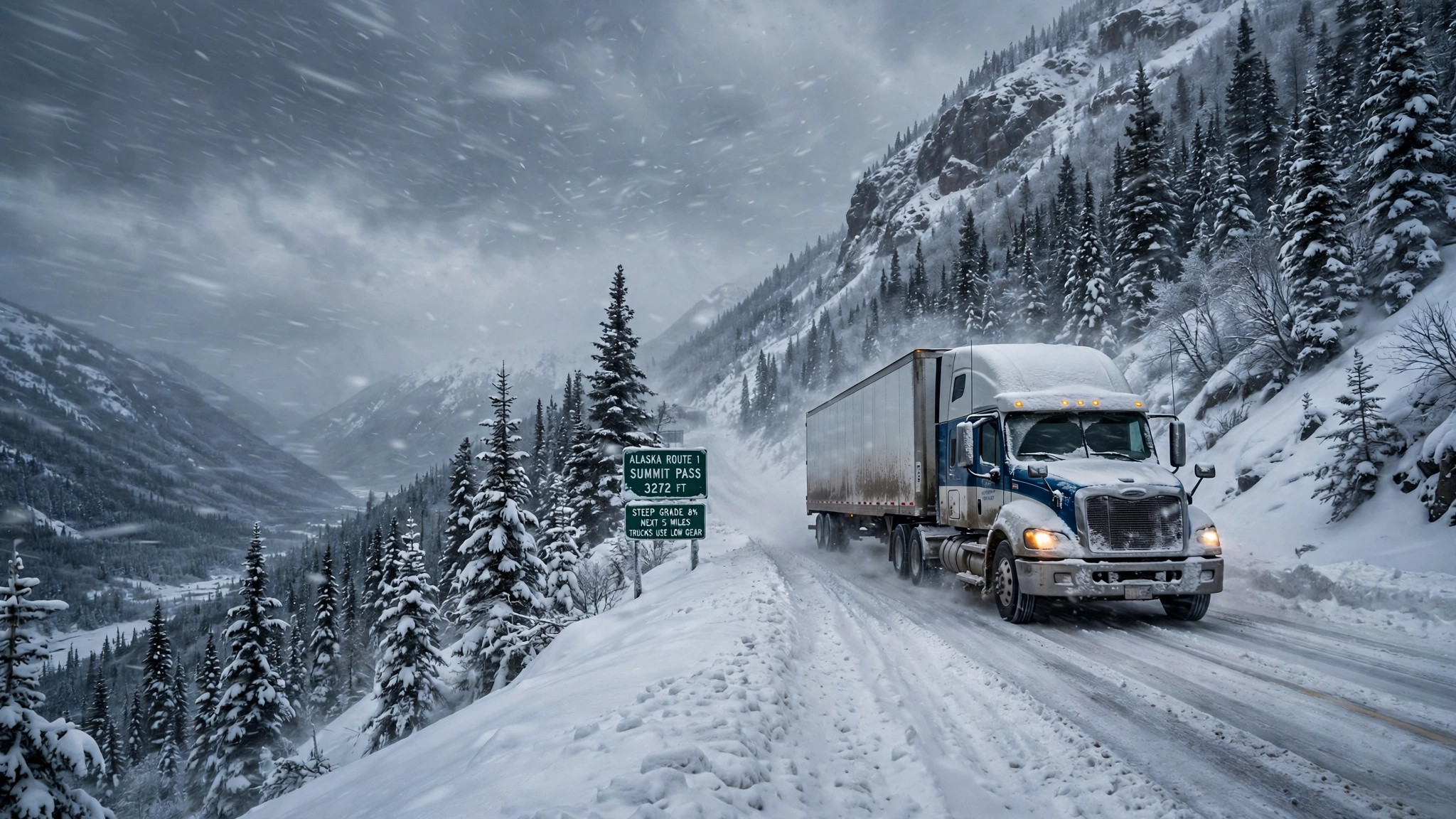
Image: Illustration: AI-generated by CDLWire
Alaska’s two Southeast border highways and its largest city are in the same storm on Monday. The National Weather Service in Juneau upgraded its winter storm watch to a winter storm warning for the upper elevations of the Haines Highway near the border crossing, in effect from 3:00 AM to 6:00 PM AKST on Monday, with heavy snow and total accumulations of 8 to 12 inches possible and travel that could be very difficult, according to the National Weather Service on Nov. 8. The warning covers Haines Borough and Klukwan, including the city of Haines, and it is aimed at the stretch of highway every truck leaving the Haines ferry terminal for Canada has to climb.
The second Southeast crossing is one tier down. A winter weather advisory covers the Klondike Highway near White Pass, for the Municipality of Skagway including Skagway and White Pass, over the same Monday hours — 3:00 AM to 6:00 PM AKST — with snow expected and total accumulations of 5 to 8 inches possible, winds gusting up to 25 mph, blowing snow and reduced visibilities, and travel that could be difficult. Juneau’s forecasters explained the split in their message: a strong system moves through Sunday night into Monday with temperatures below freezing and snow levels below 1,000 feet, and mid-level southeasterly flow may shelter White Pass from much of the precipitation while allowing ample moisture into the Haines Borough, falling as snow at the border. On the Haines side, snow levels rise steadily from about 500 feet to 2,000 feet by Monday evening — the storm warms as it winds down, but not before the warning’s snow has fallen on the pass.
Well to the northwest, the same Gulf of Alaska system reaches the state’s freight hub with a more complicated forecast. The Anchorage office’s winter weather advisory for the Anchorage Hillside and Eagle River, corrected at 3:29 AM AKST on Monday, remains in effect from noon Monday to 3:00 PM AKST on Tuesday: mixed precipitation expected, total snow accumulations between 2 and 8 inches and ice accumulations around a light glaze, with winds gusting as high as 60 mph, mainly across the southern parts of the Anchorage Hillside. The office is explicit about the timing that matters to anyone dispatching into the city: travel could be very difficult, the hazardous conditions will impact the Monday evening and Tuesday morning commutes, and the strong winds could cause damage to trees and power lines.
The Anchorage sequence is a changeover storm, and the changeover is the risk. Precipitation starts as mainly heavy snow on Monday afternoon, then transitions to a mix of snow and freezing rain tonight into early Tuesday morning as east winds pick up, and could transition to plain rain by Tuesday morning as temperatures rise above freezing. The office says the uncertainty in that timing remains high: a later transition to rain and freezing rain means higher snowfall totals, while warmer air arriving quicker means less snow and ice. Autoblog, summarizing the Anchorage advisories on Nov. 9, puts the wider map at up to 3 inches of snow, ice from a light glaze to a tenth of an inch and gusts to 50 mph for the Anchorage Bowl and the Lower Matanuska Valley — Wasilla, Palmer and Big Lake, the Glenn Highway corridor — and 1 to 8 inches of snow, up to a tenth of an inch of ice and coastal gusts to 45 mph on the western Kenai Peninsula, including Kenai, Soldotna, Homer and Cooper Landing, with low confidence in when the precipitation switches to rain. A separate system brings up to 3 inches and gusts to 50 mph to the Arctic Coast from Tuesday into Wednesday.
Why two Southeast passes matter beyond their zip codes is the structure of Alaska freight. Haines and Skagway are ferry ports: freight that arrives by Alaska Marine Highway or barge and is bound for the Yukon, the Alaska Highway or the Interior rolls out of those terminals over exactly two roads — the Haines Highway through Haines Customs into British Columbia and the Yukon, and the Klondike Highway over White Pass out of Skagway. There is no alternate route around either pass: a slow, chained-up crawl at the border elevations does not reroute that freight; it holds it at the terminal until the pass clears. Anchorage, meanwhile, is where the state’s port, airport and warehouse freight concentrates, and its Monday-evening and Tuesday-morning commutes are the hours its local delivery work shares the Glenn and Seward highway corridors with everyone else.
The driving details in the advisories are the standard Alaska kit, stated plainly because they decide days like this. Bridges and overpasses ice first, and a span can be glazed while its approaches look merely wet. Studded tires are now legal on every paved road in the state, and chains are allowed whenever snow or ice makes skidding likely — on the Haines and Klondike passes, Monday is a carry-them-and-expect-to-use-them day, not a judgment call. Ice also coats the windshield, mirrors, headlights and the grille-mounted sensors behind adaptive cruise and automatic emergency braking, and has to be scraped, not brushed, or those systems can drop out mid-drive. Juneau’s message closes with the instruction both offices repeat: if you must travel, keep an extra flashlight, food and water in the vehicle, and check 511.alaska.gov or call 511 for the latest road conditions before rolling — on a two-pass freight map, the 511 check is the dispatch decision.
Sources
Related coverage
 November 8, 2026 · Weather and roadsSouth Texas flood threat escalates overnight: forecast totals raised to a widespread 3 to 6 inches, worst of it late today into early Monday
 November 7, 2026 · Weather and roadsFlood Watch for South Texas through Monday morning: 2 to 4 inches of rain, locally over 5, on the Laredo and I-10 freight corridors
 November 5, 2026 · Weather and roadsPagosa's Piedra River fix is now a four-week job: temporary bridge needs new abutments, Wolf Creek stays shut, and Highway 84 is the lifeline
Comments
Loading comments…