Holiday freight is moving: reefer spot climbs $0.10 to $3.70 a mile in DAT's week ending Nov. 6, and van and reefer trail only 2021 for early November
DAT's weekly release for the week ending Nov. 6, published Monday, puts the 7-day average broker-to-carrier reefer rate at $3.70 a mile, up $0.10, with reefer load posts up 16% and the load-to-truck ratio at 19.0. Van linehaul rose $0.06 to $2.26 a mile and flatbed $0.02 to $2.63, truck posts run 24% to 34% below a year ago, and DAT's 35-day forecast has van linehaul reaching $2.32 by mid-December.
Summarized from The Trucker.
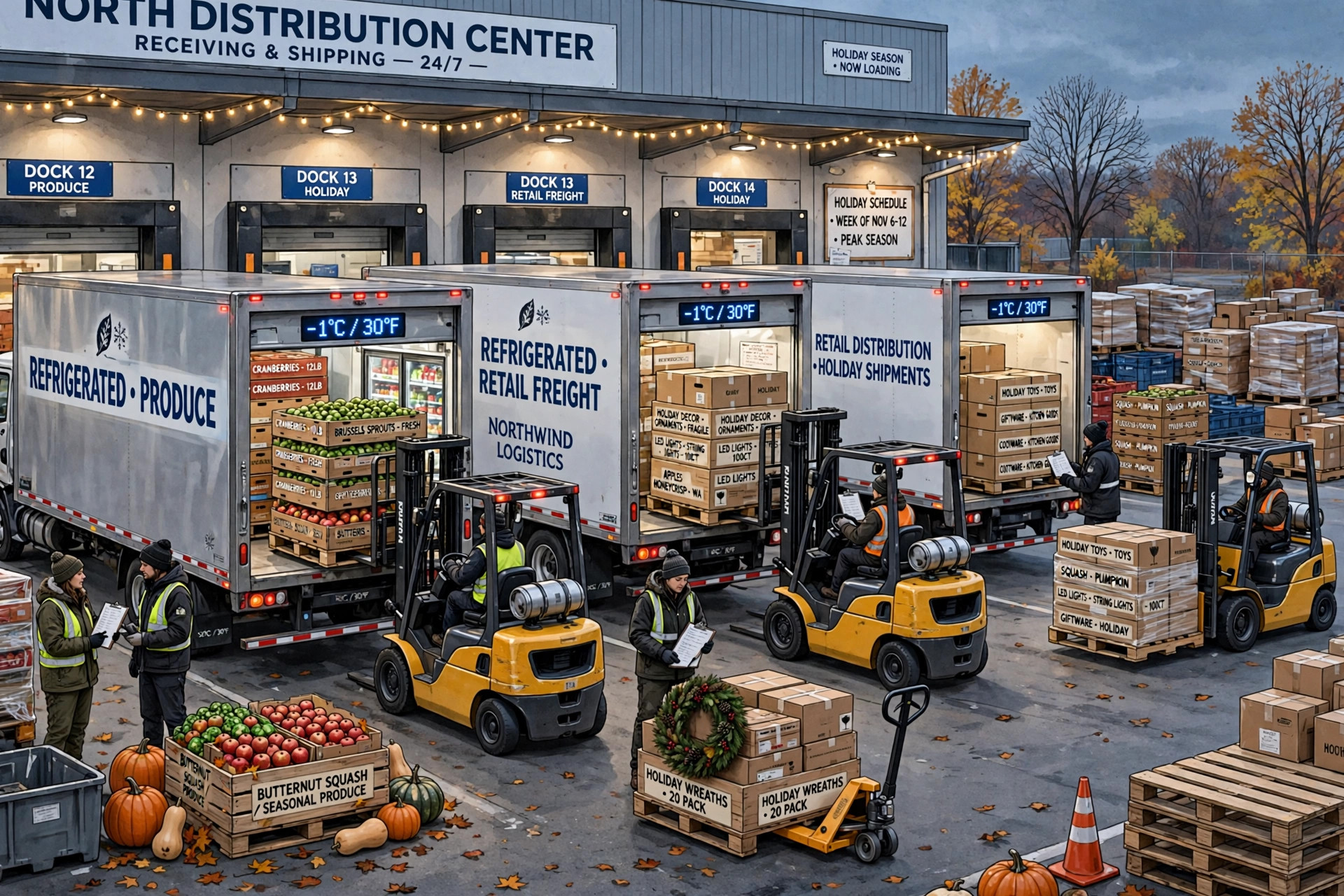
Image: Illustration: AI-generated by CDLWire
Holiday freight started moving in earnest in the week ending Nov. 6, and spot rates climbed with it. DAT One load posts totaled 2.85 million, up 4%, while equipment posts fell 2% to 171,389, according to The Trucker on Nov. 9, reporting DAT Freight & Analytics’ weekly release. Spot linehaul rates rose $0.02 to $0.09 a mile across the three equipment types, and broker-to-carrier spot rates — linehaul plus the fuel surcharge — rose $0.04 to $0.10 a mile, with linehaul driving most of the increase.
The 7-day average broker-to-carrier rates put reefer on top: $3.70 per mile, up $0.10 from the prior week. Dry van averaged $3.11 per mile, up $0.07, and flatbed averaged $3.65 per mile, up $0.04. “Van and reefer rates trail only 2021 for early November,” said Dean Croke, industry analyst at DAT. Linehaul rates are 35% above last year for van, 34% for reefer and 31% for flatbed, and 23% to 28% above their nine-year seasonal averages.
Dry van was the quietest board, and it still firmed: load posts slipped 2% to 1,257,623 and truck posts slipped 2% to 115,330, the ratio held at 10.9, and the linehaul rate rose $0.06 to $2.26 per mile — because posted trucks run 24% to 34% below a year ago across the equipment types, while load posts run 22% to 47% higher.
Reefer had the big week. Load posts jumped 16% to 631,561 — the largest gain of the three types — while truck posts fell 4% to 33,218, driving the load-to-truck ratio to 19.0 from 15.7, and reefer linehaul gained $0.09 to $2.77 per mile, also the largest increase of the three. “Reefer freight had a big week,” Croke said. Trucks are tight for Northwest apples and California citrus: the U.S. Department of Agriculture’s Nov. 3 truck rate report rated availability adequate in most produce areas, with slight shortages for apples and pears out of Washington’s Yakima Valley and Wenatchee district and for citrus from South and Central California, and rates of $12,900 to $13,800 a load to move Washington apples and pears to Miami.
Flatbed loosened at the margin without getting loose: load posts rose 5% to 965,338, truck posts rose 3% to 22,841, the ratio nudged up to 42.3 from 41.7 — nearly double last year’s 21.1 — and linehaul rose $0.02 to $2.63 per mile.
The other board drivers watch tells the same tightness story in a different mix. Truckstop and FTR, covering the same week and also reported by The Trucker on Nov. 9, said broker-posted rates rose for dry van and refrigerated equipment and fell for flatbed, down $0.057 a mile — moves FTR called mostly seasonal. Truckstop load activity rose 7.0% while truck postings fell 8.5%, the largest drop in nearly six months, pushing its Market Demand Index to the highest level since early July. Refrigerated rates there rose just over $0.07 a mile — the largest increase since the week before Labor Day and the first in four weeks — on load volume up 18.4%. Its total market rate eased $0.018 a mile but stood almost 41% higher than a year ago.
Fuel is doing more of the work inside the all-in rate than drivers may realize. DAT says the fuel surcharge portion of the dry van spot rate is now $0.85 a mile, up from $0.37 in mid-January and above the 2022 peak of $0.76; $0.44 of the $1.02-a-mile year-over-year increase in the all-in van rate came from fuel, which now accounts for 27% of that rate, up from 16% at the start of the year. The surcharge math used the Energy Information Administration’s $6.352-a-gallon average for the week of Oct. 26; the agency has since reported $6.292 for the week of Nov. 2, down $0.06 and its first decline in three weeks, which feeds next week’s surcharge and takes about $0.01 a mile off all three types.
The calendar is the rest of the story. “The calendar adds to a tight truck supply,” Croke said. “Holiday retail freight and food are moving” as restocking draws freight out of distribution centers, and Christmas tree loads out of Oregon are under way. DAT’s 35-day RateCast forecast has van linehaul rising to $2.32 a mile by mid-December, reefer easing to $2.76 and flatbed edging up to $2.64. One regional wrinkle: Diwali peaked on Sunday, Nov. 8, and many Punjabi Sikh drivers take the week off, tightening California capacity, especially long-haul reefer out of markets like Stockton; California’s reefer rate rose $0.15 to $2.91 a mile this week, and its dry van rate rose $0.15 to $2.77, the largest dry van gain among top origin regions.
For drivers, the practical read is that reefer is the hot board into Thanksgiving on Nov. 26, van capacity stays tight with a forecast still rising into mid-December, and flatbed demand is historically strong even where the all-in rate softens seasonally. Negotiate on the linehaul, not the all-in number: the fuel piece may give back roughly $0.01 to $0.02 a mile as the lower Nov. 2 diesel print feeds surcharges — diesel has fallen between early November and late December in seven of the past 11 years, by a median of about $0.11 a gallon. Treat the prints as provisional: DAT revises as invoices arrive, and last week’s first-reported van and reefer linehaul rates were later revised down to $2.20 and $2.69 per mile, with flatbed holding at $2.61.
Sources
Related coverage
 November 6, 2026 · Fuel & ratesATA's Costello: the freight market has turned — but it is a supply recovery, not a demand boom, and shipper spending is up 32% on flat shipments
 November 3, 2026 · Fuel & ratesOctober LMI: transportation capacity contracts for an 11th straight month at 38, prices read 88, and new truckload contracts are resetting about 13% higher
 November 3, 2026 · Fuel & ratesDAT says spot linehaul rates climbed again in the week ending Oct. 31 — van $2.23, reefer $2.71, flatbed $2.61 — while Truckstop's all-in rates fell for all three types
Comments
Loading comments…