ATA's Costello: the freight market has turned — but it is a supply recovery, not a demand boom, and shipper spending is up 32% on flat shipments
American Trucking Associations Chief Economist Bob Costello told his annual U.S. Bank update that capacity finally came down enough to meet demand, helped by the non-domiciled CDL, English-proficiency and training-school crackdowns that began in spring 2025. Shipments are roughly flat, but shippers paid 32% more in the third quarter — and in Texas, spending rose 37% while shipments fell 12.9%.
Summarized from Transport Topics.
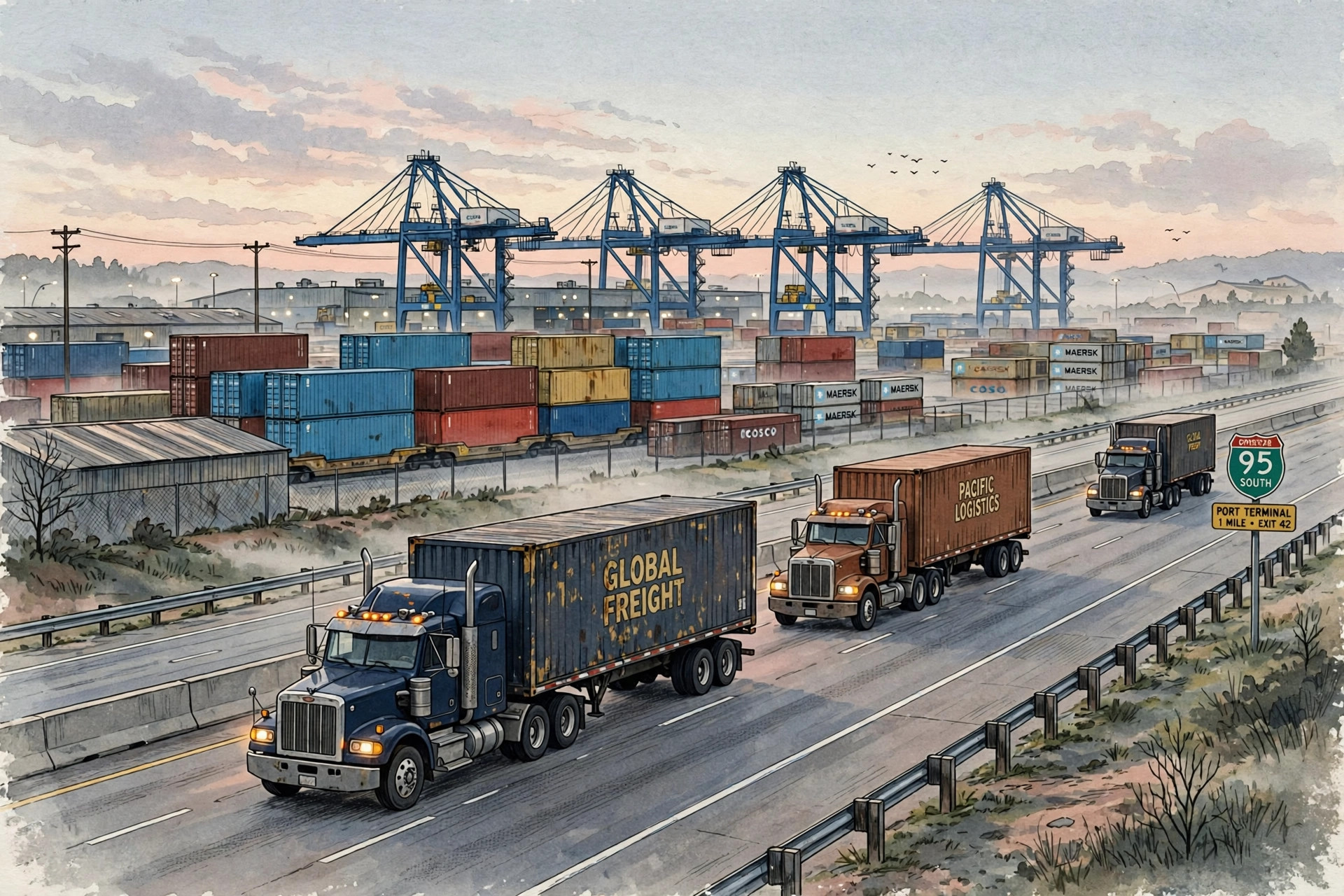
Image: Illustration: AI-generated by CDLWire
The trucking industry is only at the beginning of a supply-driven recovery after a prolonged downcycle, American Trucking Associations Chief Economist Bob Costello said, according to Transport Topics on Nov. 5. Costello made the remarks during his annual economic and trucking update in partnership with U.S. Bank, delivered at the ATA's MCE 2026 gathering in Charlotte, North Carolina — and his central point was a distinction every driver pricing freight this winter should understand: the market has turned because trucks and drivers left, not because freight flooded back.
“Broadly speaking, the freight market is not super strong,” Costello said during the discussion. “You might go, ‘I thought he said early on the market has turned.’ It absolutely has. But understand it is all around industry supply, and we’ve never really seen a recovery quite like this.” The background is the cycle the industry has lived since the pandemic: a freight boom drove an oversupply of capacity, freight demand adjusted downward, and carriers then spent years grappling with declining rates and high expenses. Companies went out of business through that stretch, Costello noted, but not fast enough to bring capacity in line with demand — which is why the downturn felt endless even as trucks quietly exited.
“So the good news is the market has turned, and it will continue to turn, I believe, but it’s all based on supply,” Costello said. “Capacity absolutely did come down. It’s just that you never felt it because it didn’t come down enough to meet demand.” What changed, in his telling, was a second phase that started in the spring of 2025, when new and increased driver enforcement rules arrived. “Then we entered phase two, and phase two started in say, the spring of 2025, and we were getting new and increased driver enforcement rules,” Costello said. “We’ve had court rulings, we’ve had high diesel fuel prices, and this has been the catalyst.” The Department of Transportation was a major driver of the escalation, tightening enforcement of the rules governing non-domiciled commercial driver licenses, English-language proficiency standards and driver training schools with concerning track records, while Customs and Border Protection has worked with the department to stop illegal uses of B-1 business-visitor visas.
The demand side, by contrast, is uneven rather than strong. Costello said the freight market is more mixed than the macroeconomic view suggests, with some trucking companies doing better than others depending on what they haul and who they compete against. He pointed to airplane production and equipment going into data centers as drivers of overall factory output, while retail sales and construction show similarly mixed pictures. Wages, he noted, were the biggest cost through the downturn, as competition for qualified drivers grew — a reminder that even in a weak market, the driver shortage that mattered was always the shortage of drivers carriers were willing and able to qualify.
The clearest number in the update is the gap between freight and money. “For everybody across all regions combined, you can see that shipments are pretty flat, up a little bit in the third quarter year over year, down a little bit year to date,” Costello said. “But look at shipper spending, up quite a bit, 32% in the third quarter year over year.” Shippers are paying roughly a third more to move roughly the same amount of freight — that is what a supply-side tightening looks like in a ledger. The trend is especially pronounced in states with high exposure to cross-border freight, including Texas, Oklahoma, New Mexico and Arizona: shipments in Texas are down 12.9% so far this year, while shipper spending there has increased 37%.
Costello also addressed the two things that could end or extend the turn. The first is the economy itself: “So then the question becomes, how long is this market going to last,” he said. “One thing that could bring it to an end is a recession. But even though there’s only some pockets of strength overall for the goods economy and so forth, we just don’t see that at this point. It’s something we’ll watch closely but we don’t see a recession on the horizon.” The second is politics. He does not anticipate changes in political leadership following elections — including the recent midterm elections or the upcoming presidential election — doing much to derail the enforcement crackdowns, since many of the initiatives involve administrative actions and are tied to safety. Nor does he expect a significant upsurge in capacity: OEM sales and orders have improved, but replacement rates have been very low for the last couple of years, leaving a long way to go before new trucks rebuild the fleet.
For drivers and small carriers, the practical read is to price this recovery for what it is. A supply-driven turn rewards whoever is still running and qualified when a load posts — it does not promise more freight, and it can reverse on the demand side if the pockets of strength in manufacturing fade. The enforcement actions doing the tightening are, on Costello’s account, administrative and safety-based rather than electoral, so carriers should plan as if the non-domiciled, English-proficiency and training-school scrutiny continues under any Congress.
Sources
Related coverage
 November 3, 2026 · Fuel & ratesOctober LMI: transportation capacity contracts for an 11th straight month at 38, prices read 88, and new truckload contracts are resetting about 13% higher
 November 3, 2026 · Fuel & ratesDAT says spot linehaul rates climbed again in the week ending Oct. 31 — van $2.23, reefer $2.71, flatbed $2.61 — while Truckstop's all-in rates fell for all three types
 November 3, 2026 · Fuel & ratesOil fell more than 6% Monday on U.S.–Iran diplomacy hopes and pump diesel eased to about $6.28–$6.29 a gallon — but Goldman still puts a $140 scenario on 2027
Comments
Loading comments…