Saia asks FMCSA to let learner's-permit trainees pull doubles under supervision — about 300 trainees a year
FMCSA published Saia LTL Freight's request on Nov. 17 for a five-year exemption from 49 CFR 383.93(b)(1) and 383.37(a), so CLP holders in its training program could operate doubles without a T endorsement while directly supervised by a qualified CDL holder who has one — with a company knowledge test mirroring the state exam and closed-yard proficiency first. Public comment opens when the notice publishes in the Federal Register on Nov. 18.
Summarized from CDLLife.
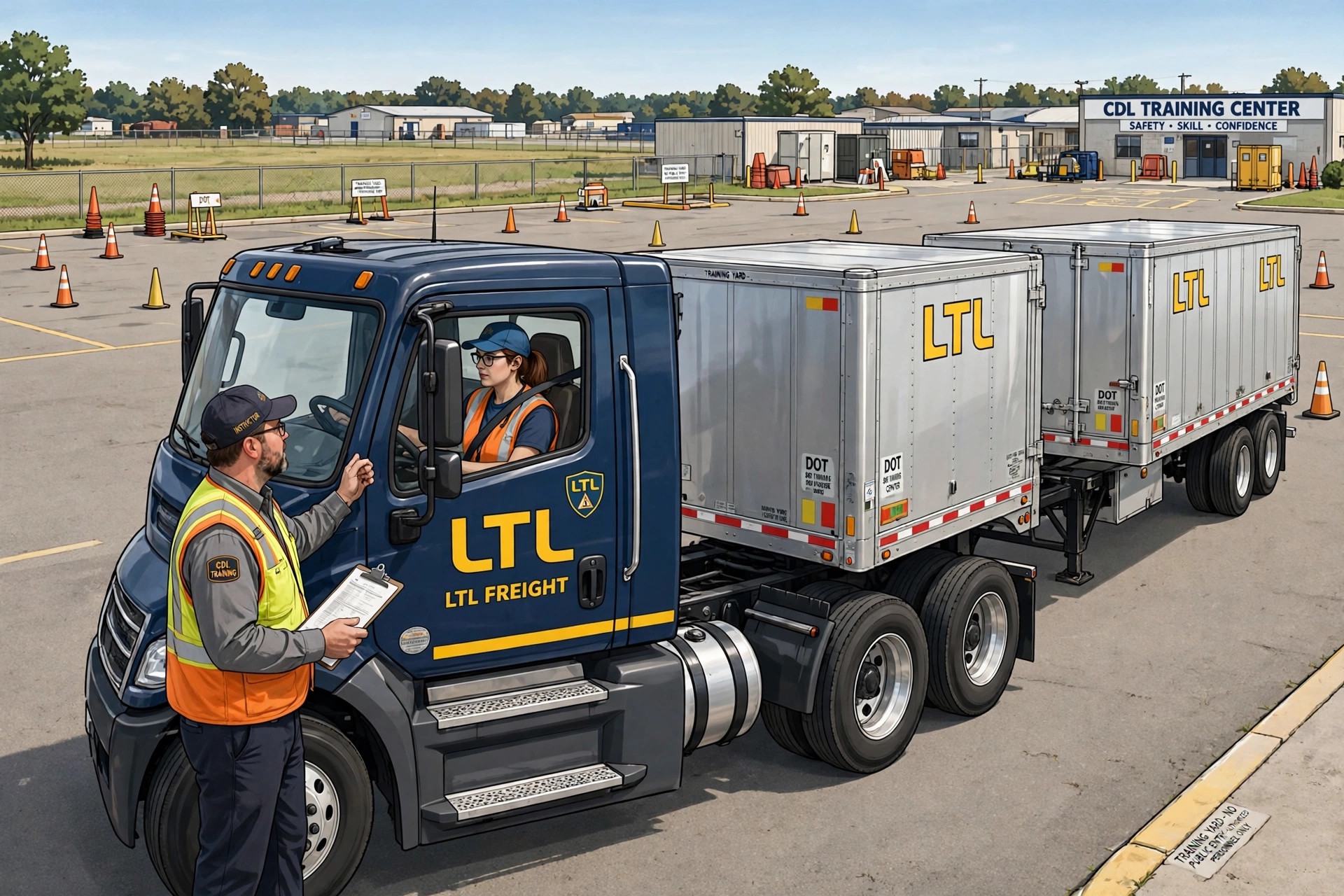
Image: Illustration: AI-generated by CDLWire
A large nationwide carrier has asked the Federal Motor Carrier Safety Administration for an exemption that would let its learner's-permit trainees operate double trailers under supervision before they hold the endorsement those trailers normally require, according to CDLLife on Nov. 17.
On Nov. 17, 2026, FMCSA published a notice from Georgia-headquartered Saia LTL Freight seeking a five-year exemption from the requirements in 49 CFR 383.93(b)(1) and 49 CFR 383.37(a). Specifically, Saia requested an exemption that would allow commercial learner's permit holders to operate commercial motor vehicles configured with double trailers without holding a commercial driver's license with a doubles/triples (T) endorsement, while under the direct supervision of a qualified CDL holder with a T endorsement.
The request is made on behalf of CLP holders enrolled in Saia's driver training program, in order to, in the company's words, "streamline the training pipeline and allow its trainees (CLP holders) to gain on-the-road experience with doubles under expert supervision before taking the final CDL test, thereby increasing the supply of qualified drivers for its operations." The exemption would apply to approximately 300 Saia driver trainees annually — a number that makes this a pipeline question for one large LTL carrier rather than a general change to endorsement law, and also makes the scale concrete: if granted for five years on those terms, roughly fifteen hundred trainee cohorts' worth of drivers would learn doubles this way, one annual class at a time.
Saia's safety case rests on substituting its own checks for the state's, in sequence, before any trainee touches a public road with doubles. The company argues that allowing the exemption would not compromise safety because student drivers must pass a company-administered knowledge test that mirrors the state CDL doubles/triples exam. Additionally, Saia requires trainees to show proficiency in coupling, uncoupling and maneuvering doubles in a closed-yard environment before operating on public roadways. And if the exemption were granted, trainees would carry proof of the completed internal training and the company-administered exam at all times while operating — the document a roadside inspector would have to rely on in place of the endorsement that would normally appear on the license itself.
That substitution is the point on which the request will be judged, and it is worth being precise about what is and is not being asked. Saia is not asking to waive the T endorsement for licensed drivers, to let trainees drive doubles alone, or to change the final CDL test: the supervision condition is a qualified CDL holder with a T endorsement, directly supervising, and the stated purpose is experience before taking the final test, not instead of it. What is being asked is narrower and still significant — that the order of operations in doubles training be reversed for this one program, so the road experience comes before the endorsement rather than after it, on the strength of a company test that mirrors the state exam and a closed-yard proficiency check.
The procedural next step is public. FMCSA will accept public comment on the exemption request after the notice is published in the Federal Register on Nov. 18. Exemption requests of this kind live or die in that comment record and in FMCSA's reading of whether the proposed alternative achieves an equivalent level of safety: other carriers, training providers, safety groups and drivers can all put views on the record, and the agency's decision, when it comes, will be a grant or a denial of this specific five-year request — not a rulemaking that changes 49 CFR 383 for everyone else.
For drivers and trainees, nothing changes today. A CLP holder still may not operate doubles without the endorsement outside the terms of an exemption that has not been granted, and a trainee in Saia's program gains no new authority from a published request. What has changed is that the question is now formally open: whether supervised, company-tested, yard-checked trainees should be able to learn the LTL industry's defining configuration on the road before the test, with about 300 trainees a year and a five-year term as the stated stakes. Drivers with a view on that — for or against — have a comment docket opening Nov. 18 to put it in.
Sources
Related coverage
 November 17, 2026 · RegulationsA House bill would write the CDL fraud tipline into law — hotline, web form and annual reports to Congress
 November 16, 2026 · RegulationsThe 121 revoked ELDs came from just 84 providers — and more than half of this year's revocations trace to repeat names
 November 14, 2026 · RegulationsTrucker Bathroom Access Act gets a Senate markup five days after introduction
Comments
Loading comments…