RXO: spot rate growth cooled to 26.2% in the fourth quarter — and that is not deflation, with contract renewals averaging 12%
RXO's Curve Report, reported by FreightWaves on Nov. 17, put its linehaul dataset up 37.9% year over year in the third quarter to levels not seen since peak COVID-era shipping, easing to up 26.2% so far in the fourth quarter — still significantly higher than 2025 heading into peak season — while recent contract renewals are averaging 12% and its all-in cost-per-mile index hit 160.1, its highest since the first quarter of 2022.
Summarized from FreightWaves.

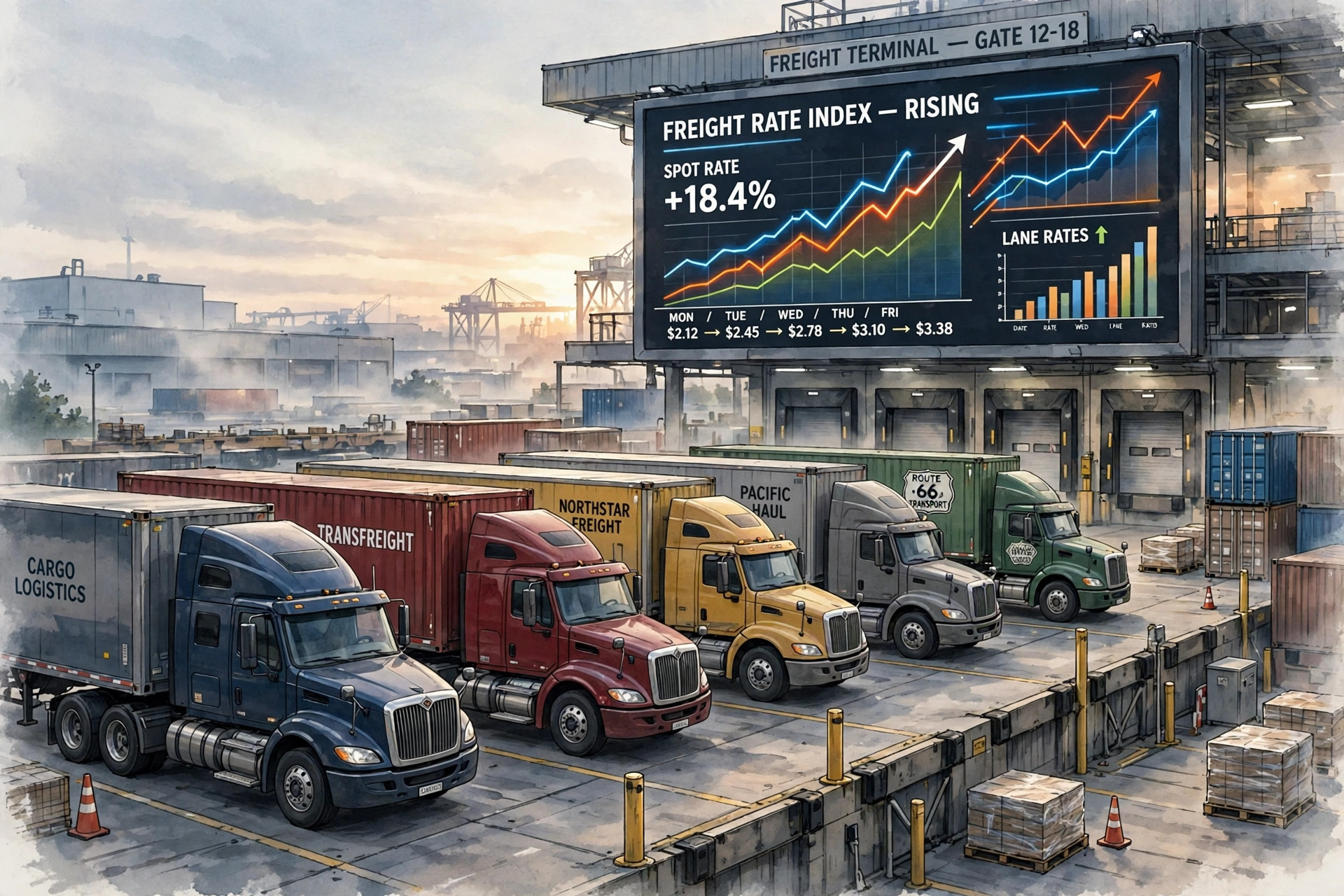
Image: Illustration: AI-generated by CDLWire
Freight broker RXO said Tuesday that even though truckload spot rates have cooled in the fourth quarter, the market is not entering deflationary territory, according to FreightWaves on Nov. 17 — a distinction that matters to anyone pricing freight between now and peak season.
RXO's linehaul rate dataset, which excludes fuel surcharges, jumped 37.9% year over year in the third quarter, to "levels not seen since peak COVID-era shipping." So far in the fourth quarter, rate growth has slowed to 26.2% year over year, which the company called "still significantly higher than 2025 heading into peak season." The direction and the level point opposite ways, and RXO's Curve Report is explicit about which one it is reading: "In Q4, the overall demand picture remains muted against an uncertain economic backdrop, but sustained pressure on the supply side of the market (carriers) has created a tight environment for shippers — and peak season is fast approaching," the report stated.
That supply-side framing is consistent with the rest of the week's market data, and RXO names the forces behind it directly. Strict regulatory enforcement and years of weak carrier profitability have drawn down capacity, significantly tightening the market despite flat demand. "The combination of federal policy enforcement, increasing insurance premiums, record-high fuel, and high interest rates has both reduced the available labor pool while making the financial barriers to entry much higher," the RXO report said. "As long as freight demand remains muted, there won't be extreme market volatility, but any incremental increase in shipments could result in a very difficult market for shippers."
The contract side is where the report's most concrete number sits. While cost pressures dominated the headlines during the third-quarter earnings season, fleets are logging large contractual rate gains after a multiyear downturn, and recent contract renewals are averaging 12%, according to the SONAR Contract Rate Change Direction dataset FreightWaves published with the report. Knight-Swift Transportation is now targeting "at least double-digit increases" in its new bid season, which began earlier this month — the same posture CDLWire reported Tuesday, drawing on Cass Information Systems' Monday October release, in which the contract-weighted truckload linehaul index rose 9.9% year over year in its 22nd straight annual increase. RXO's dataset is a broker's linehaul sample rather than Cass' freight-bill index, and the two should not be averaged together; what they agree on is the direction of the base rates under contracted freight, which is up by roughly a tenth or more.
RXO's cost measure shows why carriers are holding that line even as spot growth cools. The broker's all-in cost-per-mile index, which includes fuel surcharges, stood at 160.1 in the third quarter, indexed to a 2015 baseline — the highest reading since the first quarter of 2022. Diesel fuel prices were up 48% year over year in the quarter, but the report said diesel did not account for all the rate increase. "A substantially higher cost structure has moved the baseline up for carriers, regardless of fuel costs," the report said. That sentence is the answer to the deflation question in RXO's own terms: a market whose carrier cost baseline has reset higher does not return to last year's prices just because the year-over-year spot comparison cools from 37.9% to 26.2%.
FreightWaves' own summary of why it matters points the advice at shippers — driven by tightening capacity and higher operating costs, these rate trends signal a shift in market power toward carriers seeking margin improvement, and shippers should respond by securing dependable capacity and guarding against routing guide deterioration. Read from the carrier's seat, the same facts invert into a pricing instruction: the routing guide is where a shipper's contracted price meets a carrier's decision to accept or reject, and a market in which renewals are averaging 12% is a market in which accepting last year's contract price is a voluntary discount.
For drivers and small carriers, the practical read is to separate the two numbers RXO published and use each for what it measures. The cooling from 37.9% to 26.2% year-over-year spot growth says the spot market's rate of climb is slowing in the fourth quarter; it does not say spot rates are falling, and RXO says explicitly that they remain significantly higher than 2025 heading into peak. The 12% average on contract renewals, the 160.1 cost-per-mile index and a demand picture the broker itself calls muted together say the tightness is a supply story — fewer carriers, higher barriers, higher costs — not a freight boom that could vanish with one soft month. Price accordingly: this is a market to lock in the higher baseline on contract work while it is being offered, not a market to chase deflation that the broker with the dataset says is not arriving.
Sources
Related coverage
 November 17, 2026 · Fuel & ratesOctober truckload linehaul rates rose 9.9% from a year ago — and shipments grew for a third straight month
 November 17, 2026 · Fuel & ratesSpot rates rose again in the week ending Nov. 13 — but trucks came back to the board and every load-to-truck ratio fell
 November 15, 2026 · Fuel & ratesSpot rates jump to their highest since July — and fuel is not the reason
Comments
Loading comments…