Mexico's truckers and federal government advance 29 highway-safety agreements — a month after the nationwide strike shut down freight in 19 states
Mexico's federal government and trucking industry representatives have advanced 29 agreements on cargo theft, highway security and deteriorating infrastructure, out of six working groups that followed the Oct. 26-27 nationwide strike. The package presented Wednesday includes direct reporting channels to law enforcement, faster release of recovered trucks, action against GPS jammers and unauthorized checkpoints, priority repairs on 62 highway segments, and a December launch for a computerized towing registry meant to curb excessive charges.
Summarized from FreightWaves.
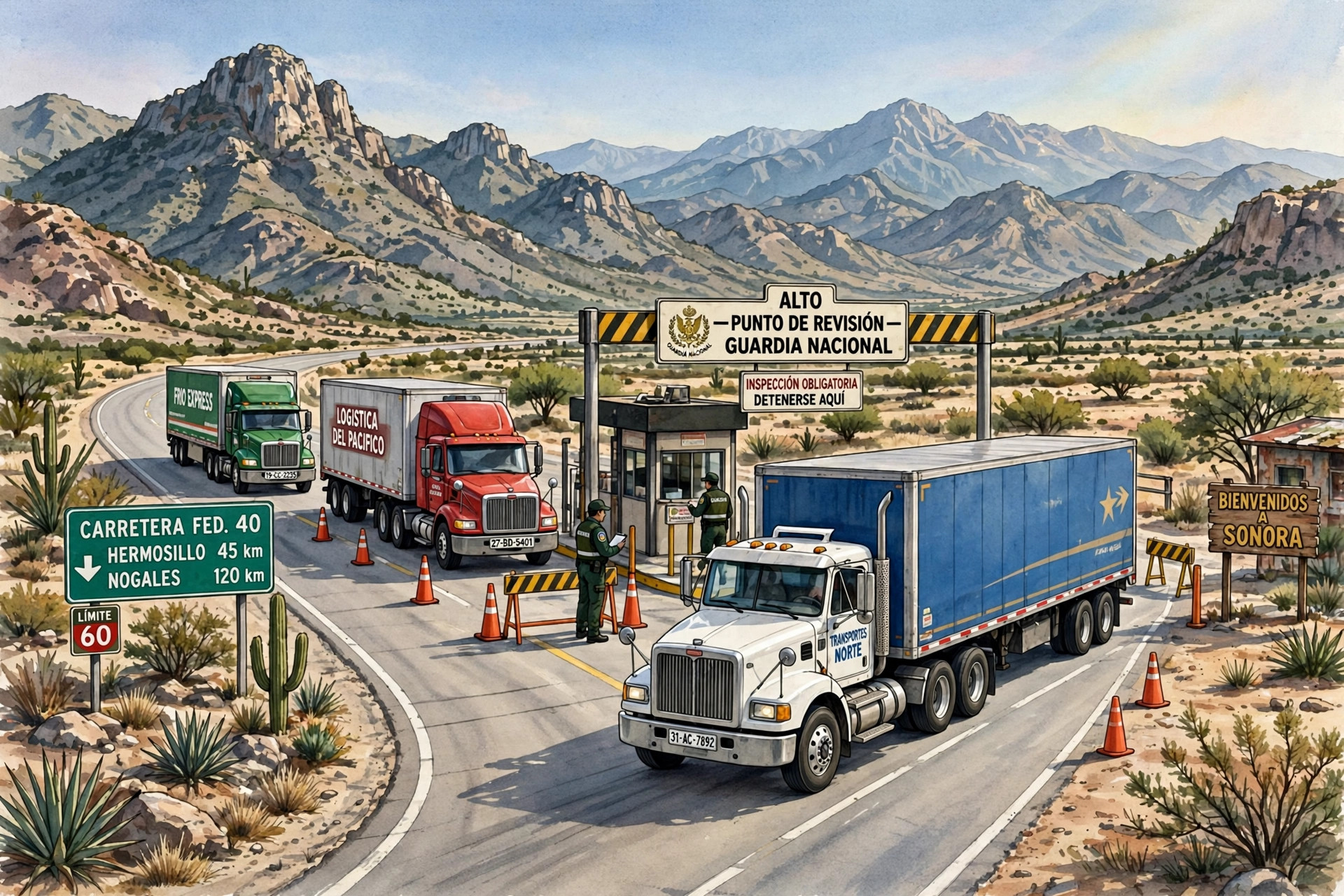
Image: Illustration: AI-generated by CDLWire
Mexico's federal government and its trucking industry have advanced 29 agreements aimed at the problems that shut down the country's freight network a month ago — cargo theft, extortion, broken highways and abusive towing charges — according to FreightWaves on Nov. 22, in its weekly Borderlands Mexico rundown.
The agreements emerged from six working groups involving 10 government authorities and representatives of the National Chamber of Freight Transportation (CANACAR), the Honorable Mexican Alliance of Transport Organizations (HAMOTAC), the Mexican-American Federation of Transporters (FEMATRAC) and the Integrating Organization of Conventional Rights (INDECO). The organizations, supported by Mexico's Confederation of National Chambers of Commerce, Services and Tourism (CONCANACO SERVYTUR), announced the progress Wednesday during a news conference in Mexico City. The negotiations focus on the persistent problems affecting Mexico's trucking industry: cargo theft, extortion, highway maintenance, excessive towing charges, regulatory requirements and the safety of commercial truck drivers.
The strike that forced the talks is the context every cross-border carrier already knows. The discussions follow the Oct. 26-27 nationwide trucking strike, which prompted demonstrations and highway blockades across major freight corridors. Mexico's Interior Ministry reported demonstrations at 38 locations across 19 states, involving 691 vehicles and 858 participants. The protests highlighted concerns about highway crime and rising transportation costs, particularly along the routes connecting Mexico's industrial centers to United States border crossings — the same corridors that carry the manufactured freight United States drivers pick up at Laredo, El Paso and the other gateways.
Highway security and cargo theft are the center of the package. One central component involves improving coordination among Mexico's Interior Ministry (SEGOB), the Ministry of Security and Citizen Protection (SSPC), the National Guard and state authorities. The agreements call for establishing direct communication channels between transportation companies and law enforcement agencies to report criminal activity and respond to security incidents. Authorities and trucking representatives also agreed to work toward standardizing the procedures prosecutors use, including efforts to accelerate the release of recovered trucks following cargo theft investigations — a point that matters in dollars, because a recovered tractor that sits impounded through an investigation is a truck earning nothing. Other measures include identifying unauthorized highway checkpoints and strengthening enforcement against devices used to jam GPS tracking signals. The scale of the problem was stated at the news conference in the industry's own numbers: according to figures presented Wednesday by the Mexican transportation publication T21, Mexico recorded 6,211 cargo transportation robberies from January through September 2026, and CANACAR reported 145 additional incidents during October. Carlos García Álvarez, national president of HAMOTAC, expressed frustration that highway crimes have continued despite meetings with federal authorities.
Infrastructure is the second pillar. The trucking organizations submitted an assessment to Mexico's Ministry of Infrastructure, Communications and Transportation (SICT) identifying 62 highway segments requiring priority maintenance and repairs, intended to help federal authorities choose roads for future construction and maintenance programs. Industry representatives also reported progress toward reclassifying approximately 11,000 kilometers — 6,835 miles — of Mexico's highway network; the proposed changes cover 40 segments across 102 highways, with publication in Mexico's Official Gazette expected by December. Adalberto Gutiérrez Muñoz, national president of INDECO, criticized deteriorating highway conditions and the high tolls paid by commercial carriers, and called for improvements to highway access points that could be exploited by criminal organizations. According to CANACAR, freight transportation companies contributed more than $3.6 billion, representing approximately 56% of toll highway revenue in 2025 — the industry's argument, in one figure, for why its repair list deserves priority.
The third piece is the one drivers feel at the roadside: towing. Another significant agreement involves the planned December launch of SICT's computerized towing service registration system, known as SIRSE, designed to improve transparency in towing, vehicle recovery and impound services while reducing excessive charges and abusive practices — complaints trucking representatives have raised repeatedly about the cost and difficulty of recovering commercial vehicles after accidents or law enforcement investigations. Around it sit administrative measures: the organizations submitted an assessment of federal, state and municipal regulatory requirements to Mexico's Digital Transformation and Telecommunications Agency, a review that could lead to a unified digital record for trucking companies and a single-window system to simplify procedures; discussions include proposed tax incentives for private investment in secure truck parking facilities and driver rest areas; and industry representatives are seeking clarification of forthcoming labor regulations governing electronic work-hour records, including how driving, waiting, loading, unloading and rest periods will be classified.
For United States drivers and carriers, nothing in the 29 agreements changes a rule at the border this week, and CDLWire reports them as agreements advanced — announced progress from working groups — not as laws in force. What they change is the risk picture on the Mexican legs of cross-border freight: the corridors where cargo is stolen, jammed and held are the corridors these measures target, and the December items — the Official Gazette reclassifications and the SIRSE towing registry launch — are the first dated tests of whether the package moves from a news conference to the road. FreightWaves' own closing note is the right frame: the negotiations could reduce cargo theft risks and costly disruptions along the critical freight corridors connecting Mexican manufacturers with United States markets. A month after 858 participants parked trucks in 19 states to make that point, the industry now has 29 agreements to be measured against.
Sources
Related coverage
 November 16, 2026 · BorderLaredo's Saturday pilot is moving 400 to 500 trucks off Sundays — and CBP expects to extend it another 90 days
 November 12, 2026 · BorderTrump threatens to immediately double tariffs on Mexico over migrant caravans
 November 7, 2026 · BorderTexas-border spot rates are up 24% as USMCA goes to annual reviews — and DAT says exiting capacity, not demand, is doing the work
Comments
Loading comments…