Texas-border spot rates are up 24% as USMCA goes to annual reviews — and DAT says exiting capacity, not demand, is doing the work
Transport Topics reports the U.S. declined on July 1 to confirm a 16-year USMCA extension, triggering annual reviews that could continue until the pact expires in 2036. DAT iQ's Dean Croke says southern border freight volumes are running about 6.5% higher than a year ago while spot rates on lanes out of the Texas border have climbed 24%, driven by enforcement of English-proficiency, non-domiciled CDL and cabotage rules. Northbound Mexico intermodal is up 17%, and crossing paperwork now includes driver names and plate numbers submitted in advance.
Summarized from Transport Topics.
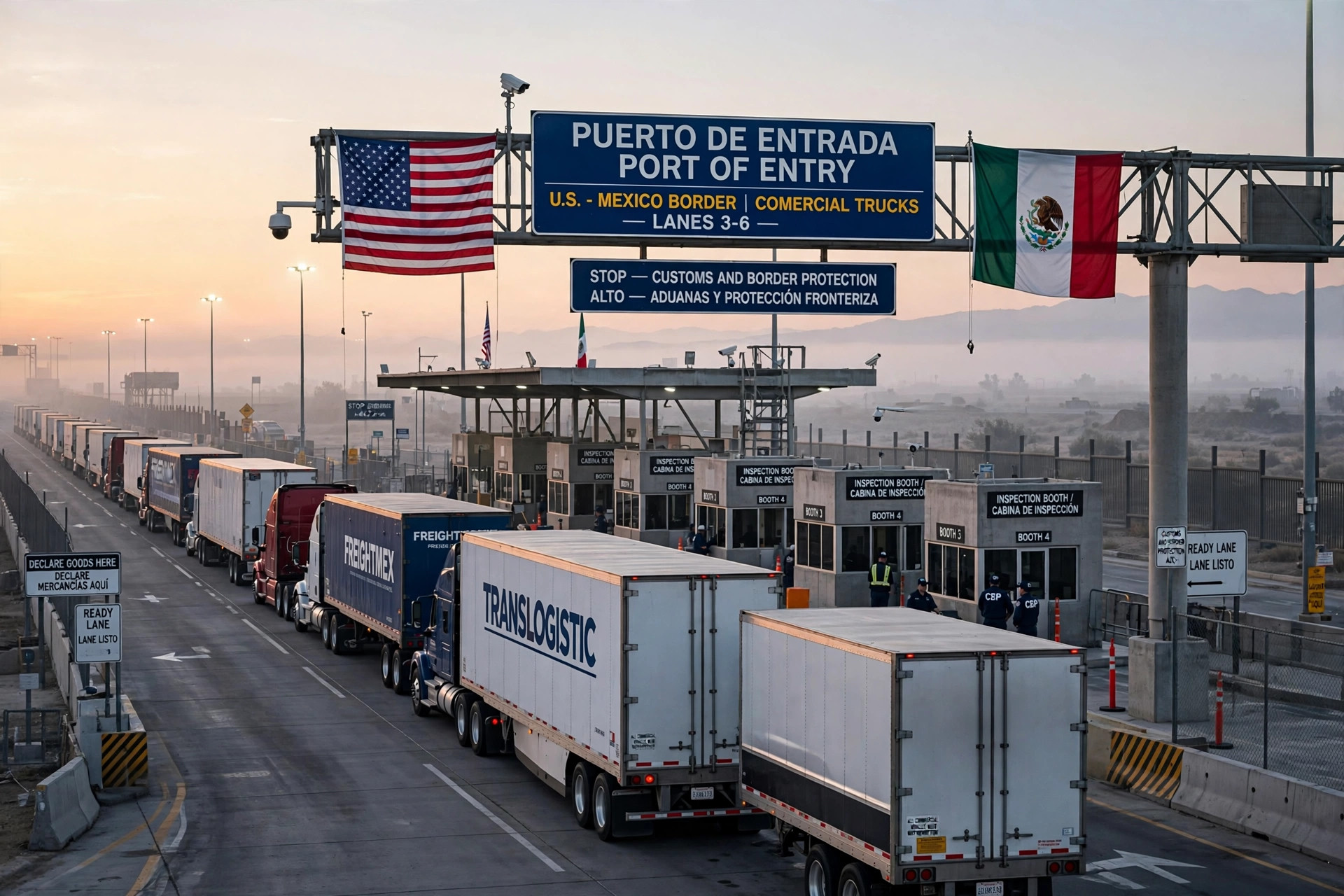
Image: Illustration: AI-generated by CDLWire
Cross-border freight is growing, cross-border capacity is shrinking, and the trade agreement underneath all of it is now on an annual-review clock. The United States declined to confirm a 16-year extension of the U.S.-Mexico-Canada Agreement on July 1, triggering annual reviews that could continue until the pact expires in 2036, according to Transport Topics on Nov. 7. For the carriers and drivers who run the border, the review process is the background uncertainty; the foreground fact is pricing — spot rates on lanes out of the Texas border have climbed 24%, and the analyst supplying that figure attributes it to the same enforcement wave that has tightened capacity everywhere else in this week’s news.
Dean Croke, principal analyst at DAT iQ, told Transport Topics that southern border freight volumes are running about 6.5% higher than a year ago, while tightening truck capacity drives the pricing increase. “Capacity exiting is doing all the heavy lifting, not demand,” Croke said, citing increased enforcement of English-language proficiency requirements, non-domiciled commercial driver license rules and cabotage restrictions, which prohibit foreign carriers from hauling domestic loads. That is the supply-driven recovery described by ATA’s Bob Costello in Thursday’s edition, measured at the border: volumes up modestly, rates up sharply, because the trucks and drivers available to haul cross-border freight are exiting faster than freight is growing.
The northern border shows a different imbalance. LoadLink Technologies data showed U.S.-to-Canada loads increased 24% in September while Canada-to-U.S. loads declined 12%, an imbalance that could drive rates up on the loaded direction. Anne Reinke, president and CEO of the Intermodal Association of North America, said northbound intermodal volumes from Mexico increased 17% over the past 12 months while U.S.-Canada intermodal volumes declined 2% — a shift suggesting some shippers are moving freight from trucks to rail to ease their exposure to truck capacity constraints. Canada, meanwhile, is working to reduce its reliance on the U.S. market, signing approximately 20 trade, economic or strategic agreements with other countries since January 2025. “The best indication of future behavior isn’t past behavior where trade is concerned,” said Mark McKendry, president of IMC Logistics’ Canada business. “Because of the capricious nature of trade policy these days, I don’t believe anyone could predict what next month will look like.”
Shippers’ exhaustion with the policy churn has a name in the account: tariff fatigue. “Some of our customers got tariff fatigue the last time tariffs started changing at a rapid pace,” said George Chasteen, chief operating officer of Mesilla Valley Transportation. “By the time they implemented a new plan for an announced tariff, the plan was no longer relevant or valid due to a change in the tariff policy the following week or month.” MVT has not responded by retreating: it expects Mexico freight volumes to keep growing at a mid- to high-single-digit pace, has not delayed its U.S.-side investments, and has added bonded and foreign trade zone warehousing along the southern border — letting customers defer duties and improve cash flow — along with crossdocks, rail-served warehouses, partner carriers and an in-house licensed customs broker.
The compliance burden at the crossing itself is getting heavier, and it now reaches the driver by name. Troy Ryley, president of Echo Global Logistics’ Mexico division, said Mexican crossing agents must submit more information before freight crosses the border, including driver names and license plate numbers. “It’s become a much more dynamic and much more compliance-focused environment,” Ryley said. “That’s going to be a key element in a client’s success running freight in and out of the border.” The same uncertainty is chilling investment: some Chinese manufacturers have postponed Mexican factories until country-of-origin requirements become clearer, Ryley said, and DAT’s shipper conversations show growing caution about adding capacity at all.
Not everyone expects the agreement to break. FTR CEO Jonathan Starks said the policy environment has stabilized somewhat since last year, giving companies more confidence in their decisions. ATA’s Costello said established North American manufacturing networks remain largely unchanged and he expects that to continue through the review: “I really believe that a deal gets done and USMCA remains a trilateral agreement,” he said. “Now, the finished product may not be until next year, but it will most likely happen.” IANA’s Reinke said her association will urge the three countries to commit to a long-term agreement in comments to the U.S. Trade Representative for the 2027 annual review, arguing that the annual review requirement itself “increases uncertainty, creates cross-border friction and slows the movement of goods.”
For border drivers and the carriers who dispatch them, the practical read is threefold. First, the 24% rate climb on Texas-border lanes is an enforcement story, not a volume story — it holds only as long as capacity keeps exiting, and it is strongest exactly where English-proficiency, non-domiciled CDL and cabotage enforcement bites hardest. Second, paperwork is now part of the driving job at the southern border in a new way: your name and your plate number go to the crossing agent before the freight moves, so mismatches between the driver assigned, the driver who arrives and the documents submitted are a delay built into the load. Third, plan for the review calendar, not just the crossing: annual USMCA reviews mean trade-policy headlines — and the tariff changes that follow them — are now a recurring feature of border freight through at least the 2027 review, and carriers with bonded warehousing, crossdocks and an in-house broker are the ones positioned when a plan has to change in a week.
Sources
Related coverage
 November 5, 2026 · Border909 packages of meth in a load of leeks: CBP's 1,082-pound Pharr seizure anchors Operation Southern Surge's first results
 November 1, 2026 · BorderCabotage enforcement is 'really ramping up,' Knight-Swift's CEO warns — as Nuevo León halves the Colombia Bridge truck toll
 October 31, 2026 · BorderOhio will downgrade all 5,000 reviewed non-domiciled CDLs — 2,000 already done — as Louisiana and Wyoming confirm they will never resume issuing
Comments
Loading comments…