A rejected tender now costs shippers 10.69% more to cover — the backup-plan premium hit its highest level since September
SONAR's Routing Guide Premium for the second tender climbed to 10.69% on Thursday, up 1.87 percentage points from 8.82% a week earlier and its highest reading since September, while first-tender acceptance slid to 88.06%, its lowest since September. FreightWaves' Chart of the Week reads the jump as the contract market's early warning: fewer loads are sticking with the primary carrier, and the carriers asked to cover the failures are charging closer to market for the favor.
Summarized from FreightWaves.
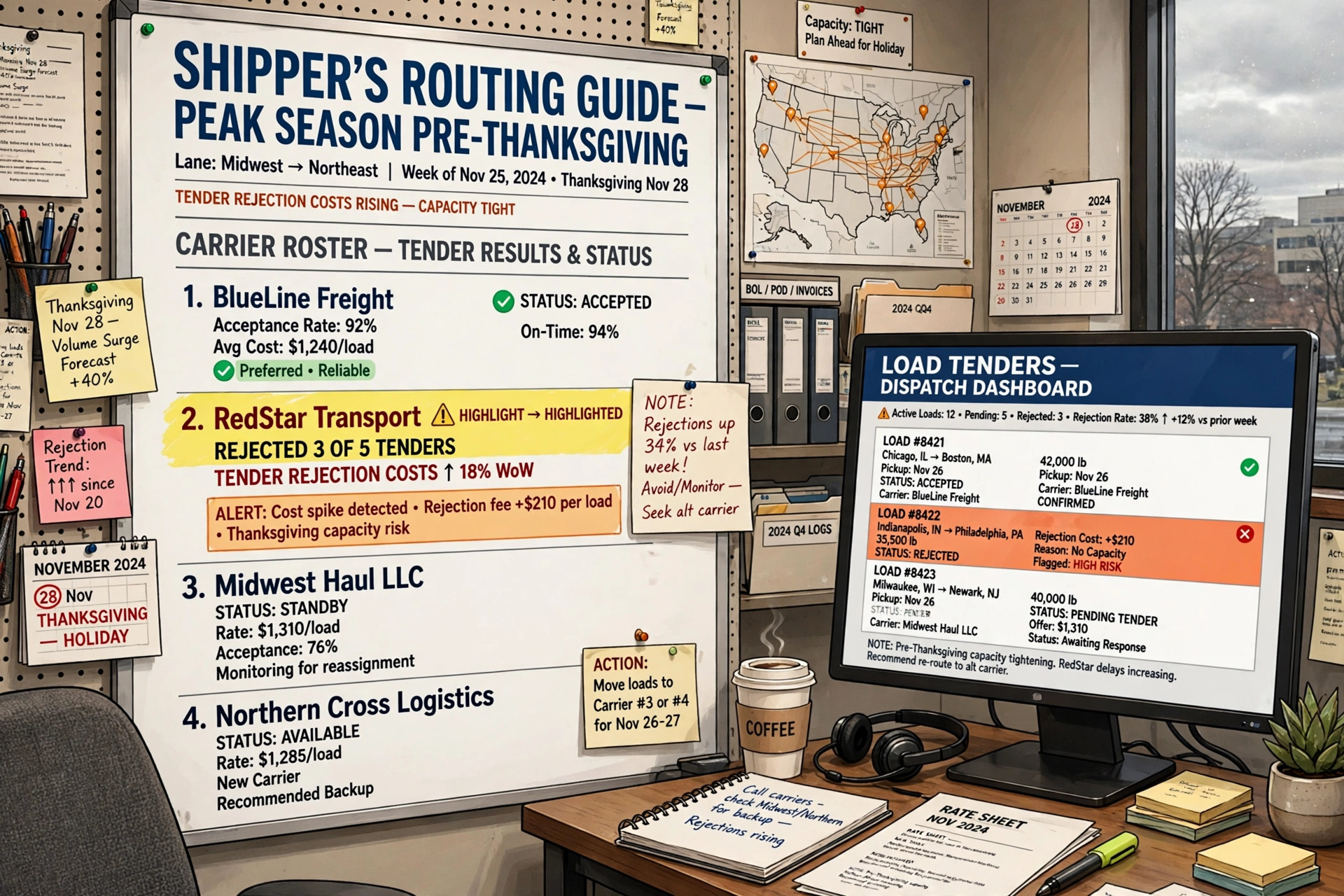
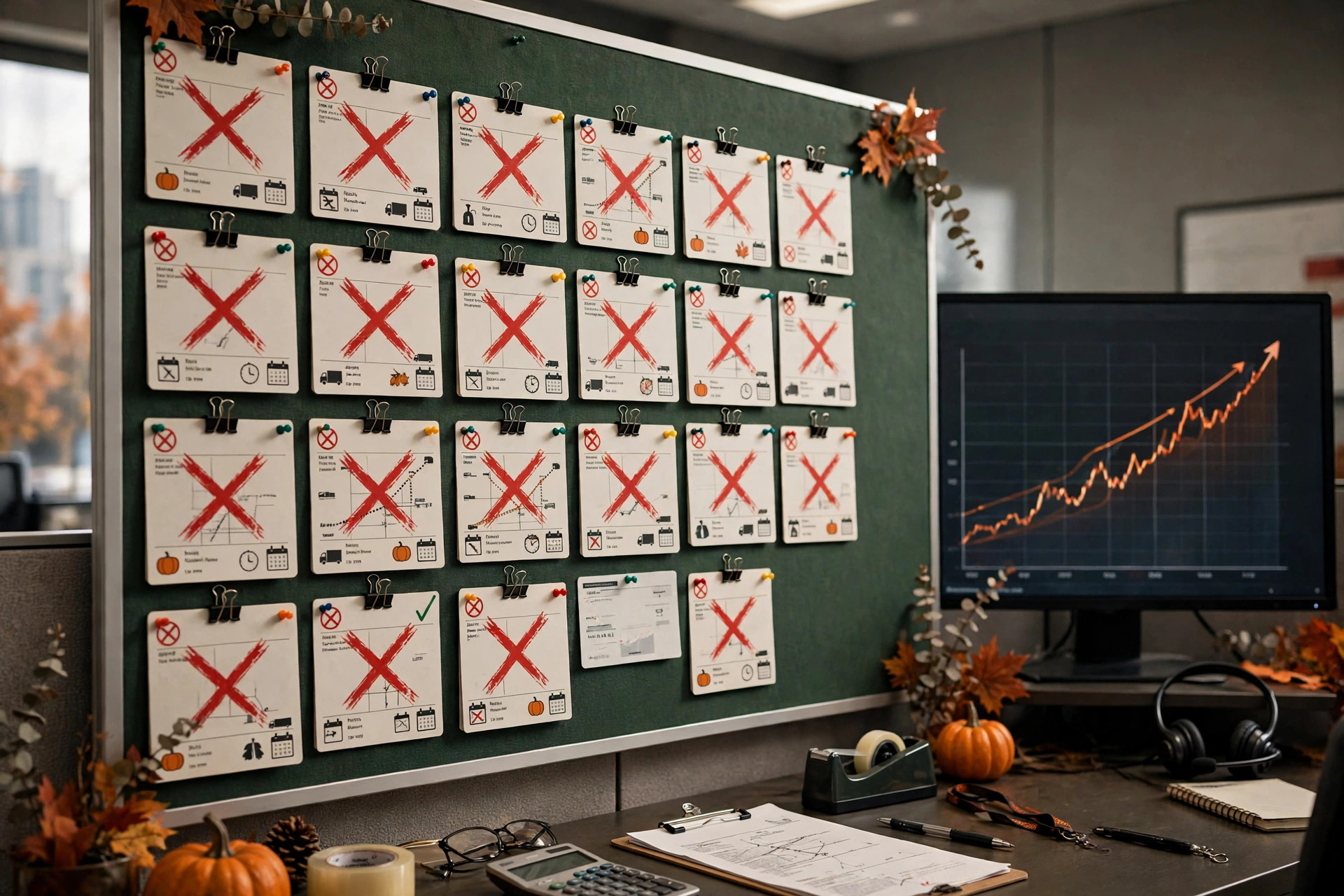
Image: Illustration: AI-generated by CDLWire
The price of a rejected tender jumped this week, and it jumped fast, according to FreightWaves on Nov. 22, reporting SONAR data — a reading that puts a dollar-shaped number on the tightening this edition has been tracking through the Thanksgiving run-up.
SONAR's Routing Guide Premium for the 2nd tender, tracked as RGP2, climbed to 10.69% on Thursday, up 1.87 percentage points from 8.82% a week earlier and its highest reading since September. At the same time, the Routing Guide Acceptance Share for the first, or primary, tender slid to 88.06%, down 88 basis points in a week and its lowest level since September. Put simply, as FreightWaves frames it, fewer loads are sticking with the primary carrier, and backup carriers are charging more to take them — and both moves landed in the run-up to Thanksgiving, when holiday freight typically starts to squeeze truckload capacity.
The routing guide premium needs a plain explanation, because it measures something different from the spot rates and rejection rates CDLWire has published this week. A shipper's routing guide is the ordered list of carriers it offers each load to: the primary carrier first, then backups in sequence. The premium is the difference in cost between the primary carrier and the carriers further down that guide — an all-in rate difference that includes fuel and accessorial charges. When the primary carrier accepts, the shipper pays the contract price. When the primary declines and the load falls to the second tender, the shipper pays the premium on top. A premium of 10.69% is therefore the measured cost of a plan failing: for every load the primary carrier said no to this week, covering it down the guide cost roughly a tenth more than the rate the shipper had planned on.
Premiums move inversely to tender acceptance, and FreightWaves notes they tend to move slowly until they don't — sharp changes around holidays and market disruptions can blow up shippers' contingency budgets. The year-ago comparison shows how much room this number still has to run. Heading into this holiday period, the cost of a primary acceptance failure sat at around 8.8%; a year ago it was around 4%, and that premium expanded to around 8% by Christmas. This year's starting point is already above last year's Christmas level, the one-week move is nearly 2 percentage points, and FreightWaves expects it will probably go higher from here.
Why a backup carrier charges more is not opportunism alone, and the article is clear about the mechanics. Secondary carriers typically feel the same capacity pressure as primary carriers, and because a shipper is not a top priority for them, the shipper is not a top priority in return: when the whole market is under pressure and spot rates are climbing, a carrier has little reason to haul freight below market rates for business it will not keep once the market stabilizes. Part of the increase also comes from contract-plus pricing, in which the shipper adds an amount on top of the standard contract rate for the primary carrier — a deliberate payment to keep the load inside the guide rather than turning to the spot market or asking an unfamiliar carrier to go out of its way, at a much higher cost to serve.
The reason this chart matters beyond shippers' budgets is timing. The premium does not show up directly in spot rates, because the freight involved is not technically spot freight. Contract tenders have much longer lead times than spot loads — currently around 3.7 days versus roughly a single day — which often makes the contract market a leading indicator of market disruption. As of Thursday, Nov. 19, shippers were already feeling the pain of deteriorating carrier compliance even though spot rates, as measured by the National Truckload Index, were flat to slightly lower week over week. Read alongside Saturday's edition — tender rejections climbing back toward 13%, with roughly 14% forecast for the holiday week — the routing guide data is the same tightening seen from the shipper's side of the desk: rejections are not an abstraction, they are a line item, and this week the line item grew by nearly a fifth in seven days.
The practical takeaway splits by which side of the tender you sit on. If you are a carrier in a shipper's routing guide, the numbers say your no is getting expensive for the shipper and your yes is worth more than the paper rate — that is leverage to discuss before the holiday peak, while the relationship point FreightWaves closes on still holds: carriers cannot be expected to ignore the market for a shipper that values their service only when it needs a backup. If you are tendering freight, the contingency is no longer cheap insurance: a backup plan priced at last year's 4% assumption is underfunded by more than half at a 10.69% premium, with the seasonal pattern pointing up into Christmas. Either way, the chart's lesson is the one to carry into the week — contingency carriers are not a given when the market turns volatile, and this week the market put a price on finding that out.
Sources
Related coverage
 November 21, 2026 · Fuel & ratesTender rejections climbed back toward 13% before Thanksgiving — SONAR sees roughly 14% next week, and says fuel is not the reason
 November 19, 2026 · Fuel & ratesSpot rates rose more than 4% while diesel fell 3.5% — the early-November jump FreightWaves calls unusual
 November 18, 2026 · Fuel & ratesRXO: spot rate growth cooled to 26.2% in the fourth quarter — and that is not deflation, with contract renewals averaging 12%
Comments
Loading comments…