Class 8 truck orders plunge in October — FTR counts 15,600, down 36%, and ACT counts 13,500, down 45%, as EPA 2027 uncertainty freezes fleet buying
Both preliminary trackers agree on the direction if not the level: the 2027 order season opened with a drop to roughly half the 10-year October average. FTR says the EPA pre-buy is complete and orders now hinge on profitability and regulatory certainty; ACT says fleets cannot plan until they know what a 2027 truck will cost.
Summarized from FreightWaves.
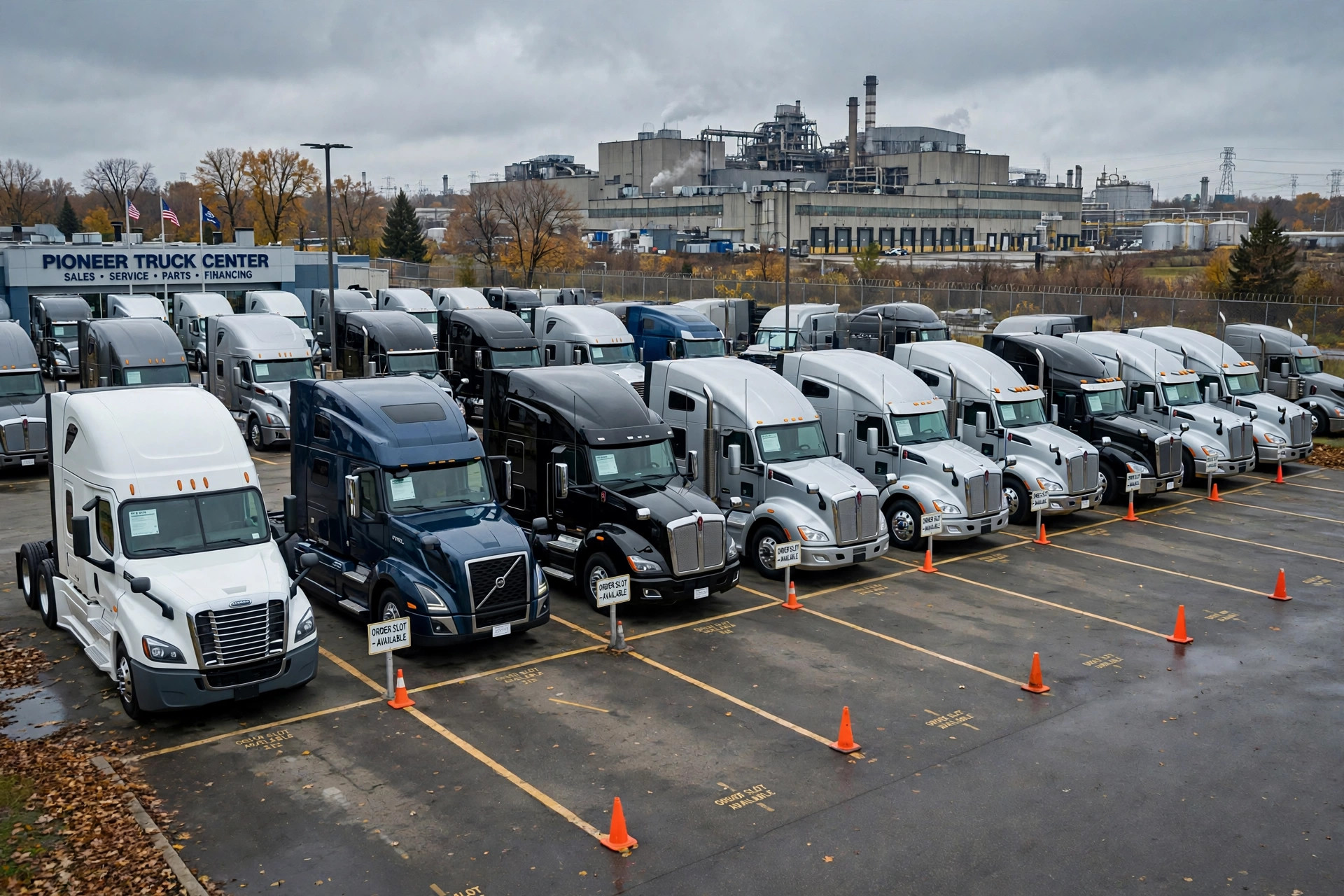
Image: Illustration: AI-generated by CDLWire
North American Class 8 truck orders plunged in October, giving the 2027 order season a surprisingly weak start as fleets held back in the face of regulatory uncertainty, rising equipment costs and pressure on operating margins, according to FreightWaves on Nov. 4. FTR Transportation Intelligence, which released its preliminary figures on Wednesday, put October net orders at 15,600 units — down 36% from a year earlier and down 24% from September. The October total was nearly 50% below the 10-year average of 31,089 units for the month, underscoring a significant slowdown in heavy-duty truck demand heading into 2027.
A second tracker read the same month even weaker, and the gap between the two is part of the story. ACT Research, in its own Nov. 4 release, put preliminary North America Class 8 net orders at 13,500 units in October, down 45% year over year. ACT attributed the decline to unresolved regulatory questions ahead of EPA 2027 implementation, ongoing cost pressures and midterm political uncertainty, despite continued strength in spot freight rates. The two firms estimate the same market with different preliminary counts; what they agree on is the direction, and it is sharply down. ACT says final October data will be published in mid-November, and FTR likewise labels its figures preliminary.
The fall was a reversal of the order season fleets had been building toward. ACT’s final count for September was 19,172 units, down 7% year over year, in a month that typically marks the start of the annual order season but was already subdued because not all manufacturers had fully opened their 2027 order boards. FTR’s combined September and October orders reached 36,002 units, down 20% from the comparable period last year. In other words, September was soft and October got materially worse, just as fleets normally commit to next year’s tractors.
FTR’s explanation starts with where fleet money is going instead. Dan Moyer, FTR’s senior analyst for commercial vehicles, said fleets may be shifting their capital spending priorities toward trailers instead of tractors in the near term, and he noted that higher operating expenses continue to challenge carriers despite improvements in freight pricing. “Also, while freight rates are strong, so are costs for fuel, insurance, and labor, pressuring margins and possibly limiting purchases for now,” Moyer said. A carrier whose rates rise while its diesel, insurance and driver costs rise alongside them does not automatically have more cash for a new tractor — October’s orders are what that squeeze looks like.
The second explanation is a wave that has already crested. Moyer said the earlier wave of truck purchases ahead of anticipated 2027 emissions requirements has already run its course. “Underlying replacement needs, tighter capacity, and firmer freight rates continue to support Class 8 demand,” Moyer said. “However, with the earlier EPA 2027 pre-buy now complete, orders are increasingly tied to fleet profitability, capital spending priorities, and regulatory certainty.” Fleets that wanted to buy ahead of the 2027 engine rules have largely bought; the buyers left in the market are the ones who will order when the numbers pencil out, not before.
ACT’s analyst put the regulatory piece of that in plainer terms. “While spot rates remain supportive of equipment demand, the lack of clarity around EPA 2027 rules and associated costs has left OEMs and fleets unable to plan for next year,” said Carter Vieth, research analyst at ACT Research. “It’s not a lack of desire for new equipment holding fleets back, but rather the inability to make informed investment decisions in the face of regulatory and economic uncertainty.” Until a fleet knows what a 2027-compliant truck will cost and what rules it has to meet, deferring an order is the rational move — which is why both firms describe October as hesitation under uncertainty, not as fleets deciding they no longer need trucks.
Two figures keep the plunge in proportion. FTR’s year-to-date Class 8 orders still total 278,201 units, up 74% compared with the same period in 2025 — the pre-buy pulled a large amount of demand forward into the first part of this year, which is part of why the fall looks so thin by comparison. And the weakness is concentrated in the heaviest class: ACT reports preliminary Classes 5-7 net orders rising 14% year over year to 18,000 units in October. This is a Class 8 story, tied to Class 8 prices and emissions rules, not a collapse in truck buying across the board.
The practical takeaway is to treat October as a deferral signal, not a demand verdict. FTR cautioned that October’s weak orders may reflect purchases being delayed rather than eliminated, potentially allowing orders to strengthen as emissions requirements, production schedules and equipment pricing become clearer. Fleets planning 2027 replacements should watch two things in the next few weeks: the final October numbers in mid-November, which will settle how deep the drop really was, and any EPA 2027 clarity that lets a purchase be priced with confidence. For drivers, the read is narrower but real: strong spot rates alongside weak truck orders means carriers are earning on the equipment they already run, and stretching it — expect existing tractors to be kept longer and maintained harder until the cost of a new one can be planned, rather than a wave of new trucks arriving on the old schedule.
Sources
Related coverage
 October 30, 2026 · EquipmentNHTSA starts the first major tire-standard overhaul in more than 20 years — and the bias-era tests may not survive it
 October 27, 2026 · EquipmentPilot and Tesla open their first two heavy-duty truck charging sites — Ellabell, Georgia and Tulare, California
 October 24, 2026 · EquipmentA zero-emission dealer says stop aiming at Class 8 first: 'Class 4, 5 and 6 are ready now'
Comments
Loading comments…