A fake email, eight fuel cards and $760,320.19 in unpaid fuel across 23 states: two Atlanta men are indicted in a Detroit carrier's name
CDLLife reports Zachary Walker and Mario Bailey were indicted Sept. 23 on trafficking in an unauthorized access device, wire fraud and mail fraud charges, after a credit application in Voyager Express Inc.'s name won eight Coyne Oil & Propane fuel cards that were mailed to a rented Detroit apartment. Walker made his initial court appearance Nov. 3 and was freed on $10,000 unsecured bond; the next court date for both men is pending.
Summarized from CDLLife.
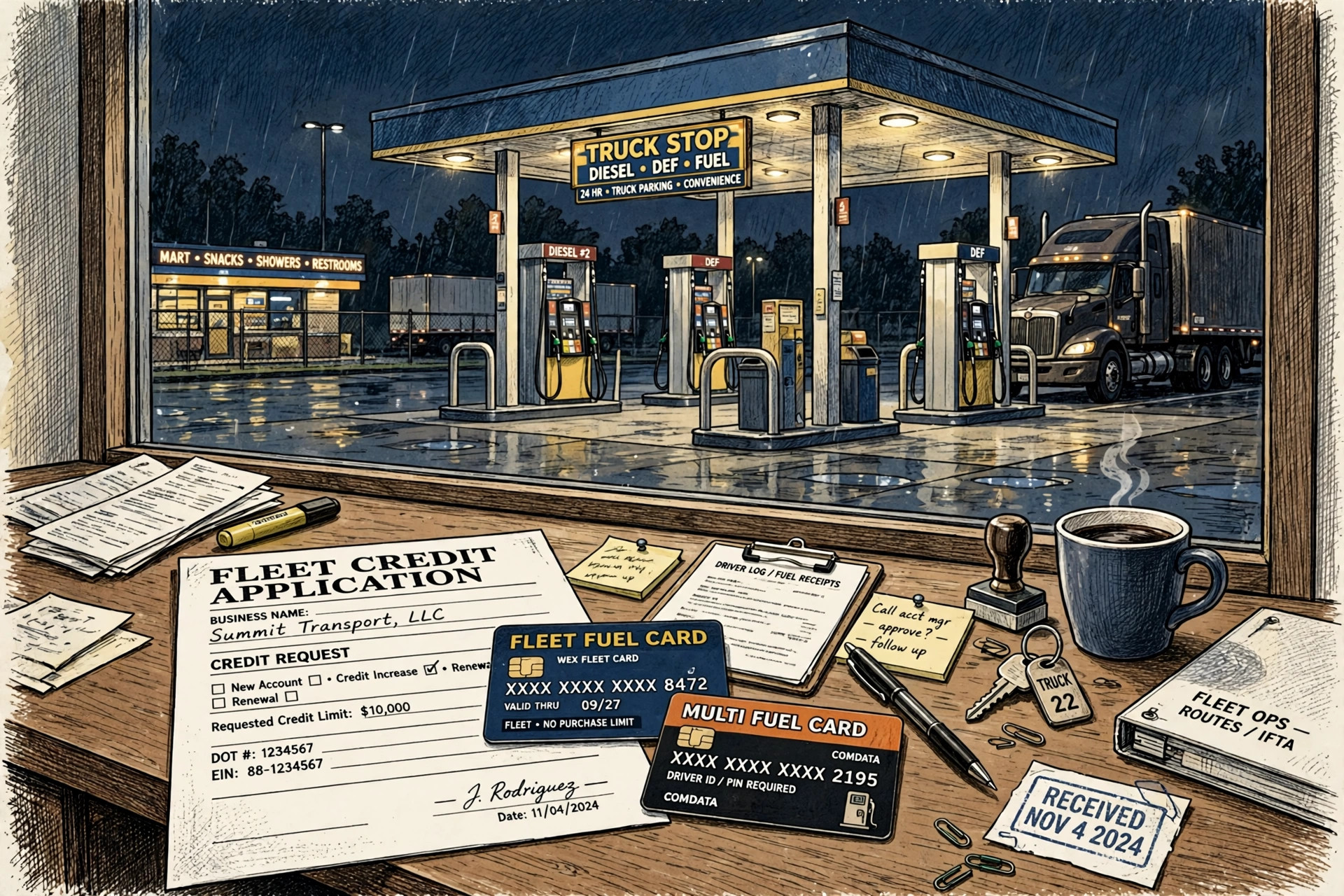
Image: Illustration: AI-generated by CDLWire
Two Atlanta men have been indicted on federal fraud charges after allegedly impersonating a Detroit trucking company to obtain fuel cards that were then used to buy fuel in 23 states without a single payment, according to CDLLife on Nov. 5. Zachary Walker and Mario Bailey were indicted by a federal grand jury on Sept. 23, on charges of trafficking in an unauthorized access device, wire fraud and mail fraud. The indictment became a live court matter this week: Walker appeared at his initial court appearance on Nov. 3 and was freed on $10,000 unsecured bond, and the next court date for both Walker and Bailey is pending. The charges are allegations in an indictment, not convictions.
The scheme, as the indictment lays it out, was built on a rented apartment and a look-alike email address. It began when Walker rented an apartment at the Jeffersonian Apartments, at 9000 E. Jefferson Avenue in Detroit, Michigan, in July 2025. The following month, the identity of the owner of Voyager Express Inc., a trucking company based in Detroit, was assumed, and that identity was used to submit a credit application to Coyne Oil & Propane using a fake email address mimicking that of the real Voyager Express. One detail in the reporting deserves a flag rather than a guess: CDLLife’s account attributes the impersonation and the application to Walker, while MLive’s account, as summarized in other coverage of the indictment, attributes them to Bailey. The two accounts agree on the structure of the scheme and on everything that happened after the application; CDLWire is not assigning that step to either man by name, because the sources in hand do not agree on it.
What both accounts agree on is the payoff and the loss. The application was approved — Coyne Oil, a fuel supplier based in Mount Pleasant, Michigan, approved it in September 2025 — and eight fuel cards were mailed to the rented Detroit apartment, where Bailey later retrieved them; the MLive account puts the retrieval on Sept. 13, 2025, after apartment staff granted Bailey access to Walker’s unit at Walker’s request. The cards were then used to purchase fuel in 23 states, racking up a total of $760,320.19, which was never paid. The MLive account adds that the unpaid balance, swollen by accrued interest, reached that $760,320.19 figure, that the purchases ran through January, and that Coyne Oil never received payment for a single purchase.
Read the mechanics as a carrier, because every step in the chain is a place a real fleet’s name can be used the same way. No truck was stolen and no yard was entered. The assets taken were a company’s identity, an owner’s name, and a credit line: a credit application a fuel supplier believed came from a Detroit carrier, an email address close enough to the real one to pass a quick look, and a mailing address — a rented apartment — that had nothing to do with the carrier’s actual place of business. The eight cards that came back by mail were the whole crime in physical form: once they were in hand, the alleged spending needed nothing but fuel islands in 23 states and time, running from September 2025 through January before the balance, with interest, stood at $760,320.19 unpaid.
The charges reflect that structure. Trafficking in an unauthorized access device is the charge that fits the fuel cards themselves — a card issued on a credit account is an access device, and trafficking in one obtained by fraud is a federal offense separate from the fraud that obtained it. Wire fraud and mail fraud cover the communications and the mailing: the application submitted as if from Voyager Express, and the cards sent through the mail to the Detroit apartment. What happens next is a court process whose next date had not been set when the accounts were published.
For carriers, the practical defenses are unglamorous and specific, and they map directly onto the steps above. Verify any fuel-card or credit application that arrives under your company’s name through a contact you already have — a look-alike email domain is the oldest trick in this file, and it worked here. Treat a request to mail cards anywhere other than the carrier’s known business address as a stop-and-check event, the same way a changed pickup number should be. Reconcile fuel purchases against trucks and routes weekly, not quarterly: a scheme that runs in 23 states for months grows in the gap between purchase and review, and $760,320.19 is what that gap cost one supplier. And if your company’s name is the one impersonated, the exposure is not only financial — it is your credit, your supplier relationships and your name in a federal indictment’s first paragraph.
The case now sits where fuel-fraud cases sit for months: indicted in September, a first court appearance in November, and no next date set. For Voyager Express, the Detroit carrier whose owner’s identity was allegedly borrowed, and for Coyne Oil, the supplier left with the unpaid balance, the proceedings ahead decide whether the $760,320.19 is ever recovered. For every other carrier reading the indictment, the lesson is already complete: your fuel credit is only as safe as the weakest verification step between a stranger’s application and a card in an envelope.
Sources
Related coverage
 October 14, 2026 · Fuel techDenver-area sheriff warns fleet fuel-card holders: skimmers and razor blades found on pumps
 October 3, 2026 · Fuel techGeotab launches telematics-locked fleet card to fight fuel fraud
 September 27, 2026 · Fuel techWex rolls out cardless fuel payments at major truck stops
Comments
Loading comments…