No cab, no hitch, no driver: Humble Robotics raises $51 million to pilot its cabless electric hauler on port and warehouse runs under 250 miles
FreightWaves reports the Series A brings the San Francisco startup's total funding to $75 million, six months after a $24 million seed round. The Humble Hauler is a flat platform that carries 40-foot and 53-foot containers directly — 200-mile maximum range, 55 mph top speed, billed as 20% lighter than a tractor and trailer — and founder Eyal Cohen is aiming for customer pilots over the next 12 months, through August 2027.
Summarized from FreightWaves.
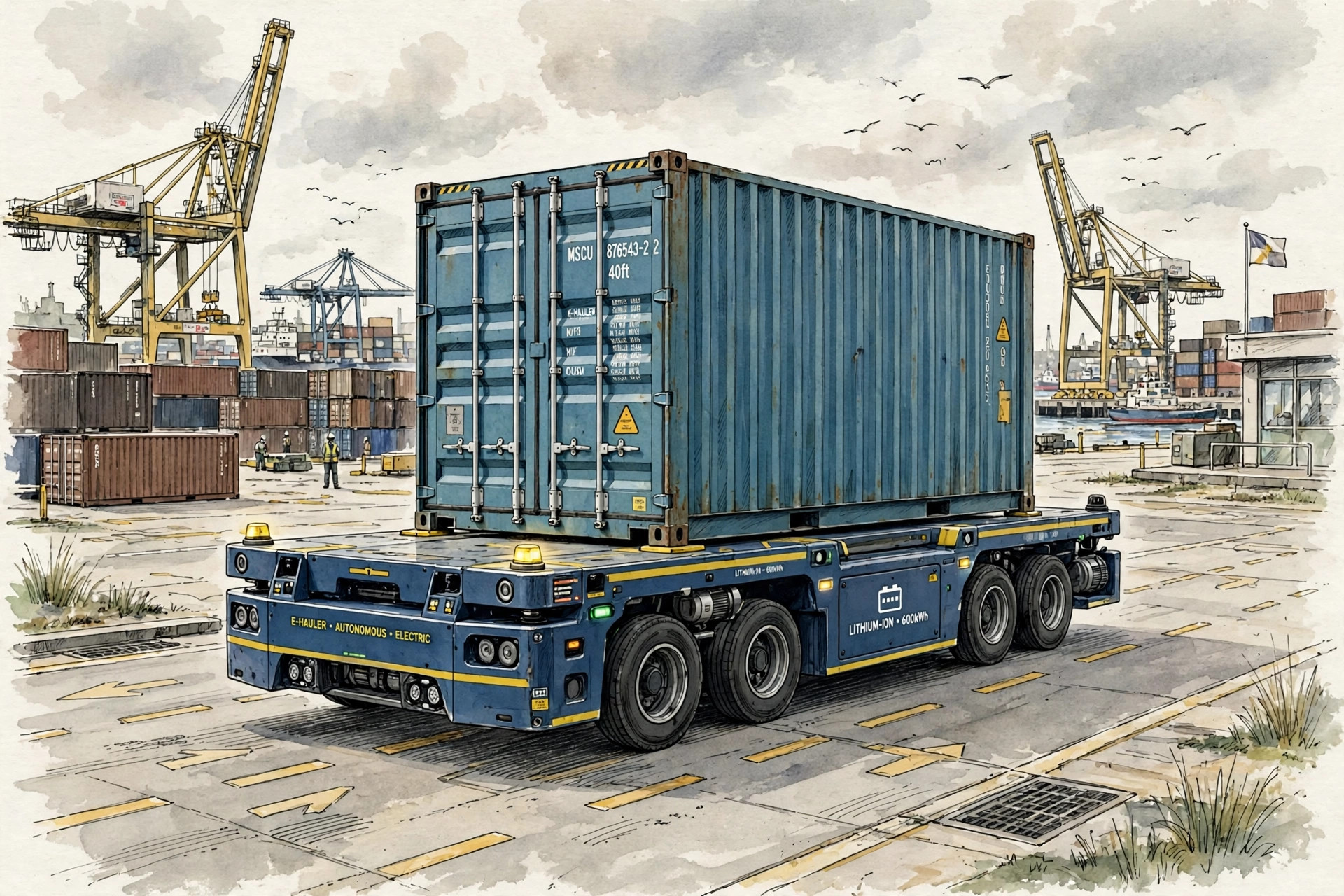
Image: Illustration: AI-generated by CDLWire
Humble Robotics raised a $51 million Series A on Thursday to move its cabless, electric Humble Hauler into customer pilots on port drayage and warehouse runs, according to FreightWaves on Nov. 5. Obvious Ventures led the round, with participation from existing investors Eclipse and Energy Impact Partners. The raise brings the San Francisco startup’s total funding to $75 million, about six months after it emerged from stealth with a $24 million seed round and a driverless truck built with no cab.
The company is the bet of founder and CEO Eyal Cohen, who spent a decade on long-haul autonomy before deciding the open highway was the wrong place to start. Cohen’s long-haul work focused on lanes such as Dallas to Houston and Dallas to El Paso, Texas, he said in an August interview with FreightWaves; then he looked at short-haul freight, a large market almost no one was trying to automate. Humble is targeting regional routes under 250 miles, which it says make up 87% of U.S. truck tonnage. That figure comes from 2021 federal data via a Department of Energy analysis: 87% of the nearly 12 billion tons trucks moved traveled less than 250 miles, and shipments under 100 miles were 44% on their own.
The vehicle itself is the argument. A conventional drayage move uses a day cab tractor pulling a container on a chassis, and most autonomous trucking automates only the tractor — which leaves two problems, Cohen said: something has to make the connection to the trailer, and the tractor’s sensors cannot see behind it. “Today, if you have a tractor and you want to hook a trailer to it, you have to somehow automate that connection, right? That is non-trivial and I think people have been working on that for a while,” Cohen said. “People are using robotic arms and other mechanisms to try to connect a trailer to a tractor. Very challenging, right?” His answer was to combine the two into one flat, skateboard-style platform: its standard configuration carries 40-foot international and 53-foot domestic containers directly, and sensor pods with cameras, lidar and radar give it a 360-degree view, according to the company’s site.
Dropping the cab also drops weight. The website bills the Hauler as 20% lighter than a traditional tractor and trailer, and that freed-up weight is the economic pitch. “The goal is to take more weight per move if we can to reduce the cost per mile as well,” Cohen said. The company’s site lists four use cases — port drayage, plant-to-warehouse shuttles, rail yard moves and short legs between a carrier’s own terminals — along with a 200-mile maximum range and a 55 mph top speed. The shorter distance also changes the failure math, Cohen argues: a depot and engineers can be nearby, and short moves are served very well by electrification, while long haul means a massive battery and a massive charging system.
The new money will pay for customer pilots, testing and validation, early manufacturing and a broader family of vehicles built on Humble’s modular platform, the company said in its release, and Humble told FreightWaves in September that it plans to sell the haulers to third-party operators. Eclipse, which led the seed round, returned for the Series A. “We’ve spent years proving that a truck can drive itself. The harder question is how to make autonomy something a freight operator can depend on every day,” Cohen said in the release.
Two cautions in FreightWaves’ account keep the announcement in proportion. The release names no customers, and in August Cohen said the company was “aiming for customer pilots over the next 12 months” — a target FreightWaves notes runs through August 2027. Cohen also acknowledged that Humble is building electric trucks for a market that has been slow to buy them: “The electric trucks famously have not really taken off in the United States, but they’re taking off elsewhere internationally,” he said. For scale, Gatik raised $200 million in a Series D in August after completing 85,000 fully driverless orders — Humble is raising pilot money at a stage where a comparison point is already running paid driverless work.
Cohen’s own history explains the caution: he joined Otto as one of its first engineers, stayed through its acquisition by Uber, then worked at Pronto and Waabi, and worked on Otto’s October 2016 run in which a self-driving truck hauled Budweiser 120 miles down Interstate 25 in Colorado with no one in the driver’s seat. “You could see how amazing the technology could be and you could also see how far away the technology was,” he said.
For drivers, the near-term read is specific rather than sweeping. The freight Humble wants first is the shortest, most repetitive work in trucking — port drayage, plant-to-warehouse shuttles, rail yard moves and terminal-to-terminal legs under 250 miles — and even there, what was announced Thursday is pilot funding, not deployed trucks: no named customers, a pilot window running through August 2027, a 200-mile range and a 55 mph top speed. Drayage and shuttle drivers around major ports are the ones who should watch this company, because if the pilots show the lighter platform really does carry more weight per move at a lower cost per mile, the first driverless competition they meet will not be on a thousand-mile lane. It will be on the short loop they run every day.
Sources
Related coverage
 November 5, 2026 · EquipmentKodiak's first Gen7 Western Star day cabs go driverless in the Permian — and a 75-truck fleet deal queues up behind them
 November 4, 2026 · EquipmentClass 8 truck orders plunge in October — FTR counts 15,600, down 36%, and ACT counts 13,500, down 45%, as EPA 2027 uncertainty freezes fleet buying
 October 30, 2026 · EquipmentNHTSA starts the first major tire-standard overhaul in more than 20 years — and the bias-era tests may not survive it
Comments
Loading comments…