Laredo carrier owner indicted in alleged B-1 driver scheme: 57 drivers, 1,044 domestic trips
Federal prosecutors say VMS Transport LLC owner Armando Martinez Varela recruited B-1 visa drivers to haul domestic freight out of Laredo across the United States, paying $0.25 to $0.50 a mile against $0.70 a mile for authorized drivers and allegedly saving the company about $299,606 in labor costs.
Summarized from U.S. Attorney's Office for the Southern District of Texas.
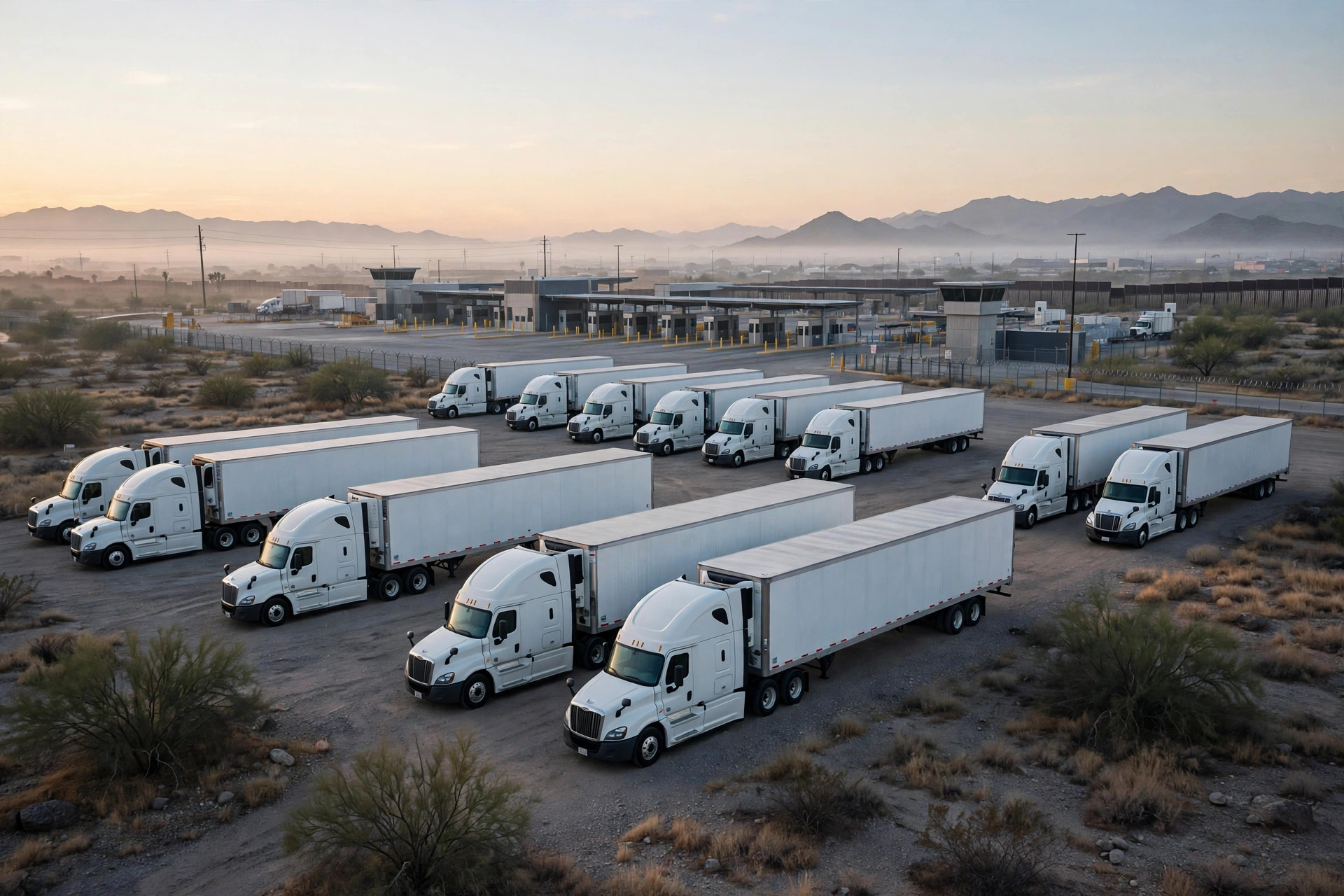
Image: Illustration: AI-generated by CDLWire
The owner of a Laredo, Texas, interstate carrier has been indicted on federal charges alleging he built his domestic freight operation on drivers who were not authorized to haul it, according to the U.S. Attorney's Office for the Southern District of Texas on Nov. 10. Armando Martinez Varela, 56, of Laredo, owned VMS Transport LLC and recruited drivers admitted to the United States under B-1 nonimmigrant status to transport domestic freight without authorization, prosecutors allege. He faces charges involving employment of unauthorized workers, encouraging or inducing unlawful entry or residence, harboring aliens, and making materially false statements to federal investigators.
The alleged scale is what separates this indictment from a paperwork case. Between Feb. 20 and May 15, VMS records allegedly showed 1,044 domestic transportation trips involving 57 B-1 visa drivers. The drivers allegedly picked up trailers in Laredo and delivered shipments throughout the United States. The indictment further alleges Varela arranged housing for the drivers between assignments rather than having them return to Mexico — a detail that matters because B-1 status is built around temporary entry for specific business activity, not living in the United States to work a domestic route network.
The alleged economics are the heart of the case. The charges allege VMS paid the B-1 drivers $0.25 to $0.50 a mile, compared with $0.70 a mile for authorized drivers performing similar work, and that the arrangement saved the company approximately $299,606 in labor costs — about $287 for each of the 1,044 alleged trips. The comparison figure is not an abstraction: $0.70 a mile is the starting solo rate fleets have been advertising in the pay competition covered elsewhere in today's edition, which means the indictment describes a carrier allegedly buying the same mile for as little as a third of its market price.
The legal line the case turns on is the difference between international and domestic transportation. B-1 status permits certain temporary business activities, including qualifying international transportation, but it does not authorize employment transporting freight solely within the United States, the U.S. Attorney's Office said. In practical terms, a B-1 driver may take part in an international movement, such as bringing freight in from Mexico, but picking up a trailer in Laredo and delivering it to another point in the United States is a domestic movement — the point-to-point work that cabotage rules reserve for drivers authorized to work here. Prosecutors allege VMS assigned exactly that work, at scale, for just under three months.
VMS Transport is not a one-truck operation, and its roadside record was already poor before the indictment. FreightWaves, reporting on Nov. 11, described VMS as a Laredo-based interstate trucking company operating 53 power units and employing 50 drivers. Federal records cited by FreightWaves show the carrier underwent 90 roadside inspections during the 24-month period ending Nov. 9, resulting in 12 driver out-of-service violations and 10 vehicle out-of-service violations, and its driver out-of-service rate of 13.3% was nearly double the national average of 6.67%. The carrier was also involved in two reportable crashes during that period, including one involving injuries, and FMCSA records listed its operating authority as active as of Nov. 9.
Laredo is also the center of the legal B-1 trade, which is why the distinction in this case matters beyond one carrier. Cross-border operations there rely heavily on B-1 drivers for the international leg — a survey of carriers on a cross-border freight platform, reported last month, found two-thirds of its Laredo carriers run majority-B-1 fleets — while about 25,000 Mexican drivers have lost their B-1 visas since April 2025 as federal scrutiny of the program tightened. The indictment lands in the middle of a broader federal push on driver authorization that has also put 33,000 drivers out of service nationally for English-language proficiency failures since the April 2025 executive order, according to the Department of Transportation's Nov. 4 update.
Immigration and Customs Enforcement Homeland Security Investigations conducted the investigation, and Assistant U.S. Attorney Christine A. Cortez is prosecuting the case. If convicted, Varela faces up to 10 years in federal prison and a possible $250,000 maximum fine. The Justice Department's announcement did not say whether additional company officials or drivers face charges in connection with the alleged scheme, and it did not identify the freight customers involved or the destinations served by the 1,044 trips. An indictment is a formal accusation of criminal conduct, not evidence, and Varela is presumed innocent unless convicted through due process of law.
For drivers and compliant carriers, the practical point is the rate gap. An alleged labor saving of $0.20 to $0.45 a mile against the authorized rate is not a rounding error: on a long domestic run it is the margin that lets a carrier underbid fleets paying market wages and still keep money in the load. For B-1 drivers, the case is a warning that domestic point-to-point work arranged by a carrier can become the driver's immigration problem as well as the owner's criminal case. And for shippers and brokers tendering freight out of Laredo, the carrier at the center of this indictment still showed active operating authority on Nov. 9 — vetting that stops at an active authority would not have caught any of this.
Sources
Related coverage
 November 10, 2026 · EnforcementOperation Highway Shield reaches Maryland and D.C.: 941 inspections put 191 vehicles and 92 drivers out of service, and local crackdowns add hundreds more violations
 November 8, 2026 · EnforcementColorado troopers stopped 119 drivers who ran past I-70 chain checks — 262 citations in two Dotsero details, and the next one is Tuesday
 November 7, 2026 · EnforcementIndiana police and the FBI are investigating a 45-truck carrier over alleged ELD cheating and pay-skimming — and the owner says fired employees invented it
Comments
Loading comments…