Operation Highway Shield reaches Maryland and D.C.: 941 inspections put 191 vehicles and 92 drivers out of service, and local crackdowns add hundreds more violations
FreightWaves reports Operation Highway Shield expanded into Maryland and Washington, D.C.: FMCSA and Maryland agencies ran 941 inspections, placing 191 vehicles and 92 drivers out of service, while the District's Nov. 6 update reported 125 inspections, 193 violations and 50 out-of-service violations. The same roundup carries local enforcement in Virginia, Oregon and New York, an arrest on suspicion of DUI on I-40 in Arizona after a preliminary breath sample of 0.301, and a British Columbia brake failure that could have caused a catastrophic collision — with DOT's Nov. 4 update putting 33,000 drivers out of service nationally for English proficiency.
Summarized from FreightWaves.
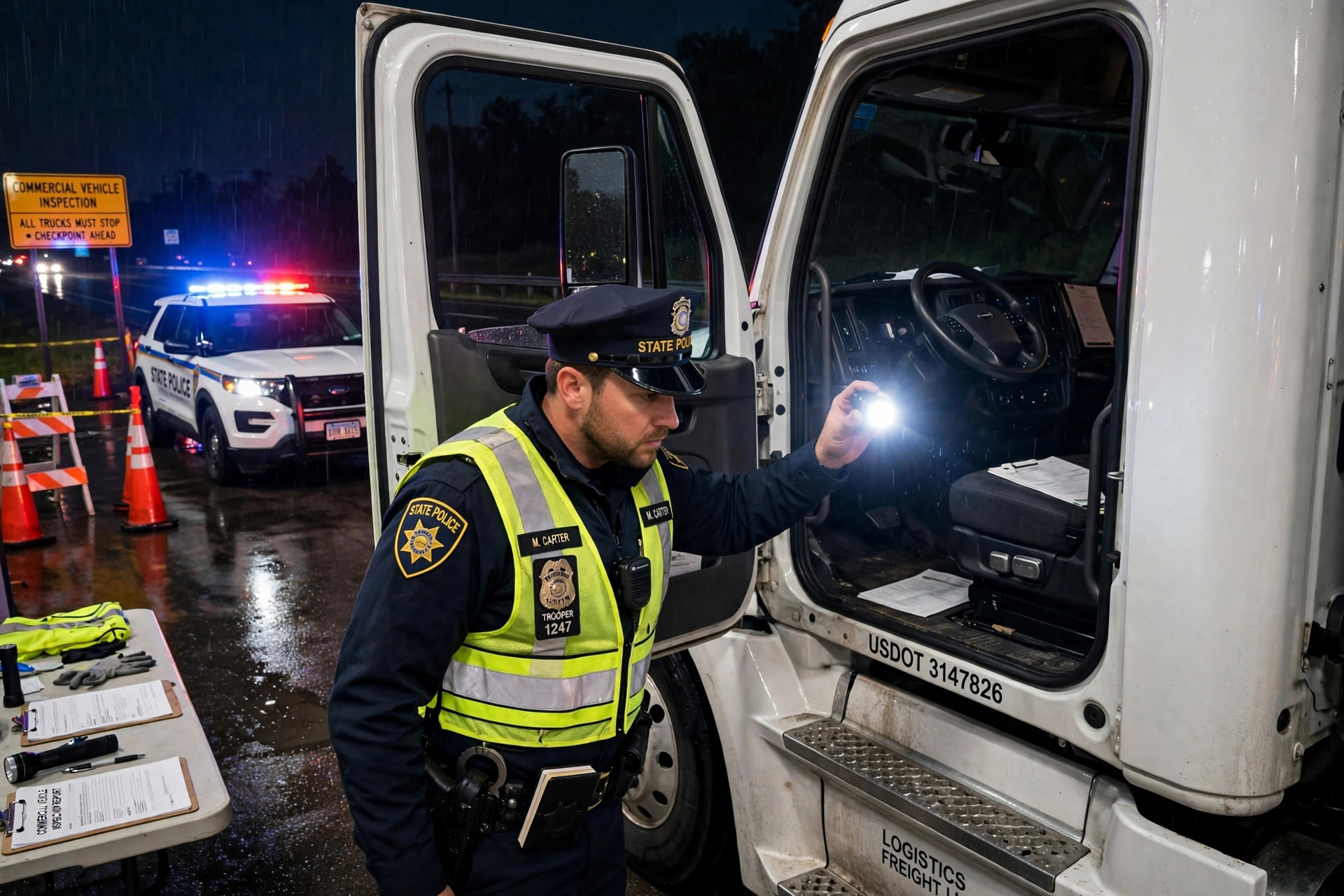
Image: Illustration: AI-generated by CDLWire
Federal and state inspectors have taken Operation Highway Shield into Maryland and Washington, D.C., and the new jurisdictions produced the same pattern the campaign has shown everywhere else it has gone: a high share of inspected trucks and drivers taken off the road for safety and licensing violations, according to FreightWaves on Nov. 9. In Maryland, the Federal Motor Carrier Safety Administration partnered with state agencies to conduct 941 inspections, resulting in 191 vehicles and 92 drivers placed out of service. In Washington, D.C., FMCSA inspectors working with the Metropolitan Police Department reported 125 inspections, 193 violations and 50 out-of-service violations in the District's Nov. 6 update.
The Maryland operation was the larger of the two. FMCSA said its Maryland campaign involved the Maryland State Police, the Maryland Transportation Authority Police, the Maryland Department of the Environment and the Comptroller of Maryland. The agency gave no breakdown of the violations and did not say how many sidelined drivers were disqualified for English-language deficiencies; in the District, it likewise disclosed only the operation's violation and out-of-service counts, not how many individual drivers or vehicles were placed out of service.
The Maryland and District operations are the newest wave of a campaign that has built state by state. The same account notes that an Oct. 27-29 operation in Arkansas resulted in 393 drivers and commercial vehicles placed out of service, 183 English-language proficiency violations and 44 criminal arrests, and that a separate operation in Stephens City, Virginia, identified 100 violations during 86 inspections, with 11 vehicles and two drivers placed out of service. The U.S. Department of Transportation's Nov. 4 enforcement update, quoted in the same report, puts the campaign's national scale in numbers drivers should know: federal authorities have placed 33,000 drivers out of service nationwide for failing English-language proficiency requirements since the April 2025 executive order, revoked 31,000 improperly issued commercial driver's licenses, and closed nearly 10,000 driving schools characterized as operating improperly.
Not everything in the roundup was part of Highway Shield, and the distinction matters. A Culpeper County, Virginia, campaign run by the sheriff's office with seven regional agencies involved 22 inspections and produced 148 violations, including 34 out-of-service violations; authorities placed 14 vehicles out of service, cited two drivers for operating without valid commercial driver's licenses, and towed four unsafe vehicles. In Salem, Oregon, police traffic officers conducted commercial vehicle safety inspections along Mission Street SE on Nov. 5, inspecting 12 trucks and identifying 48 equipment violations, nine driver violations and 24 out-of-service violations, with nine vehicles and five drivers placed out of service. In the Town of Wallkill, New York, inspectors working the State Route 302 and State Route 17M corridors identified 248 violations, placing 19 trucks, six trailers and six drivers out of service. These were separate state and local initiatives, not Highway Shield operations, but the picture is the same: enforcement pressure on equipment and licensing is rising on local corridors as well as on the interstates.
Two Arizona incidents show what the inspections are catching beyond paperwork. On Nov. 5, Arizona Department of Public Safety troopers responded to reports of a semi-truck failing to maintain its lane along Interstate 40 near Flagstaff, where a caller reported the truck had blocked an off-ramp and its driver appeared highly intoxicated; the caller removed the driver and took the keys before troopers arrived. A preliminary breath sample indicated a blood alcohol concentration of 0.301, nearly eight times the 0.04 federal threshold for commercial drivers, and troopers reported finding alcohol in the cab. The driver was arrested on suspicion of driving under the influence, and the truck and trailer were towed and placed on a 20-day impound. In a separate Nov. 2 incident in Mesa, Arizona, troopers stopped a truck hauling an approximately 25,000-pound mobile office on State Route 202 and found the trailer had no functioning brakes and an inoperative breakaway device; the rig was ordered out of service pending repairs.
The most alarming single stop in the roundup came from across the border. Burnaby Royal Canadian Mounted Police officers stopped a commercial vehicle in early October traveling north on Royal Oak Avenue, a road not designated for truck traffic, and discovered a significant air leak, low air pressure and partially engaged spring brakes. All six brakes were overheating, and the truck's primary air line ruptured during the inspection, causing the air brake system to fail. Police said the failure could have resulted in a catastrophic collision if it had occurred while the truck was descending a nearby hill toward a busy intersection. Inspectors also found an overweight front axle, unsecured cargo and a seat belt violation; the vehicle was placed out of service.
For drivers, the practical read is that the roadside risk of an out-of-service order is now a planning factor on corridors that were not in the campaign a month ago, and the violations being written are overwhelmingly the fixable kind: brake problems, English-language proficiency, invalid licenses and paperwork. Check the brakes — including the trailer and the breakaway device the Mesa stop shows inspectors are testing — and carry the license and medical paperwork the state actually has on file for you. With 33,000 drivers already sidelined nationally for English proficiency alone, a carrier whose paperwork does not match its authority is exactly the kind of fleet these operations are built to find.
Sources
Related coverage
 November 8, 2026 · EnforcementColorado troopers stopped 119 drivers who ran past I-70 chain checks — 262 citations in two Dotsero details, and the next one is Tuesday
 November 7, 2026 · EnforcementIndiana police and the FBI are investigating a 45-truck carrier over alleged ELD cheating and pay-skimming — and the owner says fired employees invented it
 November 6, 2026 · Enforcement1 in 7 trucks parked for brakes: CVSA's Brake Safety Week puts 2,369 vehicles out of service, and the 15.3% failure rate barely moved from last year
Comments
Loading comments…