Five drivers are asking FMCSA for their CDLs back — the first exemption petitions under the non-domiciled rule are open for comment until Dec. 24
FMCSA has published five requests for relief from the non-domiciled CDL rule that took effect in March: four individual drivers — in New Jersey, Oregon, North Carolina and one whose CDL expired in August — asking to renew or reinstate licenses they say they lost over immigration-status paperwork, and a fifth, from a Marine Corps veteran, asking for a category-wide exemption for drivers in humanitarian and protection-based statuses. Each comment period runs 30 days from Nov. 24, with comments due Dec. 24. None of the five has been granted, and the notices do not indicate what FMCSA will decide.
Summarized from Commercial Carrier Journal.
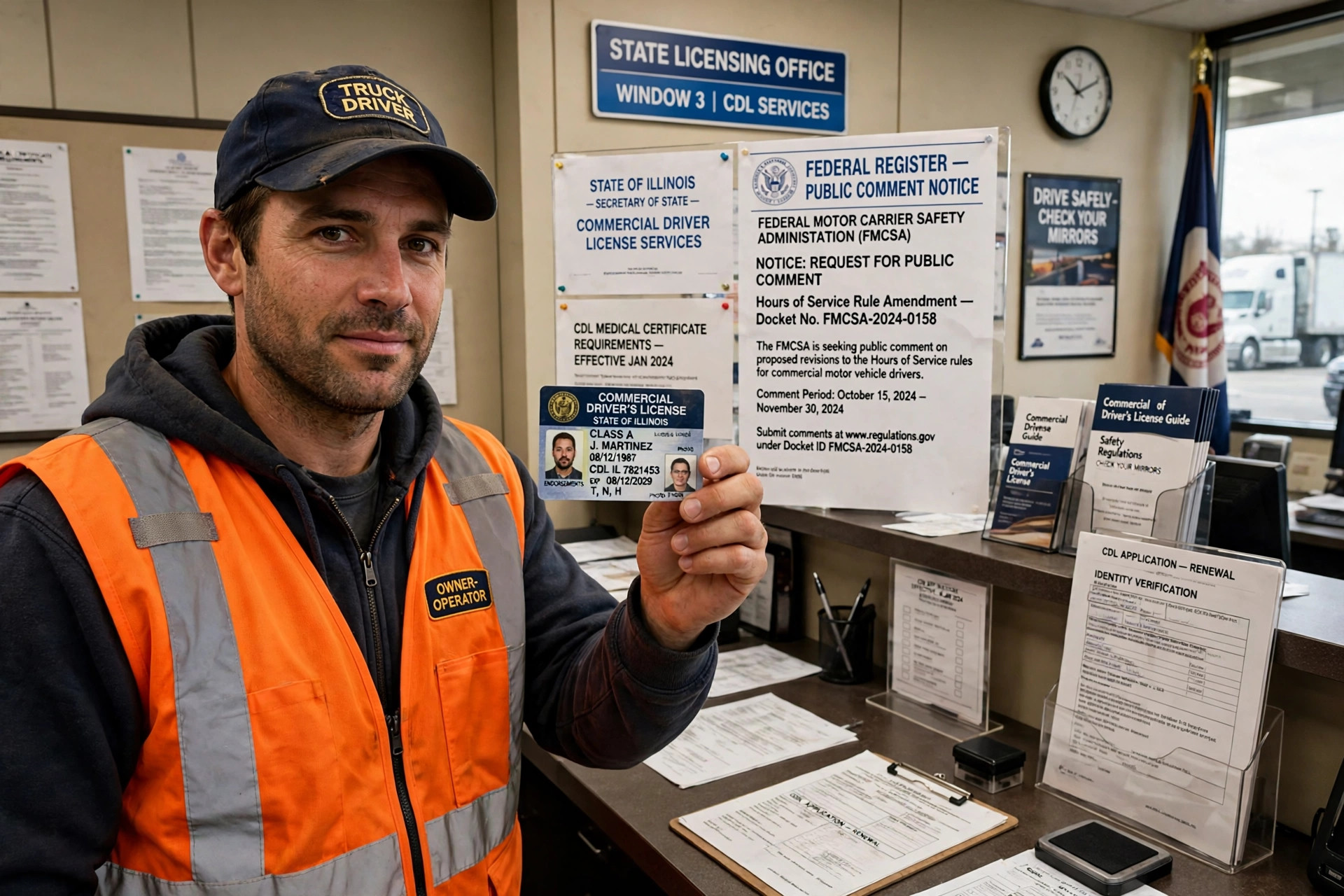
Image: Illustration: AI-generated by CDLWire
Five exemption requests now pending at the Federal Motor Carrier Safety Administration are the first individual test of the non-domiciled CDL rule — four drivers asking for their own licenses back, and a fifth asking for a whole category of drivers — with public comment open on all five starting Tuesday, according to Commercial Carrier Journal on Nov. 23.
The rule behind the petitions took effect in March. As Commercial Carrier Journal summarizes it, the rule barred nearly 200,000 non-domiciled CDL holders from renewing or updating their CDLs, and only a few categories of visa holders can now be issued a non-domiciled CDL: H-2A temporary agricultural workers, H-2B non-agricultural workers, and E-2 treaty investors. CDLLife, which reported the same five requests on Nov. 23, frames the rule as the February 13, 2026 final rule preventing state driver's licensing agencies from issuing CDLs to any non-citizens unless the applicant provides evidence of lawful immigration status. The five notices were published in the Federal Register on Nov. 24, and FMCSA will accept public comment on each for 30 days — the Federal Register notices set the deadline at Dec. 24, 2026. An exemption notice is a request for comment, not a decision: the notices state plainly that they do not indicate what FMCSA will ultimately reach, and the agency will grant or deny each request after reviewing the application, safety analyses and public comments.
The first petitioner, Amiran Morchiladze, is asking for temporary relief to renew or restore his non-domiciled CDL while his immigration case and application for adjustment of status are pending. He told FMCSA he has lived in the United States for nearly 10 years and that his CDL expired on Aug. 6, 2026. His safety argument is specific: he completed his CDL training and testing in English, passed all three portions of his CDL skills test on the first attempt, has commercial driving experience operating box trucks, dry vans, flatbeds, conestoga trailers and step-deck equipment, has not received a traffic ticket or moving violation, and has had roadside and scale inspections without violations or out-of-service orders. He said he is willing to satisfy additional safety requirements, including retaking knowledge or road tests, completing language testing, obtaining updated medical certification, and permitting additional review of his driving and inspection records. Without relief, he told the agency, he may lose his truck, the small business he has been building, and his primary source of income. Comments on his request go to Docket No. FMCSA-2026-3632 at regulations.gov.
Luca Donati's petition is a paperwork case. He is a citizen of Italy, lawfully present in the United States in E-1 nonimmigrant status — one step outside the H-2A, H-2B and E-2 categories the rule recognizes — and he asks FMCSA to let a state licensing agency accept his E-1 visa and Form I-94 as evidence of lawful immigration status and issue or renew his non-domiciled Class A CDL. He requested a five-year exemption. His Form I-94 is valid until April 4, 2027, and his E-1 visa through May 16, 2027. New Jersey issued his non-domiciled Class A CDL on Aug. 12, 2024; when he appeared in person to renew in February 2026, New Jersey downgraded his Class A license to Class D. He told FMCSA that without relief he is unable to work in the occupation for which he is trained and lawfully authorized, even though he remains lawfully present and authorized to work in the United States, and that the documentary requirement he seeks relief from is not a measure of driver competence, medical fitness or safety performance. His docket is FMCSA-2026-3169.
Nikolai Kostarev's petition turns on asylum. He asks for an exemption that would let a state treat his evidence of granted asylum as sufficient documentation to issue or renew his CDL, until he receives lawful permanent resident status or for two years, whichever is earlier. His Oregon CDL expired in August; before it expired, he was an owner-operator who drove for Jacob Transport Inc. in Vancouver, Washington. He was granted asylum on March 18, 2026, is lawfully present and authorized to work, and his Form I-485 application to adjust status is pending while he waits for his Form I-551, the permanent resident card. If the exemption is granted, he would retain a valid medical certificate, operate only for Jacob Transport, and submit to any further monitoring FMCSA or the licensing state requires; his application includes a letter of support from Jacob Transport. Without it, he said, he faces severe financial loss because he owns his truck and commercial driving is his livelihood. His docket is FMCSA-2026-3400.
Yehonatan Kapach's case is a downgrade, not an expiration. Born in Israel and living in North Carolina, he holds an unexpired Employment Authorization Document issued under category C08 because of his pending asylum application. North Carolina issued his Class A CDL with Passenger (P) and School Bus (S) endorsements in August 2023, designated limited-term and due to expire in July 2028 — but in August 2026 the North Carolina DMV downgraded his Class A CDL to a Class C CDL. He said the DMV offered no explanation of the legal basis in writing; he was told orally that it was based on his lack of lawful permanent resident status. He requests a five-year exemption to reinstate the Class A with its endorsements, and argues, in CDLLife's account of the filing, that he satisfied every performance requirement the agency imposes and held a safe operating record from Aug. 31, 2023 to Aug. 12, 2026, with no record of crashes or citations for any violation of the federal safety regulations. His docket is FMCSA-2026-2740.
The fifth request is the broad one. Nick Castello, who describes himself as a United States Marine Corps veteran and disabled veteran business owner submitting the application as a public safety and workforce continuity initiative, asks FMCSA to let state licensing agencies issue non-domiciled commercial learner's permits and CDLs to drivers in humanitarian or protection-based categories — Uniting for Ukraine, Temporary Protected Status, asylum and pending asylum among them. He told the agency he has collected 93 responses from drivers who experienced recurring problems with non-domiciled permit and license issuance, renewal, transfer, restoration, correction, replacement and upgrade transactions as a result of the final rule. His proposed conditions would keep covered drivers subject to all applicable CDL qualification and safety requirements, allow FMCSA or the Department of Homeland Security to verify each driver's identity, immigration status and work authorization, and limit each driver to the verified period of lawful presence or work authorization, one year, or another FMCSA-approved period. His docket is FMCSA-2026-3268.
The practical takeaway for drivers and carriers is procedural, and the dates are the actionable part. Nothing in these five notices changes anyone's eligibility today: the March rule remains in force, the petitions are requests, and FMCSA has granted none of them. What is open, from Nov. 24 through Dec. 24, is the comment record on which the agency will decide — at regulations.gov, under docket numbers FMCSA-2026-3632, FMCSA-2026-3169, FMCSA-2026-3400, FMCSA-2026-2740 and FMCSA-2026-3268. A driver whose own renewal is blocked by the rule is in the same position these five petitioners were in before they filed: the exemption route exists, it runs through a Federal Register notice and a public docket, and the applications that get published are the ones that document a safety record in the detail Morchiladze's and Kapach's filings do. Carriers employing non-domiciled drivers should read the five dockets as the map of where the rule's edges are being tested — an E-1 visa, granted asylum, a pending asylum application, and the humanitarian categories — because FMCSA's answers, when they come, will be written on these records.
Sources
Related coverage
 November 22, 2026 · BorderMexico's truckers and federal government advance 29 highway-safety agreements — a month after the nationwide strike shut down freight in 19 states
 November 16, 2026 · BorderLaredo's Saturday pilot is moving 400 to 500 trucks off Sundays — and CBP expects to extend it another 90 days
 November 12, 2026 · BorderTrump threatens to immediately double tariffs on Mexico over migrant caravans
Comments
Loading comments…