Highway deaths fell 2.5% in the first half of 2026 to 16,750, NHTSA estimates — but the decline stalled to 0.2% in the second quarter
NHTSA's early estimates put the first-half fatality rate at 1.02 deaths per 100 million miles, the second-lowest first-half rate ever recorded, on travel up 0.8%. But first-quarter deaths fell 5.0% while second-quarter deaths fell just 0.2%, with May and June rising — and the estimates do not yet separate out crashes involving large trucks.
Summarized from National Highway Traffic Safety Administration.
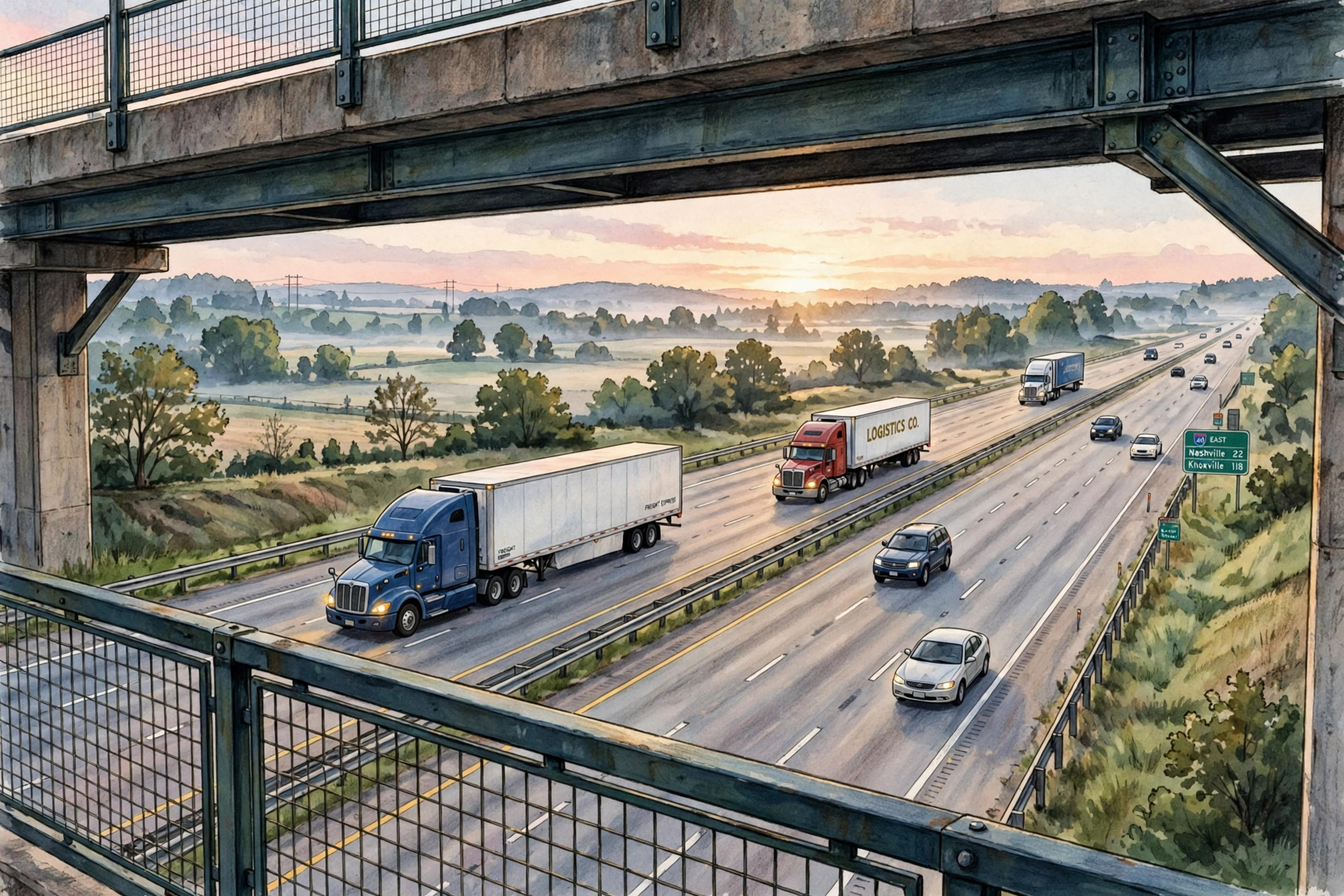
Image: Illustration: AI-generated by CDLWire
Highway deaths fell again in the first half of 2026, but the improvement nearly stalled in the second quarter, according to the National Highway Traffic Safety Administration on Nov. 10, in preliminary estimates putting traffic deaths at 16,750 for January through June — a decrease of about 2.5% from the projected 17,175 deaths in the first half of 2025. The decline came while Americans drove more: preliminary Federal Highway Administration data shows vehicle miles traveled rose by about 12.9 billion miles, an increase of about 0.8%. The fatality rate fell to 1.02 deaths per 100 million vehicle miles traveled, down from 1.05 a year earlier — and if that rate holds, it is the second-lowest ever recorded for the first half of a year, behind only the 1.01 recorded in the first half of 2014.
The quarterly split is where the report turns cautious. Deaths in the first quarter fell 5.0%, to 7,715, but second-quarter deaths fell just 0.2%, to 9,035. Looked at by month, both fatalities and the fatality rate decreased in every month of the half except May and June, which showed year-over-year increases. In other words, the national improvement in the first half of 2026 is a first-quarter story: by late spring, the trend had flattened and begun, in two consecutive months, to move the wrong way. The second quarter is also the heavier-travel quarter — 9,035 of the half's 16,750 deaths — so a stall there carries more weight than the same stall in January through March.
The improvement was broad but not universal. Eight of the agency's 10 regions are projected to show decreases in both fatalities and the fatality rate per 100 million miles. At the state level, 35 states and Puerto Rico are projected to have recorded fewer traffic deaths in the first half of 2026 than in the same period of 2025, while 15 states and the District of Columbia are projected to have recorded increases. A driver crossing state lines this winter is therefore moving between two different safety trends at once: most of the map improving, and a substantial minority of states — nearly a third — getting worse on the same measure over the same six months.
These are early estimates, and the agency is explicit about what that means. The figures are statistical projections, built region by region and collated into the national estimate; the counts for 2025 and 2026 will be slightly revised when the Fatality Analysis Reporting System's 2025 Annual Report File becomes available later this year, and refined again when the final 2025 file and the 2026 annual file arrive next year. The projections for the first nine months of 2026 are due in late December. The longer arc behind the estimate is worth holding onto: first-half deaths peaked in this decade at 20,055 in 2021, during the pandemic-era surge, then fell to 20,036 in 2022, 19,302 in 2023, 18,681 in 2024 and a projected 17,175 in 2025 before this year's 16,750. The first-half fatality rate has fallen every year in that stretch, from 1.33 in 2021 to this year's 1.02 — progress measured per mile driven, not just in raw counts on a growing highway system.
What the early estimates cannot tell a truck driver is the number he most wants: they do not separately identify fatalities involving large trucks. The most recent truck-specific figure available comes from separate agency statistics: 5,340 people died in crashes involving large trucks in 2024, down 2.5% from 2023 — and whether that decline continued through 2025 and into 2026 will not be known until the fuller fatality files are published. The Trucker, reporting the release on Nov. 11, made the same point: for professional drivers, who spend their working lives sharing highways with passenger vehicles, the overall trend is encouraging, but the truck-specific trend is still an open question. NHTSA Administrator Jonathan Morrison, quoted in the same report, struck the agency's balance between the headline and the stall: "Even with near-record low fatality rates, we will continue to work with a sense of urgency to make sure more Americans get home safely."
The practical read for CDL holders is narrower than the headline. A rate of 1.02 deaths per 100 million miles is a statistic about the traffic a professional driver moves through, and the professional's exposure is measured in hundreds of thousands of those miles a year — which is why a second quarter in which the national decline shrank from 5.0% to 0.2%, with May and June rising, matters more to a driver than the half-year average. The conditions behind the stall are the familiar ones the administrator named in announcing the agency's Pathways to Safer Streets work — reckless driving and impaired driving head the list of causes the initiative targets — and they are the behaviors a truck driver meets from the other vehicles in the crash, not from the truck. Expect the December nine-month update to show whether the May-June uptick was noise or the start of a reversal; until then, the safest summary of the first half of 2026 is that the roads got measurably safer per mile, and then, in the quarter when freight and family travel both run heaviest, stopped getting safer.
Sources
Related coverage
 October 29, 2026 · Law & safetyWerner's Leathers: capacity cuts are in the 'early innings' — about 15% of trucks still out of alignment, only 3% to 4% gone
 October 28, 2026 · Law & safetyKnight-Swift cut its approved carrier pool by about 70% — and its CEO says the CDL crackdown could make the recovery last
 October 20, 2026 · Law & safetyNew Mexico jury awards $47 million to pickup driver and his mother in 2022 tanker crash case
Comments
Loading comments…