One-to-six-truck fleets are down to about 362,000 tractors from a 398,000 peak — and most of those trucks never left the road
FreightWaves' analysis of the Nov. 9 FMCSA census snapshot finds the smallest carrier tier has shed roughly 36,000 tractors since 2023, squeezed by a record $2.336-a-mile cost base and diesel at roughly $1 a mile with no fuel surcharge to recover it. The equipment is consolidating into 20-to-100-truck fleets through lease-ons and used-truck sales, not parking.
Summarized from FreightWaves.
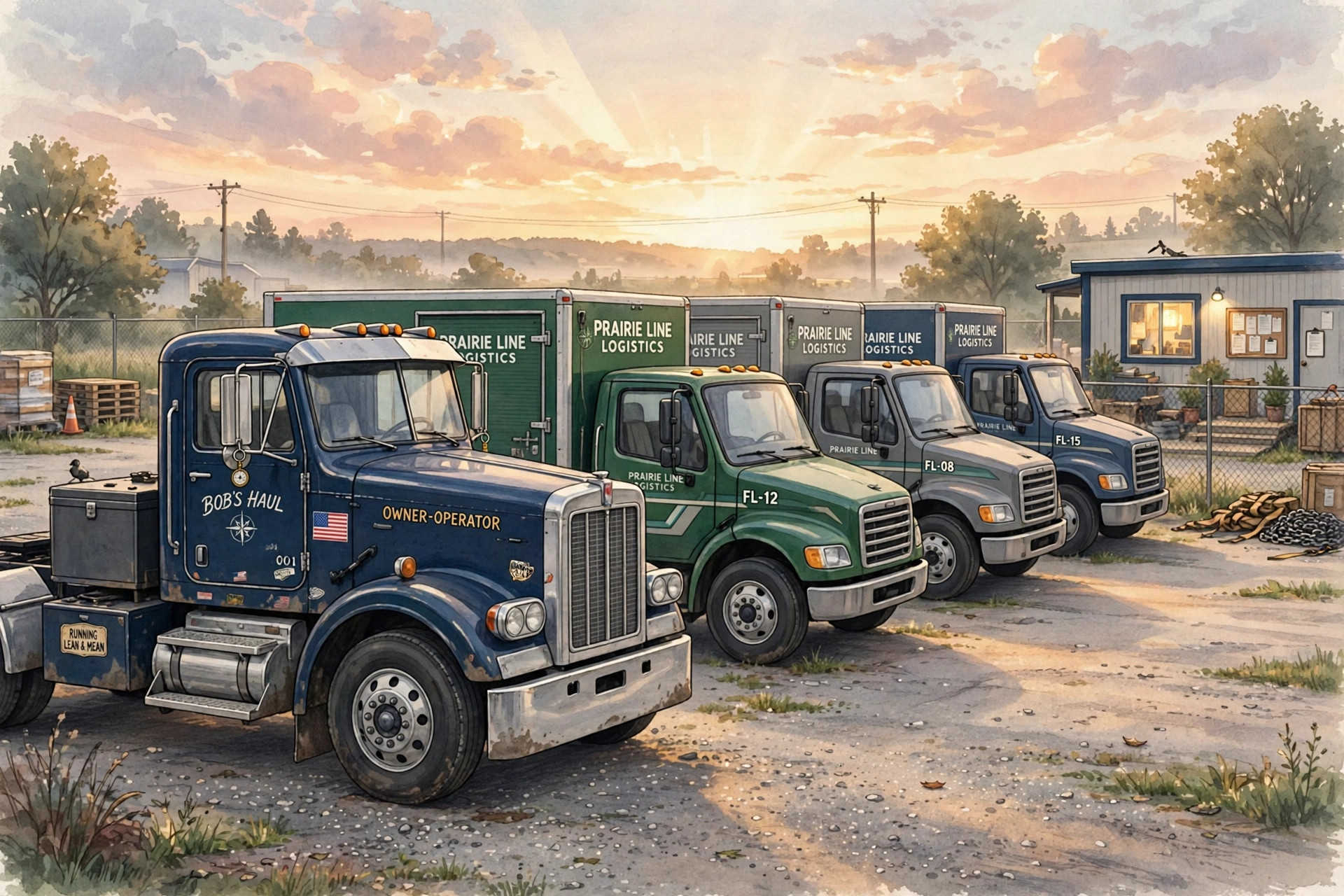
Image: Illustration: AI-generated by CDLWire
For three and a half years the smallest tier of trucking has been emptying out, with tractors run by one-to-six-truck carriers sliding from a 2023 peak near 398,000 to about 362,000 — but the easy explanation, that owner-operators are simply going out of business, misses what the federal data actually shows, according to FreightWaves on Nov. 11, in an analysis of the Federal Motor Carrier Safety Administration's company census, snapshot dated Nov. 9, and FreightWaves SONAR tractor counts from early November. A large share of those trucks never leave the road at all: they just change whose name is on the authority. The tier is still the broadest base of the market — more than 1.8 million active carrier registrations fall into the one-to-six-truck band, including private and intrastate operators, the overwhelming majority of all registered carriers.
The reasons are mathematical, starting with a cost base already at a record before diesel moved. The American Transportation Research Institute put the average marginal cost of running a truck at $2.336 a mile in 2025, the highest it has recorded, with driver pay the heaviest line at roughly $0.82 a mile and fuel the next tier down at about $0.48. Then 2026 rewrote the fuel math: diesel set records this year, reaching $6.127 a gallon in the Department of Energy's national average for the week of Nov. 9, which at six to seven miles per gallon runs roughly $1 a mile in fuel alone — close to double the year-earlier cost — on top of a cost base already at a record.
What makes that dollar a mile close to unavoidable for the smallest carriers is how the rate is built. A fuel surcharge is largely a contract-freight mechanism — a separate line that moves with the Department of Energy's weekly diesel average. The small operator living on load-board freight rarely sees one, because spot rates are quoted all-in: there is no surcharge line to adjust when diesel spikes, so the owner-operator absorbs the full move into a rate he never got to reprice, while a mid-sized contract fleet recovers a chunk of every increase. The same gallon costs him more and comes back to him less.
Insurance lands the same way: premiums ran around $0.106 a mile in 2025, up nearly 4% on the year, and the operator with one or two trucks pays the most per unit, with the least ability to self-insure or negotiate. There is no scale to spread any of it across. And it is not a rates problem. Spot van and reefer rates have firmed through 2026, running stronger for this time of year than any season since 2021, and contract pricing is forecast to climb meaningfully into next year, with some dry-van estimates calling for double-digit increases. Freight volume has stayed roughly flat, with the SONAR Truckload Volume Index holding near its average. The squeeze is that costs are rising faster than even a rising rate can cover for a carrier with no surcharge and no scale.
Where the trucks go is visible in the census itself, in the share of each fleet-size band's tractors that are leased rather than owned: about 6.9% for owner-operators, 18.2% for fleets of seven to 19 trucks, nearly a third — 31.6% — in the 20-to-100 band, and past 40% in the 101-to-999 band. In the 20-to-100 band alone, the census shows more than 217,000 term-leased tractors alongside roughly 466,000 owned ones, close to SONAR's separate count of 470,402 tractors for the same band. Not every exiting owner-operator leases on: some sell the truck outright, and that equipment tends to be bought by fleets a size or two up.
The middle band doing the absorbing is small in number, heavy in trucks. Only about 44,500 carriers fall into the 20-to-100 band — under 2% of all carriers — yet they operate roughly 1.75 million power units. It is the efficiency sweet spot: big enough to negotiate a fuel-surcharge program, buy diesel in volume, and spread insurance and maintenance across dozens of trucks, yet small enough to stay nimble and regional. Two caveats travel with every figure, stated plainly in the source: census power-unit data is self-reported through MCS-150 filings and includes private and intrastate carriers, and term-leased counts include full-service leases as well as lease-ons — so the census shows the direction and scale of the migration, not a driver-by-driver count.
For the owner-operator weighing the move, the analysis is blunt about what separates the outcomes. Running small now demands more discipline than it used to: the operators holding their ground know their true cost per mile to the penny and built direct relationships with local shippers instead of depending on the spot market. The ones leasing on are frequently making the smart call, trading some independence for a cost structure and freight base they cannot build alone. And the ones who end up surrendering their authority with nothing to show for it are usually the ones who drifted — undercapitalized and spot-dependent — until the fuel bills closed the math on them even as rates improved. For carriers, brokers and shippers, the consolidation matters too: capacity is moving into larger, more durable operations that can withstand $6 diesel and flat volumes. The central question the data poses to a one-truck operator is no longer whether to stay in trucking, but whether to stay in trucking alone.
Sources
Related coverage
 November 6, 2026 · Carrier watchPS Logistics buys Roane Transportation: a 170-driver Tennessee flatbed and Conestoga fleet joins Loudon County Trucking
 November 5, 2026 · Carrier watchArcBest beats Q3 on heavier freight: ABF tonnage up 10% on 13% heavier shipments, and October ran 20% ahead
 November 3, 2026 · Carrier watchPamt posts its truckload unit's 12th straight operating loss — a 109.1% operating ratio — as diesel timing and driver costs outrun an 11% sequential rate gain
Comments
Loading comments…