Colorado has approved paid chain-up services — private crews will be allowed to install and sell chains at designated stations, but the must-carry law and its $500 and $1,000 fines do not change
The Colorado Transportation Commission adopted updated chain law regulations on Nov. 19, clearing the way for CDOT to permit private vendors to install, remove and sell tire chains and traction devices at approved roadside locations. Land Line reports the first permits could be issued by early 2027, with price caps still to be written — and CDOT says very few truckers actually know how to install the chains they are required to carry.
Summarized from The Trucker.
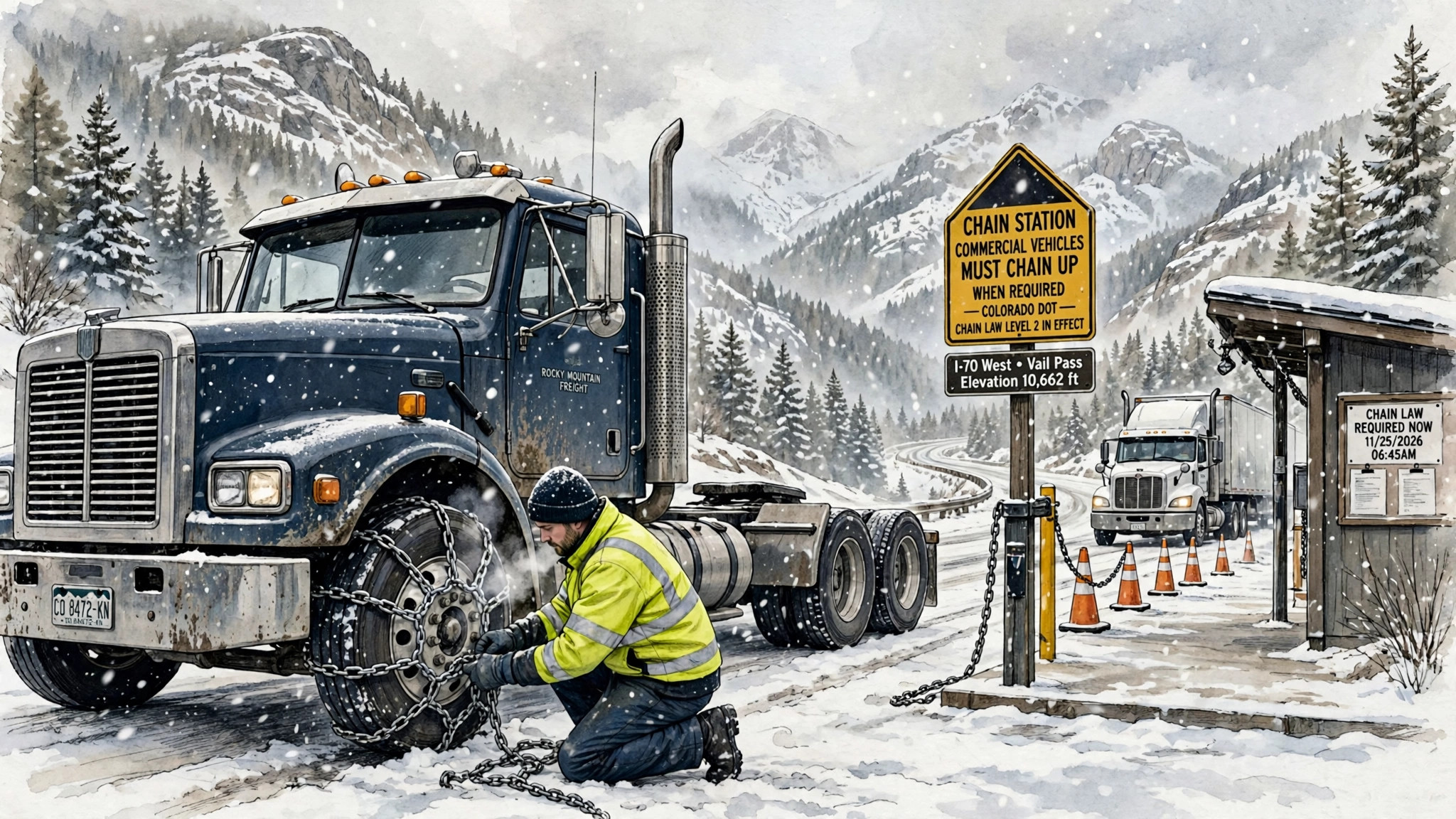
Image: Illustration: AI-generated by CDLWire
Help with chaining up is officially coming to Colorado's mountain highways: the state has adopted the rules that will let private crews charge to install your chains at designated stations, according to The Trucker on Nov. 24.
The Colorado Transportation Commission adopted updated chain law regulations on Nov. 19, paving the way for private businesses to offer paid roadside chain-up services at designated locations. The move follows Senate Bill 25-069, signed into law on May 15, 2025, which was designed to improve highway safety and reduce congestion along Colorado's mountain corridors during winter weather. Under the legislation, the Colorado Department of Transportation is authorized to issue permits to private vendors and companies to install, remove and sell tire chains and alternative traction devices at approved roadside locations.
The rules carry guardrails. The legislation directs CDOT to avoid granting permits in a way that would effectively give a single vendor a monopoly at a particular location, and service providers will be subject to safety requirements including reflective clothing, signage and traffic control equipment. The updated regulations were adopted following an Oct. 22 public hearing and subsequent revisions to the proposed rules. A timeline for the launch of services, initial locations and pricing has yet to be confirmed in The Trucker's reporting; Land Line, the OOIDA magazine, reported on Nov. 23 that CDOT could issue its first permits by early 2027, and that the program's standard operating procedures still have to set how much companies can charge, with the stated goal of protecting truckers from price gouging during storms.
The problem the program is aimed at is not carrying chains — it is installing them. Land Line reported that CDOT program manager Jori Ernst said very few truckers know how to install tire chains or other traction devices, that drivers pull into chain stations and plug them up because they either do not have chains or do not know how to install them, and that recent Colorado State Patrol enforcement showed over 90% compliance with the must-carry law itself. Chaining up is time-consuming and physically demanding, often done in freezing temperatures, poor visibility and close proximity to passing traffic, and on a Colorado crossing it may need to be repeated several times in a single trip as conditions change.
The scale of the corridor explains the state's interest. According to CDOT data released in October 2025 and cited by The Trucker, commercial motor vehicles account for approximately 10% of traffic on Interstate 70, more than 1,400 miles of Colorado highways are subject to the must-carry chain law, the state has 130 designated chain stations including 22 along the I-70 mountain corridor, and officers issued more than 1,300 citations for must-carry violations during the 2024-25 season. A truck that loses traction on a steep grade can block travel lanes and disrupt freight movement for hours.
Nothing about the new program relieves a driver of the existing duty. From Sept. 1 through May 31 each year, commercial motor vehicles weighing more than 16,000 pounds must carry tire chains or approved alternative traction devices when traveling on designated stretches of Colorado highways, regardless of weather conditions, and drivers must be prepared to install those devices when chain restrictions are activated. Failure to carry the required equipment can result in a $500 fine, while drivers who block a roadway because they failed to comply can face fines of up to $1,000, plus surcharges. Drivers can monitor road conditions, closures and chain law activations at COtrip.org.
The practical takeaway: do not plan a Colorado winter run around a service that does not exist yet. Permits, locations and prices are all still ahead, so for this winter the chain station works the way it always has — your chains, your hands, your responsibility. If you run I-70 or the other designated corridors, the cheapest chain-up help remains learning the install before you need it, in a warm lot, rather than at a plugged station in a storm — and when the paid crews do arrive, the price cap CDOT writes will be the number worth checking before you wave one over.
Sources
Related coverage
 November 24, 2026 · Law & safetyIdaho State Police are looking for a green-cab cattle hauler — a shoulder pass on US 20 set off a three-car crash, and the semi did not stop
 November 23, 2026 · Law & safetyAmtrak train strikes a semi hauling a bulldozer in Lafayette — several cars derail, at least five passengers hurt, and every car stays upright
 November 23, 2026 · Law & safetyThree fatal crashes involving semis on Louisiana roads on Saturday — a juvenile on I-10, a 19-year-old on LA 10, and a 24-year-old on LA 24
Comments
Loading comments…