DAT load posts jumped 14% to 3.06 million in the week before Thanksgiving — van loads up 17%, reefer linehaul up $0.10, and trucks scarcer than a year ago in every equipment type
DAT One posted 3.06 million loads for Nov. 14-20 while equipment posts fell 1% to 185,104. DAT's seven-day broker-to-carrier averages rose to $3.11 for van and $3.73 for reefer and eased $0.01 to $3.58 for flatbed — a separate board from the Truckstop figures CDLWire published Tuesday, telling the same story of a market tightening into the holiday.
Summarized from The Trucker.
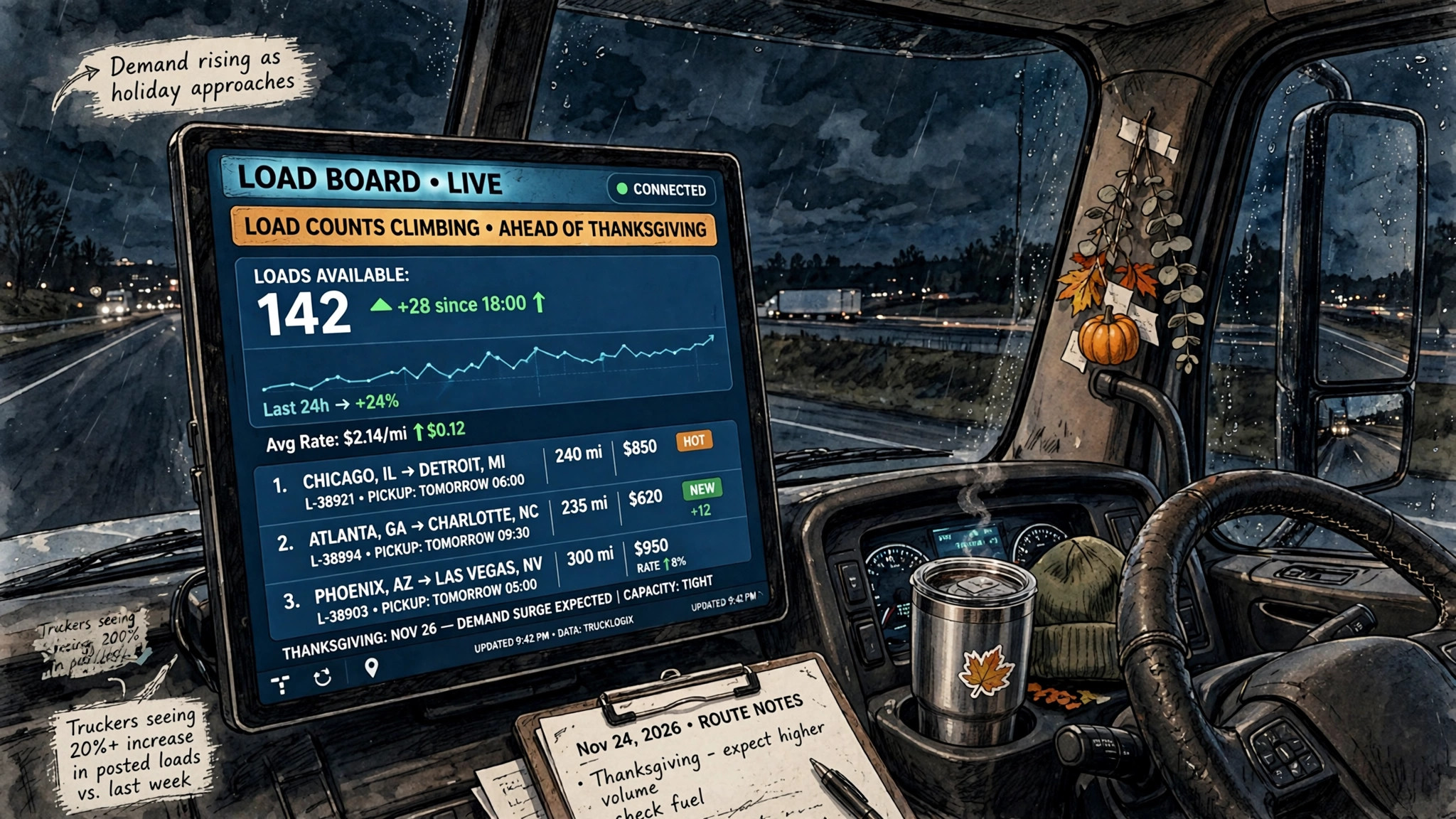
Image: Illustration: AI-generated by CDLWire
The load board surged in the last full week before Thanksgiving: DAT One load posts totaled 3.06 million for the week of Nov. 14-20, up 14% from the prior week, according to The Trucker on Nov. 24, reporting DAT Freight & Analytics.
Capacity did not keep pace. Total equipment posts fell 1% to 185,104, and the year-over-year comparison is the part of this report that explains the rate board: load posts are running 40% above the 2025 weekly average for van, 53% for reefer and 18% for flatbed, while truck posts are 35% below a year ago for van, 21% for reefer and 22% for flatbed. More freight is chasing fewer posted trucks in every equipment type, which is the arithmetic underneath every firm rate in this release.
DAT's seven-day average broker-to-carrier spot rates, which combine linehaul and fuel surcharge, rose $0.04 for van to $3.11 a mile and $0.07 for reefer to $3.73 a mile, and fell $0.01 for flatbed to $3.58 a mile. A note on method for readers comparing editions: these are DAT's figures, from a different system than the Truckstop.com and FTR numbers CDLWire published on Tuesday for the same week ended Nov. 20. The two boards measure different freight, and the fact that both printed a $3.73 reefer average this week is a coincidence of rounding, not the same data counted twice — but two independent boards moving the same direction in the same week is a stronger signal than either one alone.
By equipment, dry van did the volume work. Van load posts jumped 17% to 1,401,324 while truck posts slipped 2% to 123,280, lifting the load-to-truck ratio to 11.4 from 9.6 the prior week, and van linehaul rose $0.06 to $2.29 a mile. Reefer loads rose 16% to 744,112 against 37,422 truck posts, up 3%, for a load-to-truck ratio of 19.9, up from 17.6, and reefer linehaul rose $0.10 to $2.84 a mile — the largest linehaul gain of the three types. Flatbed loads rose 7% to 918,573 while truck posts fell 5% to 24,402, pushing the flatbed ratio to 37.6 from 33.3, and flatbed linehaul rose $0.03 to $2.61 a mile even though the all-in flatbed average dipped, because a lower diesel price took about $0.03 a mile off the fuel surcharge for each equipment type.
DAT analyst Dean Croke put the reefer move in historical context: the seven-day reefer average is up $0.14 since Nov. 1, with the last four days accounting for $0.09 of that increase, and in none of the last 10 Novembers did the same four days add more than $0.05. Croke pointed to weather as a driver — snow closed Interstate 80 over Donner Pass in California and I-70 west of Denver at Vail Pass during the week, which hits long-distance produce haulers and reefer rates hardest — and noted that holiday retail freight is now competing with produce for the same trucks. USDA produce spot rates for the week ending Nov. 17 averaged $4.09 a mile, up 48% from the same week last year, even though produce volume fell 6% on the week and 17% on the year; potato volume rose 12% and sweet potato volume rose 38%.
One caution is built into DAT's own release: rates may change as DAT iQ receives more of the week's invoices, and this week's comparisons use updated prior-week linehaul figures of $2.23 for van, $2.74 for reefer and $2.58 for flatbed. The direction, however, is not in doubt in this data set.
The practical takeaway for Thanksgiving week: the board is tilted toward the truck in van and reefer, and the leverage shows up as ratio, not just rate — 11.4 loads per van truck and 19.9 per reefer truck posted. Drivers with flexibility on home time hold the stronger hand in negotiation this week, but remember that part of the all-in rate is a fuel surcharge that is now shrinking as diesel falls, so judge offers on the linehaul line. Croke's framing is the honest one: in each of the last 10 Novembers the reefer high came after Nov. 22, so this week will show whether the current move is the top or the middle.
Sources
Related coverage
 November 24, 2026 · Fuel & ratesRefrigerated spot rates jumped $0.181 to $3.73 a mile — the strongest gain ever recorded for the week before Thanksgiving, and the highest level since the first week of 2022
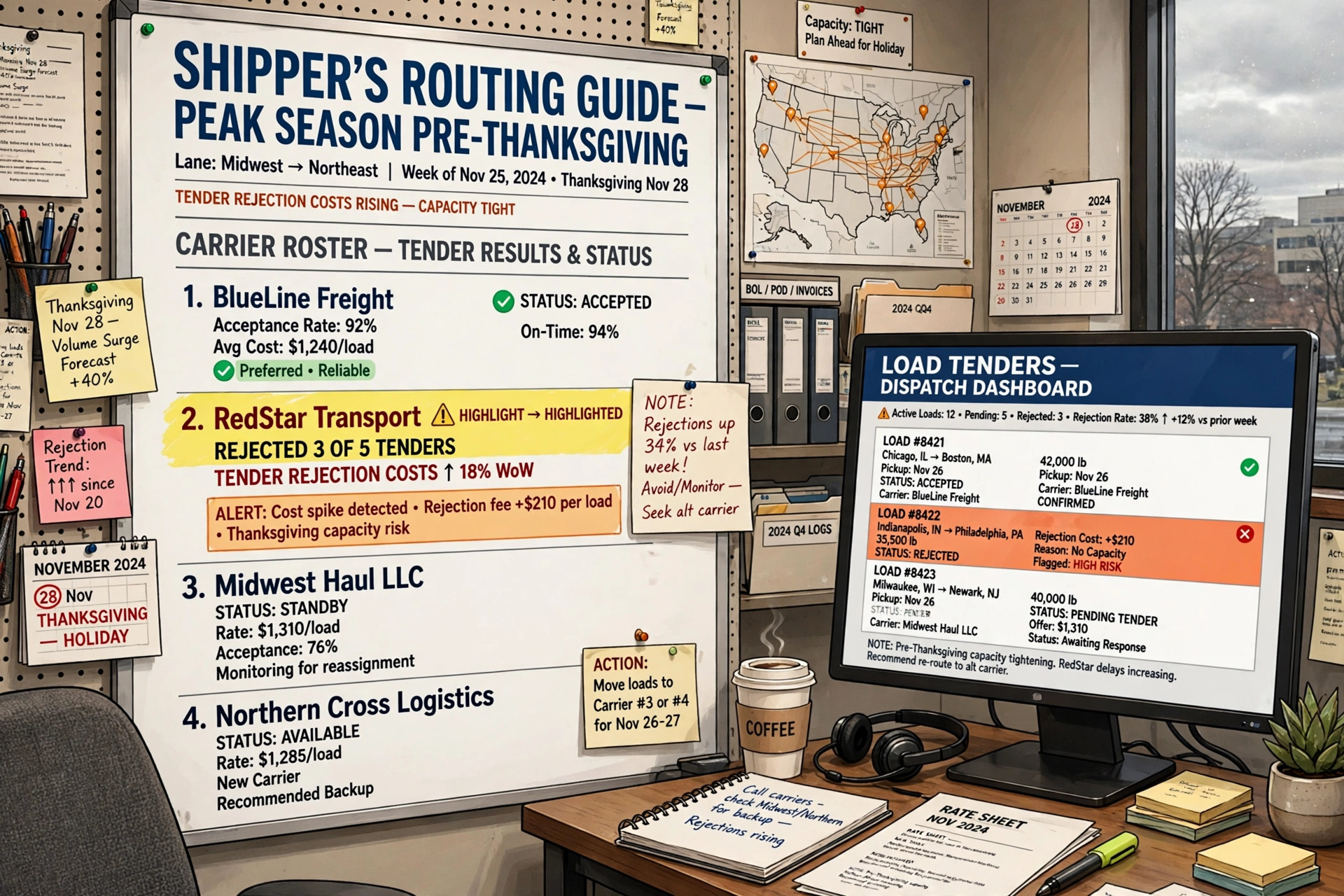 November 22, 2026 · Fuel & ratesA rejected tender now costs shippers 10.69% more to cover — the backup-plan premium hit its highest level since September
 November 21, 2026 · Fuel & ratesTender rejections climbed back toward 13% before Thanksgiving — SONAR sees roughly 14% next week, and says fuel is not the reason
Comments
Loading comments…