FMCSA denied the Lone Star hazmat HOS exemption — no safety analysis and no fatigue countermeasures in the application, the agency said
Lone Star Haz Mat Response wanted its field crews to drive home past the hours-of-service limits after a callout, arguing the work is unpredictable and runs all night. FMCSA denied the request on Nov. 25: without a safety analysis or countermeasures, the agency could not find the exemption would be as safe as the rules. Four of five commenters, including the CVSA, were opposed.
Summarized from CDLLife.
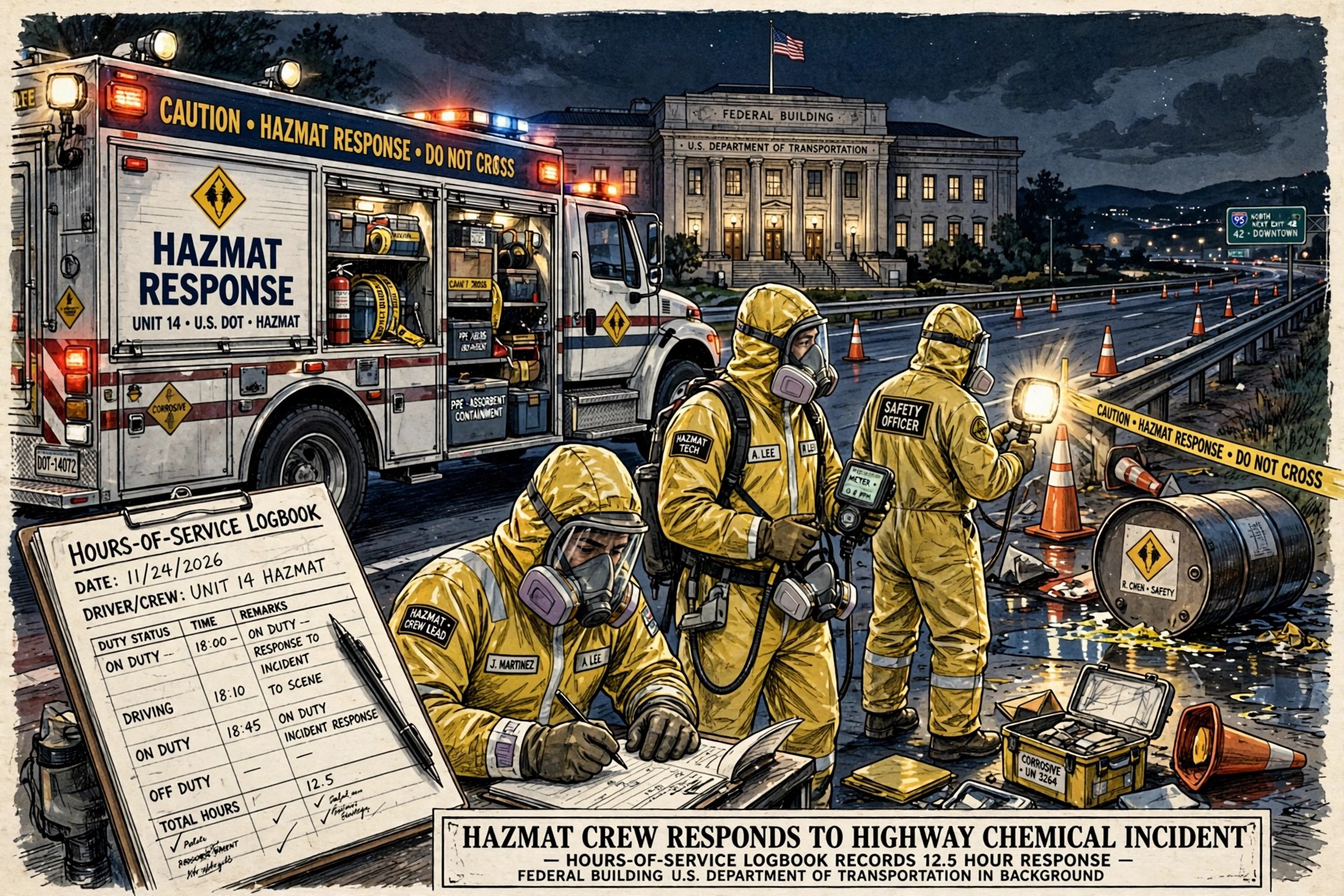
The Federal Motor Carrier Safety Administration has denied a hazmat response company's request to let its drivers run past the hours-of-service limits, according to CDLLife on Nov. 25, reporting the agency's decision announced that day. Lone Star Haz Mat Response, LLC had asked for an exemption that would allow its field response drivers to exceed the hours-of-service requirements for one specific purpose: driving back to their normal work reporting location or to their residence after a hazardous materials incident response operation ends.
Lone Star's argument, as the agency summarized it, was the nature of the work itself. Hazmat response operations are unpredictable in timing and duration, the company said, and they require immediate deployment at all hours of the day and night. A crew can be called out in the middle of the night, spend hours working a spill or a crash scene, and then face a drive home that the hours-of-service rules no longer allow — the exact situation the exemption was meant to cover.
The request drew five public comments, and four of them were opposed. The Commercial Vehicle Safety Alliance, the organization of the officials who enforce the truck safety rules, wrote that the federal safety regulations set the minimum requirements for operating commercial vehicles safely, and that an exemption should not be granted simply because the rules do not fit a company's or an industry's operational model. AWM Associates, LLC argued that the application did not address fatigue and that Lone Star appeared to be seeking relief from the regulations to overcome its ability to fulfill its contractual agreements. The Truck Safety Coalition, Citizens for Reliable and Safe Highways and Parents Against Tired Truckers filed a joint comment saying the application did not include a single countermeasure that combats driver fatigue and failed to meet the threshold for an hours-of-service exemption. One anonymous commenter supported the request.
FMCSA sided with the opponents, and its reasoning was narrow and specific. The agency did not rule that hazmat response work can never justify relief. It ruled that this application did not prove its case. In the decision's words, Lone Star's application does not provide an analysis of the safety impacts the requested exemption from the hours-of-service regulations may cause, and it does not provide any safety countermeasures. Because of that, the agency said, it was unable to determine that the exemption would likely achieve a level of safety equivalent to, or greater than, the level that would be achieved by the current regulations. On that basis, the exemption application was denied.
That equivalent-safety test is the legal bar every exemption applicant has to clear. Federal law lets FMCSA waive a safety rule only when the agency finds the waiver would likely maintain a level of safety equal to or better than compliance. An application that arrives without a safety analysis and without countermeasures — no fatigue-management plan, no limits on how far past the clock a driver could go, no rest provisions — gives the agency nothing to make that finding with. The denial, in other words, is a ruling about the paperwork Lone Star filed as much as about the driving it wanted to do.
The practical effect is immediate and simple: nothing changes. Lone Star's field response drivers remain under the standard hours-of-service rules, including on the drive back from an incident scene. A response that runs long does not extend the clock, and a driver who is out of hours at the end of a callout cannot legally drive the truck home under an exemption that does not exist. For the company, the options the decision leaves open are operational rather than regulatory — staging relief drivers, planning callouts around the clock, or filing a new application that actually includes the safety analysis and fatigue countermeasures this one lacked.
For drivers and carriers well beyond one Texas hazmat contractor, the denial is a useful map of how FMCSA is deciding exemption cases. Unpredictable work, by itself, is not an argument the agency accepted; the commenters who opposed the request framed it as a staffing and contract problem, and the agency's own objection was the missing safety case. Any carrier thinking about its own hours-of-service exemption should read the denial as instructions: bring data on the safety impact, bring concrete countermeasures against fatigue, and expect enforcement and safety groups to read the application closely — because in this docket, they did, and they won.
Image: Illustration: AI-generated by CDLWire
Sources
Related coverage
 November 19, 2026 · RegulationsLabor Department finalizes the independent-contractor rule — control and profit-or-loss decide, with lease-purchase tests written for trucking
 November 19, 2026 · RegulationsThe Trucker Bathroom Access Act advanced out of Senate committee on Nov. 18 — its furthest step yet
 November 18, 2026 · RegulationsSaia asks FMCSA to let learner's-permit trainees pull doubles under supervision — about 300 trainees a year
Comments
Loading comments…