Schneider's profit more than doubled — and its CEO says drivers, not demand, still limit the market: 'You're not seeing growth of long-haul truck drivers'
Commercial Carrier Journal reports Schneider National's third-quarter net income rose 155% to $49.5 million on revenue of $1.59 billion, up 9%. CEO Jim Filter said capacity is still constrained because long-haul driver supply is not growing — about 50,000 drivers entered in 2021–2022, many with less than a week of training, while current standards call for five to six weeks — and Schneider is answering with selective pay increases and sign-on bonuses in constrained markets, tied to rate recovery.
Summarized from Commercial Carrier Journal.
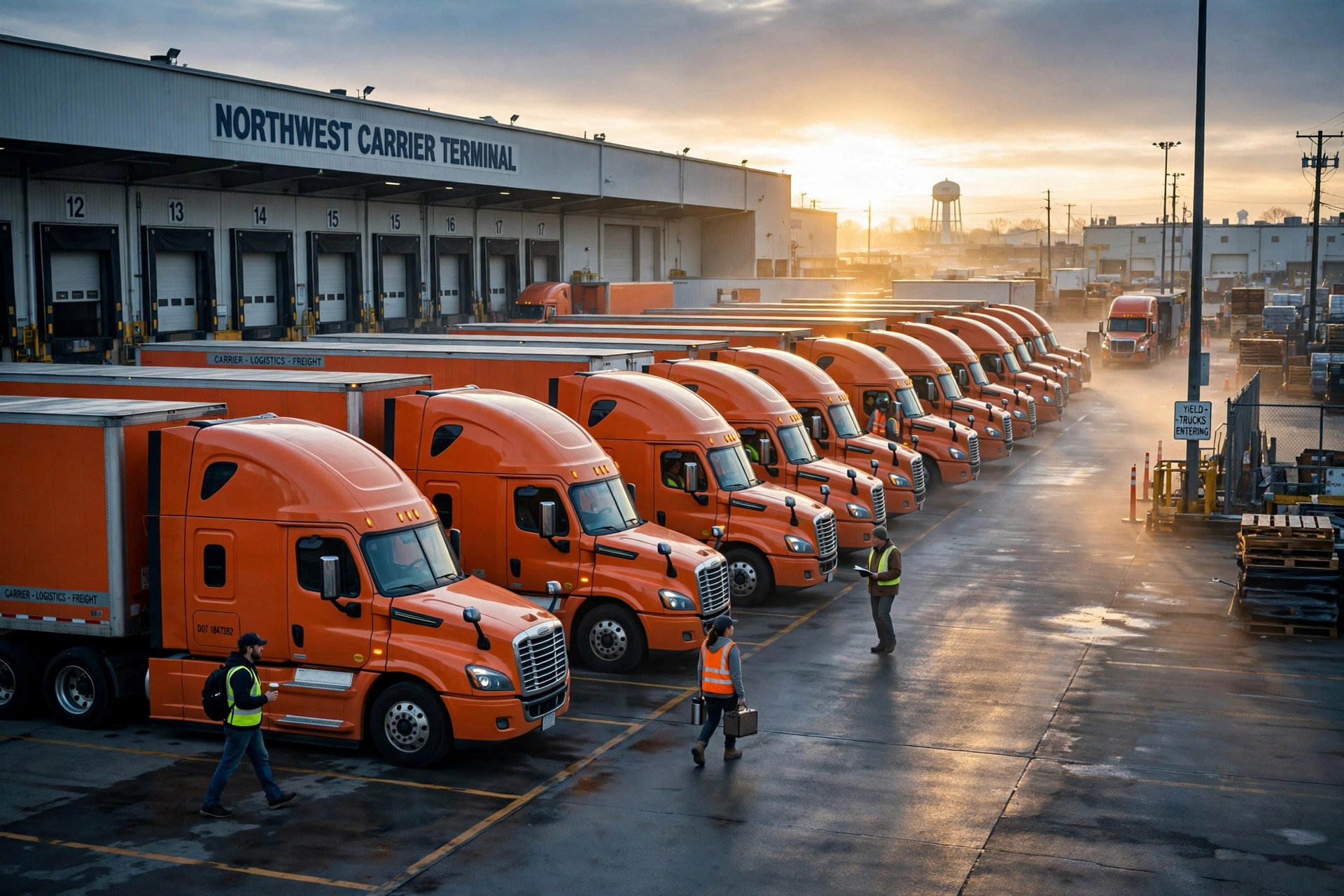
Image: Illustration: AI-generated by CDLWire
Schneider National’s third-quarter earnings more than doubled from a year ago, and its chief executive used the results call to make the same point from the hiring side that ATA’s economist made from the shipper side this week: the market is tight because qualified drivers are scarce, not because freight is booming, according to Commercial Carrier Journal on Nov. 6. “The supply side of the market is still doing the heavy lifting,” President and CEO Jim Filter told analysts. “Capacity is still constrained. You’re not seeing growth of long-haul truck drivers despite the fact that spot rates have been increasing over the course for almost a full year at this point.”
The quarter itself was strong by every headline measure. For the quarter ended Sept. 30, Schneider — No. 6 on the CCJ Top 250 — posted operating revenue of $1.59 billion, up 9% from $1.45 billion a year earlier, with revenue excluding fuel surcharges up 3% to $1.35 billion. Net income climbed 155% to $49.5 million, compared with $19.4 million in the third quarter of 2025. Price increases, productivity gains and cost cuts did that work against a smaller fleet: total average trucks were 11,347, down from 12,291, with tractor counts constrained by driver availability and the previously announced loss of a large Dedicated customer. Revenue per truck per week rose 8% in Truckload overall — fewer trucks, each earning more, because the binding constraint is the seat, not the equipment.
Filter pointed to entry-level driver training as the biggest factor behind that constraint, and his comparison is the sharpest statement of the training gap a major carrier CEO has made this cycle. About 50,000 long-haul drivers entered the market in 2021 and 2022, he said, many of them with less than a week of training to earn a CDL, at very low price points. Current standards now call for five to six weeks of training at higher cost. Ongoing federal enforcement on entry-level driver training and electronic logging devices should improve driver qualification and hours-of-service compliance, Filter said, and it makes it harder for what he called “irrational capacity” to enter or stay in the market. He noted that carriers like Schneider previously would not hire drivers out of one-week CDL schools at all.
Cost pressure is the second constraint, and it falls unevenly. Fuel and fuel taxes rose 48% year over year to $165 million in the quarter, Filter said driver wages are climbing, and smaller carriers face growing economic strain — forces that together limit how quickly supply can respond to better pricing. Capacity attrition has slowed from the pace of the first half of the year, but Filter was uncertain whether capacity has bottomed, saying there could be “a little bit more reduction” before the market flattens out. On rates, spot pricing moderated during the quarter by more than the usual seasonal pattern, particularly in August, after strength in late spring and early summer; rates remained well above year-ago levels and began improving again in September. Freight volume reflected typical seasonality and inventory normalization rather than weakening demand, and some shippers are now voicing capacity concerns, bidding strategically to lock in reliable capacity for the full year.
The driver-facing part of the call was the pay strategy, and it was deliberately selective. Schneider is funding recruiting resources, broader use of AI-enabled tools, and selective pay increases and sign-on bonuses in its constrained markets, with compensation that rewards driver productivity and performance. “We align pay increases to rate recovery,” Filter said, describing disciplined compensation practices as the reason Schneider can navigate the hiring environment. Raises are targeted “where the returns are commensurate,” and pay alone is not the pitch: “You can’t just throw money on it.” Filter listed freight selection, work configurations, how drivers are treated, and using AI to respond to drivers faster as the rest of the retention package. Dedicated customers, he added, are increasingly open to the pricing adjustments needed to secure capacity — which is where the money for those selective raises is negotiated from.
The segment results show where the model is working. Truckload revenue excluding fuel surcharges was flat at $624.8 million, but operating income more than doubled to $43.7 million and the operating ratio improved 380 basis points to 93%. Intermodal revenue excluding fuel rose 2% to $287.7 million, operating income increased 35% to $22.6 million, and the operating ratio improved 190 basis points to 92.1% — though intermodal orders slipped to 114,619, ending a nine-quarter growth streak, while revenue per order rose 3% to $2,486 despite shorter hauls, and intermodal rate increases are running “comfortably in the mid-single-digit range.” Logistics revenue excluding fuel rose 12% to $372.5 million on higher revenue per order, partly offset by lower brokerage volume, but operating income decreased $6.4 million and the operating ratio hit 100% — the brokerage side earned nothing at the operating line in a quarter when the asset side thrived.
Looking ahead, Chief Financial Officer Darell Campbell said the outlook assumes continued pricing improvement, with peak-season demand and driver capacity as the variables; Filter said peak looks like a normal season for the first time in roughly a decade. Schneider remains on track for its $40 million structural cost savings target and ended the quarter with $326.2 million in cash against $393.6 million in debt and finance lease obligations.
For drivers, the takeaway is about where leverage sits this winter. One of the largest carriers in the country is publicly tying pay increases to rate recovery and aiming them at constrained markets rather than across the board — which means a qualified driver’s negotiating position depends on the lane and the market, not on a company-wide raise announcement. Drivers in tight markets, and drivers whose records qualify them under the stricter training and ELD enforcement Filter described, are the capacity Schneider says it cannot easily replace; drivers at small carriers should hear the other half of his analysis, that fuel, taxes and wages are squeezing thin fleets hardest, and judge their employer’s staying power accordingly.
Sources
Related coverage
 October 12, 2026 · PayATA: irregular-route driver pay rose 8.3% to a median of $73,639
 October 7, 2026 · PayYellow, Teamsters reach WARN Act deal: $17.2 million for five days' damages
 October 7, 2026 · PayATA: driver pay kept climbing in 2025 — irregular-route truckload up 8.3%
Comments
Loading comments…