Arizona voters put traffic cameras on a leash — and kept the door open to a per-mile tax, rejecting the VMT ban 50-49%
Land Line reports Arizona voters approved Proposition 319, a constitutional amendment requiring local voter approval before any city can run speed or red-light cameras, with existing programs facing a voter decision in November 2027. They narrowly rejected Proposition 141, which would have banned state and local mileage taxes and limited mileage tracking. Mesa approved $135 million in road bonds; Tempe rejected a half-cent sales tax increase expected to raise about $50 million a year.
Summarized from Land Line.
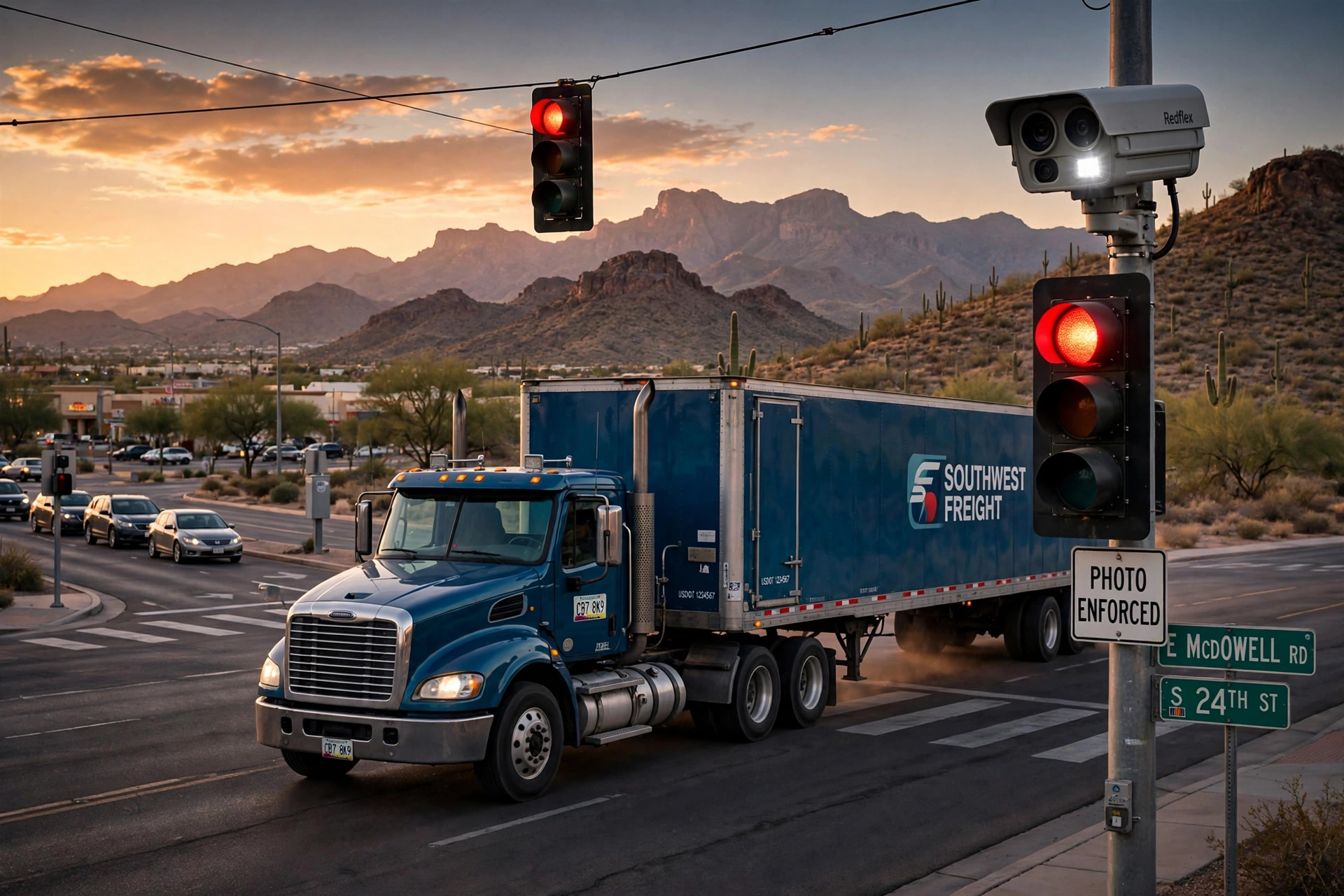
Image: Illustration: AI-generated by CDLWire
Arizona voters decided four transportation questions on Tuesday, and the two statewide answers pull in opposite directions for what driving will cost and how it will be policed: traffic cameras now need the voters’ permission to exist, but a tax on every mile driven remains legally possible after a proposed ban on it failed by a single percentage point, according to Land Line on Nov. 6. The Owner-Operator Independent Drivers Association’s magazine gave the first trucking-specific accounting of the measures — Proposition 319 on photo enforcement, Proposition 141 on mileage taxes, and city questions in Mesa and Tempe — and each one lands on truckers who run Arizona roads.
Proposition 319 passed. The constitutional amendment puts strict limits on state and local governments installing and operating photo enforcement systems: local voters must approve photo enforcement before a city can operate speed or red-light cameras. The Insurance Institute for Highway Safety lists 14 Arizona cities with red-light or speed cameras, and five use both — Chandler, Mesa, Paradise Valley, Scottsdale and Tempe. Programs operating by Dec. 31 get a temporary pass, but their future will be up to voters in November 2027. An approved camera program can run for 10 years, after which voters get another chance to end it. Supporters argued that law enforcement should protect the public, not turn traffic tickets into a government cash machine. OOIDA’s position, as Land Line reports it, is that cameras miss the bigger picture: the goal should be safer roads and smoother traffic, and ticket revenue should not drive enforcement. For a driver, the near-term change is procedural rather than immediate — cameras operating today keep operating into 2027 — but every program in the state now has an expiration mechanism controlled by voters instead of city councils.
Proposition 141 failed, narrowly — defeated by a 50-49% margin. The amendment would have written a ban on mileage taxes into the Arizona Constitution, blocking state and local governments from charging drivers based on miles traveled, whether to fund roads or to support climate policies. It also would have limited government tracking: agencies could not track or restrict a driver’s miles without that driver’s consent. Arizona currently has no vehicle-miles-traveled tax and no system that tracks miles for that purpose, so the vote changes nothing on the road today. What it preserves is the option. Opponents of the ban argued mileage taxes could replace revenue lost as vehicles burn less fuel; supporters said the protection was needed precisely because fuel-tax revenue continues to shrink and mileage taxes are gaining attention as the replacement.
Two details in the failed amendment deserve a driver’s attention. First, even the ban had carve-outs: it would not have stopped VMT programs for commercial vehicles traveling across state lines, and it would not have prevented mileage taxes or mileage limits for government-owned vehicles — the interstate commercial exception means the measure’s protection was always partial for truckers. Second, the fuel-tax baseline it was arguing over is low by national standards: Arizona charges $0.18 per gallon on gasoline, diesel is also $0.18 per gallon for light-use vehicles, and large trucks pay $0.26 per gallon. A future per-mile charge would tie transportation costs directly to every mile driven — for a truck running Arizona daily, a fundamentally different bill than a per-gallon tax paid only at Arizona pumps — and it would raise the tracking question the amendment tried to settle: how the miles are counted, and by whom.
The city measures split on how to pay for roads. In Mesa, in Maricopa County, voters passed Question 2, allowing the city to issue $135 million in bonds for transportation work — pavement repairs, street improvements and traffic signals — repayable through property taxes, without raising the sales tax. Mesa is one of the five Arizona cities running both red-light and speed cameras, so its drivers will also be among those voting on photo enforcement in 2027. In Tempe, voters rejected Proposition 424, which would have raised the local sales tax by a half-cent, from 1.8% to 2.3%. The increase was expected to raise about $50 million a year, some of it for transportation projects including transit upgrades and multimodal work. Opponents argued it was the wrong time to raise taxes amid higher everyday prices.
The practical takeaway for drivers running Arizona is a short list of dates and one open door. Photo-enforcement programs in the 14 camera cities operate under a temporary pass that ends with a voter decision in November 2027, and any new program now needs voter approval first — a citation from a camera in Arizona after this week comes from a program whose future is on a ballot. No mileage tax exists, and none was enacted Tuesday; but the constitutional ban that would have taken the idea off the table failed 50-49%, so a per-mile charge remains a live option for a future legislature facing shrinking fuel-tax revenue — with, on the failed amendment’s own terms, interstate commercial travel the segment least protected even under the ban. And in the Phoenix metro, the road money that did get approved comes as Mesa bonds for pavement and signals, not as new taxes — which is the version of paying for roads Arizona voters, including its truckers, actually chose.
Sources
Related coverage
 November 5, 2026 · RegulationsOhio will downgrade every remaining non-domiciled CDL — about 3,000 of them — while a court case could reopen California's program
 November 4, 2026 · RegulationsDemocrats win both chambers of Congress — and trucking's highway bill, lawsuit fights and CDL oversight now run through new committee chairs
 November 4, 2026 · RegulationsA $23, two-hour online CDL theory course grew fat on FMCSA's school shutdowns — now ELDT Nation faces a proposed removal of its own
Comments
Loading comments…