Axle and engine shortages dented Daimler's truck output even as sales jumped 51% — and its largest U.S. plant site will likely be named by Christmas
Transport Topics reports Daimler Truck North America sold 45,629 trucks and buses in the third quarter, up 51%, but third-party axle and engine supply issues cut the volume it could assemble and are continuing into the fourth quarter. Expedited freight for late parts cost tens of millions, catch-up before year-end looks difficult, and the company is finalizing the land purchase for a new plant — its largest in the U.S. — with the location to be revealed likely before Christmas and operations set for 2029.
Summarized from Transport Topics.
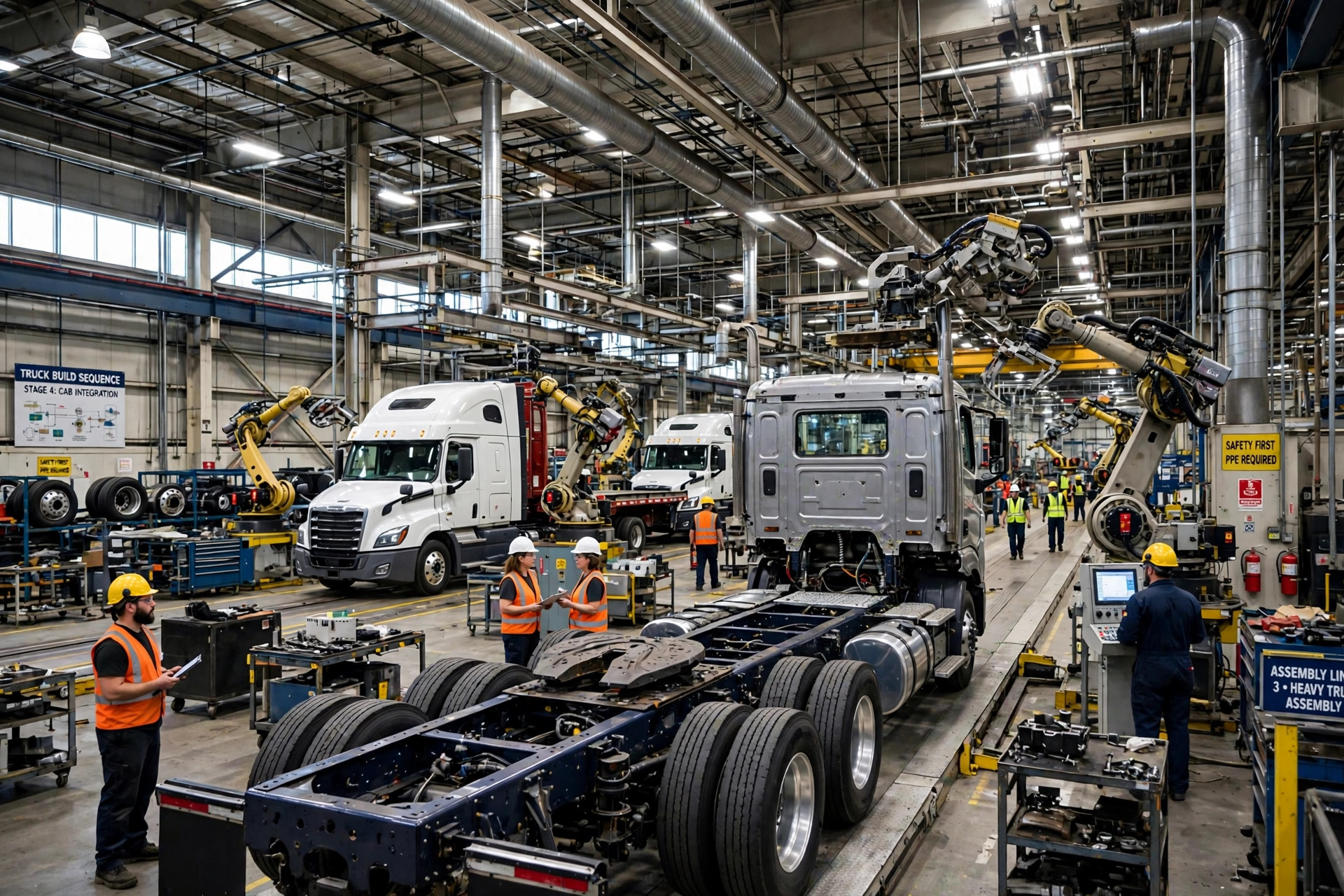
Image: Illustration: AI-generated by CDLWire
Daimler Truck North America is selling trucks faster than its suppliers can help it build them. Axle and engine supply chain issues hindered production at DTNA’s assembly plants in the third quarter of 2026, and the final quarter of the year has seen little change, Daimler Truck CEO Karin Radstrom said, according to Transport Topics on Nov. 6. The maker of Freightliner and Western Star trucks still posted a 51% increase in third-quarter sales — but the vehicles count as sold only if they have been built, and the gap between demand and buildable trucks is now the company’s central problem heading into 2027.
The shortage was, in part, a victim of the recovery itself. DTNA’s owner asked suppliers in the spring to recruit more staff, purchase more raw materials and add shifts in anticipation of a steep production ramp-up as the North American freight market rebound got underway and spread from the spot market into contract and dedicated haulage, Radstrom told analysts and investors on the company’s Nov. 6 third-quarter earnings call. Some suppliers struggled to ramp up sufficiently. The result, Chief Financial Officer Eva Scherer added, was a lower-than-expected volume of trucks assembled in the third quarter, which also hurt the plants’ efficiency levels.
The engines at issue come from two sources: DTNA’s in-house Detroit Diesel division and Cummins. A spokesperson for Cummins told Transport Topics on Nov. 6: “The pace of the industry’s production ramp-up has created challenges across the supply chain, and we have experienced some component constraints, particularly in axles. Our teams are working closely with customers to address these challenges and support demand. We’re encouraged to see the continued strengthening in the North American truck market.” Radstrom said DTNA expects it will be difficult to catch up on production before the end of the year, but she was hopeful of doing so by the beginning of 2027.
The sales figures show what the market is asking for. DTNA sold 45,629 trucks and buses in the third quarter, up from 30,225 in the third quarter of 2025: 40,084 vehicles in the United States, up 54%; 3,830 in Canada, up 39%; and 1,455 in Mexico, up 9%. The company booked orders for 29,357 trucks and buses in the quarter, a 12% increase from 26,168 a year earlier but a 17% decrease compared with the second quarter — a reminder that the order book, like Class 8 orders industry-wide, is being paced by uncertainty even as delivered sales surge. DTNA’s revenue jumped 43% year over year to $6.36 billion from $4.45 billion, while cost of sales rose 37% to $5.23 billion from $3.82 billion.
Part of that cost increase is the shortage billing itself. Scherer said expedited transportation expenses rose as the company shipped late components to assembly plants as quickly as possible, with expedited costs in the “low to mid double-digit” millions of dollars in the third quarter. “I still expect a high impact from expedited freight in the fourth quarter because we will do everything to get the trucks to our customers,” she said. At the group level, Daimler Truck reported revenue of $14.01 billion, up 19% from $11.76 billion, and a profit of $782 million, up 73% from $453.5 million — DTNA is driving the parent company’s earnings even while its supply chain caps how much of the demand it can convert.
The longer-term answer is a new plant, and its timeline firmed up on the same call. DTNA is finalizing the land purchase for what will be its largest manufacturing site in the United States, and the location will likely be revealed before Christmas, Radstrom said in a separate account of the call published by Transport Topics on Nov. 6. “As you can imagine, there are some negotiations underway, which is why it doesn’t make sense to talk about it now, but we will update you once possible, but [DTNA is] very well on track there,” she said. Construction remains scheduled to begin by the end of 2026 — “We’re on track with everything” — and the plant is expected to begin operations in 2029. The plans were revealed in early August on an expedited timeline driven by expected demand growth in the United States and Canada. DTNA’s Cleveland, North Carolina plant is currently its largest U.S. site, although a majority of its North American-built trucks are assembled in Mexico, where it owns two plants; the announced site criteria — supply chain, skilled workforce, logistics infrastructure, business environment and long-term strategy — make the Southeast, particularly the Carolinas, a heavy favorite. DTNA CEO John O’Leary said in August the plans took years and reflect long-term market-share ambitions rather than a response to tariff policies.
Freightliner is adding workers at its Saltillo, Mexico plant as production ramps up across North America, and DTNA is increasing employment at its Mount Holly, North Carolina plant. For 2027, Radstrom was openly positive: fundamentals remain “very good” on the continued freight rate rebound, although clarity on noncompliance penalties under the Environmental Protection Agency’s 2027 nitrogen oxides regulations would help. “The most important [key performance indicator] for us is the freight rates, and that has continued to develop positively,” she told analysts. “Therefore … we walk into 2027 quite comfortable that the fundamentals are good. We know there is replacement demand in the market, which should support demand even further during 2027.”
For fleets and drivers, the near-term read is delivery timing. A carrier waiting on Freightliner or Western Star orders should expect fourth-quarter slippage while axle and engine constraints persist, and should plan maintenance and trade cycles on the assumption that catch-up production arrives around the start of 2027, not before Christmas. The plant announcement, when it lands in the next several weeks, is a 2029 capacity story — it signals that the largest truck maker in North America is building for a bigger U.S. market, but it does not put a single additional truck on a lot this winter.
Sources
Related coverage
 November 6, 2026 · EquipmentNo cab, no hitch, no driver: Humble Robotics raises $51 million to pilot its cabless electric hauler on port and warehouse runs under 250 miles
 November 5, 2026 · EquipmentKodiak's first Gen7 Western Star day cabs go driverless in the Permian — and a 75-truck fleet deal queues up behind them
 November 4, 2026 · EquipmentClass 8 truck orders plunge in October — FTR counts 15,600, down 36%, and ACT counts 13,500, down 45%, as EPA 2027 uncertainty freezes fleet buying
Comments
Loading comments…